Advertisements
Advertisements
प्रश्न
Give its
(i) graphical representation,
(ii) mathematical expression
(iii) significance
Advertisements
उत्तर
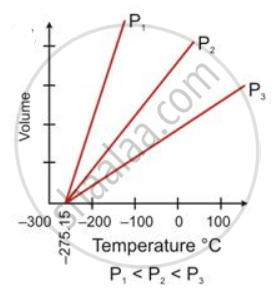
(i) Graphical representation of Charles's law
T vs V: The relationship between the volume and the temperature of a gas can be plotted on a graph. A straight line is obtained.

(ii) Mathematical expression
Let V0 be the volume of a fixed mass of a gas at 0 °C, and let V be its volume at temperature t °C at, constant pressure. then, according to Charles Law
`"V" = "V"_0 + "V"_0/273 t` (when P is constant)
`"V" = "V"_0 (1 + t/273) = "V"_0 ((273 + t)/273)` .......(1)
`"V" = "V"_0/273 "T" "where" "T" = 273 + "t"`
For a given mass of a gas,
`"V"_0/273 = "constant"`
`"V" = "k" xx "T"` (where k is constant)
(iii) Significance of Charles's Law: The volume of a given mass of a gas is directly proportional to its temperature; hence, the density decreases with temperature. This is the reason that
(a) Hot air is filled in balloons used for meteorological purposes. (b) Cable wires contract in winters and expand in summers.
APPEARS IN
संबंधित प्रश्न
Give the assumptions of the kinetic molecular theory.
State the law which is represented by the following graph:
Give reasons for the following:
Mountaineers carry oxygen cylinders with them.
How did Charles's law lead to the concept of an absolute scale of temperature?
Choose the correct answer:
The volume-temperature relationship is given by
2 liters of gas is enclosed in a vessel at a pressure of 760 mmHg. If the temperature remains constant, calculate pressure when volume changes to 4 dm3.
State Charles's law.
A certain mass of gas occupied 850 ml at a pressure of 760 mm of Hg. On increasing the pressure it was found that the volume of the gas was 75% of its initial value. Assuming constant temperature, find the final pressure of the gas?
At a given temperature the pressure of a gas reduces to 75% of its initial value and the volume increases by 40% of its initial value. Find this temperature if the initial temperature was -10°C.
According to Charles’s law, at constant pressure, the temperature is inversely proportional to volume.
