Advertisements
Advertisements
प्रश्न
What will be the minimum pressure required to compress 500 dm3 of air at 1 bar to 200 dm3 temperature remaining constant?
Advertisements
उत्तर
V1 = 500 dm3
P1 = 1 bar
T1 = 273 K
V2 = 500 dm3
T2 = 273 K
P2= ?
`("P"_1 "V"_1)/"T"_1 = ("P"_2 "V"_2)/"T"_2`
`(500 xx 1)/273 = ("P"_2 xx 200)/273`
`"P"_2 = 500/200 = 2.5` bar
APPEARS IN
संबंधित प्रश्न
State the law which is represented by the following graph:
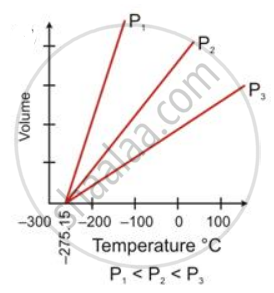
How did Charles's law lead to the concept of an absolute scale of temperature?
State the following:
Ice point in absolute temperature
Choose the correct answer:
The absolute temperature value that corresponds to 27°C is
It is found that on heating a gas its volume increases by 50% and its pressure decreases to 60% of its original value. If the original temperature was −15°C, find the temperature to which it was heated.
Taking the volume of hydrogen as calculated in Q.19, what change must be made in Kelvin (absolute) temperature to return the volume to 2500 cm3 (pressure remaining constant)?
State Charles's law.
At a given temperature the pressure of a gas reduces to 75% of its initial value and the volume increases by 40% of its initial value. Find this temperature if the initial temperature was -10°C.
It is required to reduce the volume of a gas by 20% by compressing it at a constant pressure. To do so, the gas has to be cooled. If the gas attains a final temperature of 157°C, find the initial temperature of the gas.
The following question refers to one mole of chlorine gas.
What volume will it occupy at 273°C?
