Advertisements
Advertisements
प्रश्न
104g of water at 30°C is taken in a calorimeter made of copper of mass 42 g. When a certain mass of ice at 0°C is added to it, the final steady temperature of the mixture after the ice has melted, was found to be 10°C. Find the mass of ice added. [Specific heat capacity of water = 4.2 J g–1 °C–1 ; Specific latent heat of fusion of ice = 336 J g–1; Specific heat capacity of copper = 0.4 J g–1 °C–1] .
Advertisements
उत्तर
Given: Mass of water, \(m_1=104\,\text{g}\)
Mass of copper calorimeter, \(m_2=42\,\text{g}\)
Initial temperature of water and calorimeter, \(T_1=30^\circ\text{C}\)
Initial temperature of ice = \(0^\circ\text{C}\)
Final temperature, \(T_2=10^\circ\text{C}\)
Specific heat capacity of water, \(c_1=4.2\,\text{J g}^{-1}\,^\circ\text{C}^{-1}\)
Specific heat capacity of copper, \(c_2=0.4\,\text{J g}^{-1}\,^\circ\text{C}^{-1}\)
Specific latent heat of fusion of ice, \(L=336\,\text{J g}^{-1}\)
According to the principle of calorimetry,
\[ \text{Heat lost}=\text{Heat gained} \]
The heat lost by water.
\[ Q_1=m_1c_1(T_1-T_2) \]
\[ =104\times4.2\times(30-10) \]
\[ =8736\,\text{J} \]
The heat lost by the copper calorimeter.
\[ Q_2=m_2c_2(T_1-T_2) \]
\[ =42\times0.4\times(30-10) \]
\[ =336\,\text{J} \]
The total heat lost.
\[ Q=Q_1+Q_2 \]
\[ =8736+336 \]
\[ =9072\,\text{J} \]
The heat gained by ice.
Ice at 0°C first melts into water and then the melted water warms to 10°C.
\[ Q=mL+mc_1(T_2-0) \]
\[ =336m+4.2m\times10 \]
\[ =336m+42m \]
\[ =378m \]
According to the principle of calorimetry,
\[ 9072=378m \]
\[ m=\frac{9072}{378} \]
\[{m=24\,\text{g}} \]
APPEARS IN
संबंधित प्रश्न
The coolant in a chemical or a nuclear plant (i.e., the liquid used to prevent the different parts of a plant from getting too hot) should have high specific heat.
What property of water makes it an effective coolant?
During the phase change does the average kinetic energy of the molecules of the substance increase?
Give three reasons for the increase of green house gases.
Read the following paragraph and answer the questions.
|
If heat is exchanged between a hot and cold object, the temperature of the cold object goes on increasing due to gain of energy and the temperature of the hot object goes on decreasing due to loss of energy. The change in temperature continues till the temperatures of both the objects attain the same value. In this process, the cold object gains heat energy and the hot object loses heat energy. If the system of both the objects is isolated from the environment by keeping it inside a heat resistant box (meaning that the energy exchange takes place between the two objects only), then no energy can flow from inside the box or come into the box. |
- Heat is transferred from where to where?
- Which principle do we learn about from this process?
- How will you state the principle briefly?
- Which property of the substance is measured using this principle?
A substance is heated at a constant rate from a low temperature to a high temperature. A graph of temperature against time is shown in the figure. Which part or parts of the graph correspond(s) to the substance existing in two states?
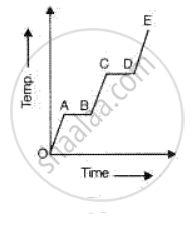
A liquid X has specific heat capacity higher than the liquid Y. Which liquid is useful as coolant in car radiators.
If, in a central heating system, steam enters a radiation pipe at 100°C and water leaves the radiation pipe at 100°C, can this radiation pipe heat a room? Give an explanation for your answer.
For a gas `"R"/"C"_"v" = 0.4,` where 'R' is the universal gas constant and 'Cv' is molar specific heat at constant volume. The gas is made up of molecules which are ______.
