Advertisements
Advertisements
प्रश्न
Advertisements
उत्तर
APPEARS IN
संबंधित प्रश्न
Calculate the mass of ice needed to cool 150 g of water contained in a calorimeter of mass 50 g at 32 °C such that the final temperature is 5 °C. Specific heat capacity of calorimeter = 0.4 J g-1 °C-1, Specific heat capacity of water = 4.2 J g-1°C-1, latent heat capacity of ice = 330 J g-1.
Give a mathematical relation between Heat Capacity and Specific Heat Capacity.
The temperature of 170 g of water at 50°C is lowered to 5°C by adding a certain amount of ice to it. Find the mass of ice added.
Given: Specific heat capacity of water = 4200 J kg-1 °C-1 and specific latent heat of ice = 336000 J kg-1.
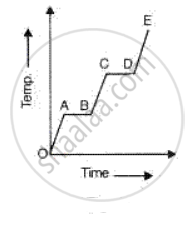
A substance is heated at a constant rate from a low temperature to a high temperature. A graph of temperature against time is shown in the figure. Which part or parts of the graph correspond(s) to the substance existing in two states?
Specific heat capacity of a substance A is 3.8 J g-1 K-1 and of substance B is 0.4 J g-1 k-1. Which substance is a good conductor of heat? How did you arrive at your conclusion?
Describe a method to determine the specific heat capacity of a solid (say, a piece of copper).
Calculate the amount of heat released when 5.0 g of water at 20°C is changed into ice at 0°C.
(Specific heat capacity of water = 4.2 J/g°C
Specific latent heat of fusion of ice = 336 J/g)
Consider the statement given below and choose the correct option.
Assertion: Radiation is a form of heat transfer which takes place only in vacuum.
Reason: The thermal energy is transferred from one part of a substance to another part without the actual movement of the atoms or molecules.
The value of 'γ' for a gas is given as `gamma = 1 + 2/"f"`, where 'f ' is the number of degrees of freedom of freedom of a molecule of a gas. What is the ratio of `gamma_"monoatonic"//gamma_"diatomic"`?
Diatomic gas consists of rigid gas molecules
