Advertisements
Advertisements
प्रश्न
104g of water at 30°C is taken in a calorimeter made of copper of mass 42 g. When a certain mass of ice at 0°C is added to it, the final steady temperature of the mixture after the ice has melted, was found to be 10°C. Find the mass of ice added. [Specific heat capacity of water = 4.2 J g–1 °C–1 ; Specific latent heat of fusion of ice = 336 J g–1; Specific heat capacity of copper = 0.4 J g–1 °C–1] .
Advertisements
उत्तर
Given: Mass of water, \(m_1=104\,\text{g}\)
Mass of copper calorimeter, \(m_2=42\,\text{g}\)
Initial temperature of water and calorimeter, \(T_1=30^\circ\text{C}\)
Initial temperature of ice = \(0^\circ\text{C}\)
Final temperature, \(T_2=10^\circ\text{C}\)
Specific heat capacity of water, \(c_1=4.2\,\text{J g}^{-1}\,^\circ\text{C}^{-1}\)
Specific heat capacity of copper, \(c_2=0.4\,\text{J g}^{-1}\,^\circ\text{C}^{-1}\)
Specific latent heat of fusion of ice, \(L=336\,\text{J g}^{-1}\)
According to the principle of calorimetry,
\[ \text{Heat lost}=\text{Heat gained} \]
The heat lost by water.
\[ Q_1=m_1c_1(T_1-T_2) \]
\[ =104\times4.2\times(30-10) \]
\[ =8736\,\text{J} \]
The heat lost by the copper calorimeter.
\[ Q_2=m_2c_2(T_1-T_2) \]
\[ =42\times0.4\times(30-10) \]
\[ =336\,\text{J} \]
The total heat lost.
\[ Q=Q_1+Q_2 \]
\[ =8736+336 \]
\[ =9072\,\text{J} \]
The heat gained by ice.
Ice at 0°C first melts into water and then the melted water warms to 10°C.
\[ Q=mL+mc_1(T_2-0) \]
\[ =336m+4.2m\times10 \]
\[ =336m+42m \]
\[ =378m \]
According to the principle of calorimetry,
\[ 9072=378m \]
\[ m=\frac{9072}{378} \]
\[{m=24\,\text{g}} \]
APPEARS IN
संबंधित प्रश्न
In an experiment on the specific heat of a metal, a 0.20 kg block of the metal at 150 °C is dropped in a copper calorimeter (of water equivalent 0.025 kg) containing 150 cm3 of water at 27 °C. The final temperature is 40 °C. Compute the specific heat of the metal. If heat losses to the surroundings are not negligible, is your answer greater or smaller than the actual value for the specific heat of the metal?
Why do the farmers fill their fields with water on a cold winter night?
In an experiment to determine the specific heat capacity of a solid following operations were
made:
Mass of calorimeter + stirrer = x kg
Mass of water = y kg
Initial temperature of water t1℃
Mass of solid = z kg
Temperature of solid = t2 ℃
Temperature of mixture = t ℃
Specific heat capacity of calorimeter and water are c1 and c2 respectively. Express the specific
heat capacity c of the solid in terms of the above data.
How will rise in sea level affect population in coastal countries?
What is heat? What is the S. I. unit of heat?
Will the value of specific heat’capacity and specific latent heat of a substance change if the scale is °F instead of °C?
A substance is in the form of a solid at 0°C. The amount of heat added to this substance and the temperature of the substance are plotted on the following graph:
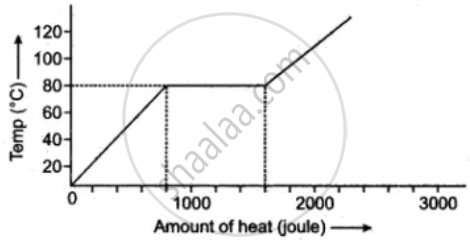
If the specific heat capacity of the solid substance is 500 J/kg °G, find from the graph, the mass of the substance.
To study energy exchange between hot and cold objects, the system of both objects is isolated from the environment by keeping them inside ______.
Prove the Mayer's relation `C_p - C _v = R/J`
