Sandeep Garg solutions for इंट्रोडक्टरी माइक्रोइकोनॉमिक्स [अंग्रेजी] कक्षा ११ chapter 5 - Production Function [Latest edition]
Chapters
1: Introduction
UNIT 5: Consumer's Equilibrium and Demand
2: Consumer's Equilibrium
3: Demand
4: Elasticity of Demand
UNIT 6: Producer Behaviour and Supply
▶ 5: Production Function
6: Cost
7: Revenue
8: Producer's Equilibrium
9: Supply
UNIT 7: Forms of Market and Price Determination Under Perfect Competition With Simple Applications
Chapter 10: Main Market Forms
Chapter 11: Price Determination and Simple Applications

Advertisements
Advertisements
Solutions for Chapter 5: Production Function
Below listed, you can find solutions for Chapter 5 of CBSE Sandeep Garg for इंट्रोडक्टरी माइक्रोइकोनॉमिक्स [अंग्रेजी] कक्षा ११.
Advertisements
Sandeep Garg solutions for इंट्रोडक्टरी माइक्रोइकोनॉमिक्स [अंग्रेजी] कक्षा ११ 5 Production Function ОBJЕСTIVE QUESTIONS [Pages 5.24 - 5.33]
Fill in the Blanks
__________ Factors refer to those factors, which can be changed in the short run.
Average Product is also known as __________ or __________.
Marginal Product = `?/ "Change in units of Variable Factor"`
A rational producer will always seek to operate in Phase __________ of Law of Variable Proportions.
__________ refers to the functional relationship between inputs and output for a given state of technology.
When average product is less than marginal product, then average product __________.
When total product is constant, average product will __________.
TP, AP and MP are __________ shaped curves.
__________ refers to addition to total product, when one more unit of variable factor is employed.
When TP increases at a __________ rate, MP starts decreasing.
Rising average product is possible only when MP is __________ than AP.
MP curve cuts AP curve at its __________ point.
True or False with Reason:
When there are diminishing returns to a factor, total product always decreases.
True or False with Reason:
Total product will increase only when marginal product increases.
True or False with Reason:
Increase in total product always indicates that there are increasing returns to a factor.
True or False with Reason:
When marginal product falls, average product will also fall.
True or False with Reason:
The distinction between short and long run is based on a fixed time period.
True or False with Reason:
When there are diminishing returns to a factor, marginal and total product both always fall.
True or False with Reason:
Production function establishes a relation between inputs and output, which is technical and not economical in nature.
True or False with Reason:
When marginal product is zero, total product is at its maximum point.
True or False with Reason:
Both average product and marginal product can be negative.
True or False with Reason:
Both average product and marginal product can be zero.
True or False with Reason:
In the operation of the Law of Variable Proportions, all the factors are assumed to be variable.
True or False with Reason:
Average product curve and Marginal product curve are ‘U-shaped’ curve.
True or False with Reason:
In the long run, all factors of production are variable.
True or False with Reason:
Only variable factors are used for production in the short period.
True or False with Reason:
Both variable and fixed factors exist in case of zero output.
True or False with Reason:
A rational producer aims to operate in first phase of Law of Variable Proportions as total product increases at increasing rate.
True or False with Reason:
When average product is maximum, marginal product is greater than average product.
True or False with Reason:
Under ‘Law of Variable Proportions’, factor ratio keeps on changing.
True or False with Reason:
Average product can rise even when marginal product starts declining.
True or False with Reason:
The production function does not depend on the state of technology.
True or False with Reason:
Average product will increase only when marginal product increases.
True or False with Reason:
Marginal product cuts average product from its top.
True or False with Reason:
When marginal product is less than average product, average product falls.
True or False with Reason:
Rising average product is possible only when MP is more than AP.
True or False with Reason:
Marginal product always rises when average product is increasing.
True or False with Reason:
Under diminishing returns to a factor, total product continue to increase till marginal product reaches zero.
True or False with Reason:
Under diminishing returns to a factor, marginal product and total product both increase at a diminishing rate.
True or False with Reason:
When total product is constant, average product will fall.
True or False with Reason:
‘Law of Variable Proportions’ operates in the long period.
Matching Type Questions
From the set of statements given in Column I and Column II, choose the correct pair of statements:
Column I Column II (a) Short run (i) Period in which output can be changed by changing only fixed factors Column I Column II (b) Variable factors (ii) They vary directly with output Column I Column II (c) Long run (iii) Period in which output can be changed by changing only variable factors Column I Column II (d) Fixed factors (iv) Such factors can be changed in the short run
Match the statements given under A with the correct options given under B.
| (A) | (B) |
|---|---|
| (i) Diminishing Returns to a Factor | a. TP falls |
| b. TP increases at diminishing rate |
Match the statements given under A with the correct options given under B.
| (A) | (B) |
|---|---|
| (i) Short Run Production Function | a. When output is increased by increasing all the inputs simultaneously and in the same proportion |
| (ii) Long Run Production Function | b. When output is increased by changing only one input while keeping other inputs unchanged |
Match the statements given under (A) with the correct options given under (B).
| (A) | (B) |
|---|---|
| (i) Short Run | a. Average Physical Product |
| (ii) TP | b. Such factors cannot be changed in the short run |
| (iii) Fixed factors | c. AP × Units of Variable Factor |
| (iv) Average Return | d. Period in which output can be changed by changing only variable factors |
Match the statements given under A with the correct options given under B.
| (A) | (B) |
|---|---|
| (i) Production function | a. Refer to those factors, which can be changed in the short run |
| (ii) Marginal Return | b. Period in which output can be changed by changing all factors |
| (iii) Variable Factors | c. Technological relation between physical inputs and output of a good |
| (iv) Law of Returns | d. Marginal Physical Product |
| (v) Long Run | e. Law of Variable Proportions |
Match the statements given under A with the correct options given under B.
| (A) | (B) |
|---|---|
| (i) When TP starts falling | a. AP is constant and minimum |
| (ii) When MP = AP | b. MP starts rising |
| c. AP is constant and maximum | |
| d. MP become negative |
Match the statements given under A with the correct options given under B.
| (A) | (B) |
|---|---|
| (i) When TP is maximum | a. MP is maximum |
| b. MP = 0 | |
| c. MP is minimum |
Match the statements given under A with the correct options given under B.
| (A) | (B) |
|---|---|
| (i) Short Run Production Function | a. Variable Proportion Type explained by Law of Returns to Scale |
| (ii) Long Run Production Function | b. Constant Proportion Type explained by Law of Variable Proportions |
| c. Variable Proportion Type explained by Law of Variable Proportions | |
| d. Constant Proportion Type explained by Law of Returns to Scale |
Multiple Choice Questions (MCQs)
When MP is zero, what can you say about TP?
TP is increasing
TP is maximum
TP is falling
None of the above
Which of the following statements accurately describes the relationship between AP and MP?
AP rises when MP is above it and falls when MP is below it
AP and MP are always parallel to each other
MP intersects AP at its minimum point
AP is always rising when MP is falling and vice-versa
Marginal Product refers to addition to total output when one more ______.
Unit is produced
Unit is sold
Unit is consumed
Unit of variable factor is employed
The period of time in which the plant capacity can be varied is known as ______.
Short run
Long run
Both (a) and (b)
Neither (a) nor (b)
______ is the extension of “Law of Diminishing Returns”.
Law of Variable Proportions
Law of Demand
Law of Equi-marginal utility
Law of Diminishing Marginal Utility
Law of Variable Proportions is also known as ______.
Law of Returns
Returns to Variable Factor
Law of Returns to Factor
All of these
The maximum possible output for a firm with two units of labour (L) and ten units of capital (K), if its production function is given as: 5L + 2K
0 units
30 units
200 units
50 units
Identify the phase in which TP increases at an increasing rate and MP also increases.
Increasing returns to a factor
Diminishing returns to a factor
Negative returns to a factor
None of these
Which of the following is not a reason for operation of increasing returns to a factor?
Better utilisation of fixed factor
Limitation of fixed factor
Increase in efficiency of variable factor
Indivisibility of fixed factor
When average product increases, the marginal product is ______.
Less than average product
Equal to the average product
More the average product
None of these
What happens to AP, when MP is more than AP?
AP rises
AP falls
AP remains constant
None of these
What is the behaviour of TP, when MP becomes negative?
TP increases at an increasing rate
TP increases at diminishing rate
TP is at its maximum point
TP decreases
According to Law of Variable Proportions, there are ______ phases.
1
3
2
4
Average product cannot be negative because ______.
Total product can never be zero
Total product can never be negative
Neither (a) nor (b)
Both (a) and (b)
The law of diminishing returns refers to an eventual fall in ______.
Productivity of factors of production
Total earnings of the firm
Marginal product of the variable factor
None of these
The 2nd phase (diminishing returns to a factor) is exhibited by the following total product sequence:
50, 50, 50, 50
50, 110, 180, 260
50, 100, 150, 200
50, 90, 120, 140
Which phase of Law of Variable Proportions has been ruled out on the grounds of technical inefficiency?
Increasing returns to a factor
Diminishing returns to a factor
Negative returns to a factor
None of these
A rational producer always aims to operate in ______ of Law of Variable Proportions.
1st Phase (Increasing returns to a factor)
2nd Phase (Diminishing returns to a factor)
3rd Phase (Negative returns to a factor)
Either 1st Phase or 2nd Phase
In general, most of the production functions measure ______.
Productivity of factors of production
Economical relation between factors of production
Technical relation between inputs and output
None of these
Product per unit of labour employed is termed as ______.
Average product
Marginal product
Total product
None of these
When AP is maximum, MP is equal to ______.
AP
TP
Zero
One
Variable factors refer to those factors of production ______.
Which can be only changed in the long run
Which can be changed in the short run
Which can never be changed
None of these
Both AP and MP curves are generally ______.
U-shaped
Inversely U-shaped
Rising
Falling
In describing a given production technology, the short run is best described as lasting ______.
Up to six months from now
Upto five years from now
As long as all inputs are fixed
As long as at least one input is fixed
______ is the period of time in which all the factors of production are variable.
Short run
Long run
Medium run
None of these
The ‘Marginal Product’ of a variable input is best described as ______.
Product divided by the number of units of variable input
Additional output resulting from a unit increase in the variable input
Additional output resulting from a unit increase in both variable and fixed inputs
Additional output resulting from a unit increase in the units produced
On the basis of following schedule, answer the foliowing question:
| Units of Labour | Total Product (TP) | Marginal Product (MP) |
|---|---|---|
| 1 | 10 | 10 |
| 2 | ? | 12 |
| 3 | 36 | ? |
What is TP at 2 units of labour?
10
12
22
20
On the basis of following schedule, answer the foliowing question:
| Units of Labour | Total Product (TP) | Marginal Product (MP) |
|---|---|---|
| 1 | 10 | 10 |
| 2 | ? | 12 |
| 3 | 36 | ? |
What is MP at 3rd unit of labour?
22
12
36
14
On the basis of following schedule, answer the foliowing question:
| Units of Labour | Total Product (TP) | Marginal Product (MP) |
|---|---|---|
| 1 | 10 | 10 |
| 2 | ? | 12 |
| 3 | 36 | ? |
The given schedule indicates the phase of:
Diminishing Returns to a Factor
Increasing Returns to a Factor
Negative Returns to a Factor
None of these
What is the maximum point of TP?
When AP becomes zero
When MP becomes zero
When MP cuts AP
None of these
Average Product can have ______.
Positive values only
Negative values only
Both positive as well as negative values
Neither positive nor negative values
Which of the following is correct?
When MP is positive and falling, TP rises at a decreasing rate
When MP is rising, TP rises at an increasing rate
When MP is negative and falling, TP falls
All of these
At the Point of Inflexion ______.
Total Product is maximum
Average Product is maximum
Marginal Product is maximum
Marginal Product is zero
When AP falls due to increase in quantity of variable input ______.
MP < AP
MP = AP
MP > AP
None of these
The Law of ______ deals with input-output relationship, when the output is increased by varying the quantity of one input.
Variable Proportions
Supply
Demand
Equi-marginal utility
According to Law of Variable Proportions, when we increase quantity of only one input, while keeping other inputs fixed, ______ initially increases at an increasing rate, then at a decreasing rate and finally at a negative rate.
Total Product
Average Product
Marginal Product
None of these
Which of the following is not a phase in the Law of Variable Proportions?
Increasing returns to a factor
Constant returns to a factor
Diminishing returns to a factor
Negative returns to a factor
The total output generated by the first four units of variable input is 200 units, 350 units, 450 units and 500 units. The marginal product of the third unit of input is:
200 units
100 units
400 units
500 units
50 units
150 units
If TP of employing one unit of variable factor is 12 units and that of 2 units of variable factor is 16 units, the marginal product of 2 units of variable factor is ______.
3 units
4 units
8 units
16 units
Which of the following is correct statement showing the relationship between AP and MP?
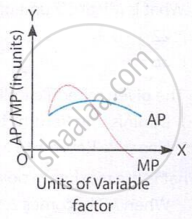
When MP > AP, AP increases
When MP = AP, AP is constant
When MP < AP, AP falls
All of these
‘Point of Inflexion’ is represented by (Refer Fig.):
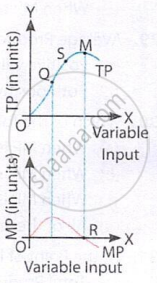
Point M
Point Q
Point R
Point S
When marginal product rises, total product ______.
(Choose the correct alternative)
Falls
Rises
Can rise or can fall
Remains constant
The average product curve in the input-output plane, will be ______.
(Choose the correct alternative)
An ‘S’ shaped curve
An inverse ‘S’ shaped curve
A ‘U’ shaped curve
An inverse ‘U’ shaped curve
Assertion Reason Questions (ARQs)
In the following Question, read the following statements: Assertion (A) and Reason (R). Choose the correct alternative among:
Assertion (A): Variable Factors can be changed in the short run.
Reason (R): Variable Factors are not required in case of zero output.
Both Assertion (A) and Reason (R) are True and Reason (R) is the correct explanation of Assertion (A).
Both Assertion (A) and Reason (R) are True and Reason (R) is not the correct explanation of Assertion (A).
Assertion (A) is True but Reason (R) is False.
Assertion (A) is False but Reason (R) is True.
In the following Question, read the following statements: Assertion (A) and Reason (R). Choose the correct alternative among:
Assertion (A): A rational producer always seeks to operate in Phase II of Law of Variable Proportions.
Reason (R): In Phase II of Law of Variable Proportions, Marginal Product is negative.
Both Assertion (A) and Reason (R) are True and Reason (R) is the correct explanation of Assertion (A).
Both Assertion (A) and Reason (R) are True and Reason (R) is not the correct explanation of Assertion (A).
Assertion (A) is True but Reason (R) is False.
Assertion (A) is False but Reason (R) is True.
In the following Question, read the following statements: Assertion (A) and Reason (R). Choose the correct alternative among:
Assertion (A): Production function establishes a relation between inputs and output, which is economical in nature.
Reason (R): Production function specifies either the maximum output that can be produced with the given inputs or the minimum quantity of inputs needed to produce a given level of output.
Both Assertion (A) and Reason (R) are True and Reason (R) is the correct explanation of Assertion (A).
Both Assertion (A) and Reason (R) are True and Reason (R) is not the correct explanation of Assertion (A).
Assertion (A) is True but Reason (R) is False.
Assertion (A) is False but Reason (R) is True.
In the following Question, read the following statements: Assertion (A) and Reason (R). Choose the correct alternative among:
Assertion (A): In the long run, production is done only by using the variable factors.
Reason (R): All factors are variable in the long run.
Both Assertion (A) and Reason (R) are True and Reason (R) is the correct explanation of Assertion (A).
Both Assertion (A) and Reason (R) are True and Reason (R) is not the correct explanation of Assertion (A).
Assertion (A) is True but Reason (R) is False.
Assertion (A) is False but Reason (R) is True.
In the following Question, read the following statements: Assertion (A) and Reason (R). Choose the correct alternative among:
Assertion (A): Marginal Product (MP) cuts Average Product (AP) from its top.
Reason (R): When AP rises, MP is more than AP and when AP falls, MP is less than AP.
Both Assertion (A) and Reason (R) are True and Reason (R) is the correct explanation of Assertion (A).
Both Assertion (A) and Reason (R) are True and Reason (R) is not the correct explanation of Assertion (A).
Assertion (A) is True but Reason (R) is False.
Assertion (A) is False but Reason (R) is True.
Statement Based Questions (SBQs)
In the following Question, read the following statement and choose the correct alternative among those given:
Statement 1: Production function is always defined with respect to a given technology.
Statement 2: Production Function changes with different time periods.
Both the Statements are true.
Both the Statements are faise.
Statement 1 is true and Statement 2 is false.
Statement 2 is true and Statement 1 is false.
In the following Question, read the following statement and choose the correct alternative among those given:
Statement 1: The distinction between short run and long run is based on calendar period.
Statement 2: Factors are classified as variable and fixed factor in the short run and long run.
Both the Statements are true.
Both the Statements are false.
Statement 1 is true and Statement 2 is false.
Statement 2 is true and Statement 1 is false.
In the following Question, read the following statement and choose the correct alternative among those given:
Statement 1: Fixed factors do not vary directly with output.
Statement 2: Fixed factors cannot be changed in the short run.
Both the Statements are true.
Both the Statements are faise.
Statement 1 is true and Statement 2 is false.
Statement 2 is true and Statement 1 is false.
In the following Question, read the following statement and choose the correct alternative among those given:
Statement 1: Law of Variable Proportions applies to all fixed factors excluding land.
Statement 2: Law of Variable Proportions applies to the field of production only.
Both the Statements are true.
Both the Statements are false.
Statement 1 is true and Statement 2 is false.
Statement 2 is true and Statement 1 is false.
In the following Question, read the following statement and choose the correct alternative among those given:
Statement 1: The second phase of Law of Variable Proportions ends when MP is zero and TP is maximum.
Statement 2: A rational producer aiways seeks to operate in Phase III of Law of Variable Proportions.
Both the Statements are true.
Both the Statements are false.
Statement 1 is true and Statement 2 is false.
Statement 2 is true and Statement 1 is false.
In the following Question, read the following statement and choose the correct alternative among those given:
Statement 1: Law of Variable Proportions is an extension to Law of Diminishing Returns.
Statement 2: Law of Diminishing Returns considers only the rising phases of MP and ignores the phase of falling MP.
Both the Statements are true.
Both the Statements are false.
Statement 1 is true and Statement 2 is false.
Statement 2 is true and Statement 1 is false.
Very Short Answer Type Questions (VSAQs)
What is production?
What is meant by production function?
What is short run?
What is Long run?
In which period, some factors of production are fixed and others are variable?
What do you mean by variable factors?
What do you mean by fixed factors?
Can Average product be zero or negative?
Define marginal product.
Can marginal product be zero or negative?
What change will take place in marginal product, when total product increases at a diminishing rate?
As the variable input labour is increased by one unit, total output falls. What would you say about the marginal productivity of labour?
Four units of labour produce 100 units of output and 5 units of labour produce 120 units of output. Calculate MP of the labour.
Name the law expressing the relationship between the quantities of a variable factor and the quantities of output.
In which phase of Law of Variable Proportions, does a rational firm aim to operate?
Mention two reasons for occurrence of the phase of increasing returns to a factor.
What is meant by “diminishing returns to a factor”?
What is the general shape of the TP, AP and MP curves?
What will happen to MP, when TP increases at an increasing rate?
How will MP react, when TP rises at a diminishing rate?
When MP is zero, what can you say about TP?
Define average product.
Give the meaning of returns to a factor.
Define short run production function.
Give the meaning of ‘Long run production function’.
Sandeep Garg solutions for इंट्रोडक्टरी माइक्रोइकोनॉमिक्स [अंग्रेजी] कक्षा ११ 5 Production Function REVISION EXERCISE [Pages 5.33 - 5.36]
Short Answer Type Questions
What is meant by variable factor? Give two examples of it.
What is meant by fixed factor? Give two examples of it.
Define the following term:
Total product
Define average product.
Define marginal product.
Give the meaning of returns to a factor.
State the law of diminishing returns to a factor.
State the relation between marginal product and average product. Show this relation in a diagram.
Give the meaning of returns to a factor.
What leads to increasing returns to a factor? Explain.
What is meant by diminishing returns to a factor? Why does it occur?
In which phase a rational producer will operate in the short run?
What does the Law of Variable Proportions show?
State the behaviour of total product according to Variable Proportions Law.
What does the Law of Variable Proportions show?
State the behaviour of marginal product according to Variable Proportions Law.
State the phases in the behaviour of Total Product as per the Law of Variable Proportions. Use diagram.
Explain the law of variable proportions with the help of a diagram.
What is meant by ‘short-run’ production function?
Give the meaning of ‘Long run production function’.
What type of production function is this in which only one input is increased and others kept constant? State the behaviour of total product in this production function.
Define production function.
Distinguish between short-run and long-run production functions.
Define marginal product.
State the behaviour of marginal product when only one input is increased and other inputs are hold constant.
OR
State the behaviour of Marginal Physical Product under Returns to a Factor.
What is meant by ‘negative returns to a factor’?
Discuss any two reasons behind negative returns to a factor.
Long Answer Type Questions
Explain the Law of Variable Proportions with the help of total and marginal physical product curves.
Explain the likely behaviour of Total Product and Marginal Product when for increasing production only one input is increased while all other inputs are kept constant.
Explain the law of diminishing returns with the help of a hypothetical schedule and diagram.
Explain reasons for increasing returns to a factor.
Explain reasons for diminishing returns to a factor.
Explain the relation between marginal product and total product with the help of a diagram.
State the relation between marginal product and average product. Show this relation in a diagram.
Distinguish between fixed factors and variable factors of production.
Distinguish Between short-run and long-run.
State the behaviour of marginal product in the law of variable proportions. Explain the causes of this behaviour.
Explain the changes that take place in total product & marginal product under diminishing returns to a factor.
State, with the help of a marginal product schedule, the different phases of the Law of Variable Proportions.
Explain the law of variable proportions with the help of a numerical example.
What is meant by “diminishing returns to a factor”?
Discuss any two reasons for the operation of diminishing returns to a factor.
Unsolved Practicals Practicals on TP, AP and MP
Calculate Average Product (AP) and Marginal Product (MP):
| Variable Factor (units) | 1 | 2 | 3 | 4 | 5 | 6 |
| TP (units) | 8 | 16 | 24 | 29 | 29 | 25 |
Calculate Average Product (AP) and Marginal Product (MP):
| Variable Factor (units) | 0 | 1 | 2 | 3 | 4 | 5 | 6 | 7 |
| TP (units) | 0 | 3 | 8 | 12 | 15 | 17 | 17 | 16 |
Calculate TP and AP:
| Variable Factor (units) | 1 | 2 | 3 | 4 | 5 | 6 | 7 |
| MP (units) | 20 | 16 | 12 | 8 | 4 | 0 | −4 |
Calculate TP and AP from the following data:
| Variable Factor (units) | 1 | 2 | 3 | 4 | 5 |
| MP (units) | 10 | 11 | 10 | 9 | 8 |
Calculate the values of TP and AP:
| Variable Factor (units) | 1 | 2 | 3 | 4 | 5 | 6 |
| MP (units) | 10 | 12 | 14 | 12 | 7 | 5 |
Compute TP and MP:
| Variable Factor (units) | 1 | 2 | 3 | 4 | 5 |
| AP (units) | 50 | 45 | 40 | 35 | 30 |
Calculate TP and MP:
| Variable Factor (units) | 1 | 2 | 3 | 4 | 5 | 6 |
| AP (units) | 50 | 48 | 45 | 42 | 39 | 35 |
Find out the missing values from the following table:
| Variable Factor (units) | 0 | 1 | 2 | 3 | 4 | 5 |
| TP (units) | - | - | 10 | - | 24 | - |
| AP (units) | - | - | - | 6 | - | 5 |
| MP (units) | - | 4 | - | - | - | - |
Complete the following table:
| Units of Labour (Units) | Average Product (Units) | Marginal Product |
| 1 | 16 | - |
| 2 | 20 | - |
| 3 | - | 20 |
| 4 | 18 | - |
| 5 | - | 8 |
| 6 | 14 | - |
Complete the following schedule:
| Units | TPP (Units) | APP (Units) | MPP (Units) |
| 1 | 100 | - | - |
| 2 | - | - | 140 |
| 3 | - | 140 | - |
| 4 | 480 | - | - |
Calculate MP of the variable factor and identify the various phases of change in total product, from the following schedule:
| Units of variable factor (VF) | 0 | 1 | 2 | 3 | 4 | 5 | 6 |
| TP (units) | 0 | 10 | 28 | 45 | 52 | 52 | 48 |
Identify the three phases of the Law of Variable Proportions from the following schedule:
| Units of Labour | 1 | 2 | 3 | 4 | 5 |
| Total Physical Product (units) | 20 | 50 | 70 | 80 | 60 |
From the following table, find out the phase during which there are increasing returns to a factor. Give reasons for your answer.
| Units of variable factor | 1 | 2 | 3 | 4 | 5 |
| Average Product (units) | 10 | 12 | 14 | 14.5 | 14 |
Identify the three phases of the law of variable proportions. Give reasons.
| Variable Input (units) | Total Product (units) |
| 1 | 5 |
| 2 | 11 |
| 3 | 15 |
| 4 | 17 |
| 5 | 15 |
Sandeep Garg solutions for इंट्रोडक्टरी माइक्रोइकोनॉमिक्स [अंग्रेजी] कक्षा ११ 5 Production Function REVISION TEST PAPERS (RTPs) [Pages 5.39 - 5.42]
Revision Test Paper - 1
According to the Law of Variable Proportions, the changes in Total Product (TP) and Marginal Product (MP) can be classified into the following three phases:
Phase I: TP rises at a decreasing rate, MP increases.
Phase II: TP rises at an increasing rate, MP decreases and is positive.
Phase III: TP falls and MP becomes negative.
Phase I: TP rises at an increasing rate, MP falls.
Phase II: TP rises at a decreasing rate, MP decreases and is positive.
Phase III: TP falls and MP becomes negative.
Phase I: TP rises at an increasing rate, MP increases.
Phase II: TP rises at constant rate, MP decreases and is positive.
Phase III: TP falls and MP becomes negative.
Phase I: TP rises at an increasing rate, MP increases.
Phase II: TP rises at a decreasing rate, MP decreases and is positive.
Phase III: TP falls and MP becomes negative.
Curvature of the TP curve changes at ______.
Point of Inflexion
Point where TP is maximum
Point where MP is zero
None of the above
Which of the following is correct?
`AP = (TP)/(trianglen)`
`MP = (triangleTP)/(n)`
`MP = (triangleTP)/(trianglen)`
`AP = (triangleTP)/(n)`
Total Product is also known as ______.
Total Physical Product
Total Output
Total Return
All of these
Production function is expressed with reference to a particular period of time. (True/False)
In ______ (Short run/Long run), ______ (Supply/Demand) is more active in price determination as ______ (Demand/Supply) cannot be increased immediately.
Read the following statements carefully and choose the correct alternative from the following:
Statement 1: The quantity of variable factors remain same in the short run irrespective of level of output, while fixed factors vary directly with the level of output.
Statement 2: Marginal Product of each variable factor is positive in the third phase of Law of Variable Proportions.
Both the Statements are True.
Both the Statements are False.
Statement 1 is True & Statement 2 is False.
Statement 2 is True & Statement 1 is False.
How will the average product react when the marginal product is equal to average product?
Calculate TP and MP:
| Variable Factor (units) | 1 | 2 | 3 | 4 | 5 | 6 |
| AP (units) | 40 | 43 | 42 | 41 | 37 | 34 |
What is meant by ‘short-run’ production function?
Give the meaning of ‘Long run production function’.
Revision Test Paper - 2
______ is obtained by dividing ______ by units of variable factor.
Total Product, Marginal Product
Marginal Product, Average Product
Average Product, Total Product
Total Product, Average Product
No firm would deliberately choose to operate in 3rd phase because ______.
MP of each variable factor is negative
MP of each variable factor is positive
MP become zero
MP falls
Which of the following statement is correct with respect to production function?
(i) It establishes a relationship between input and output, which is technical in nature. (ii) It cannot change in different time periods.
(iii) It is expressed with reference to a particular period of time.
(iv) It is always defined with respect to a given technology.
(v) It is economical in nature.
Alternatives:
(i) and (ii)
(ii), (iii) and (v)
(i), (ii) and (iii)
(i), (iii) and (iv)
Which of the following assumptions of Law of Variable Proportions are correct:
(i) It operates in the long run.
(ii) Different units of variable factor can be combined with fixed factor.
(iii) The effect of change in output due to change in variable factor can be easily determined.
(iv) The law applies to all fixed factors including land.
(v) All variable factors are not equally efficient.
Alternatives:
(i), (iii) and (iv)
(i), (ii) and (v)
(i) and (iv)
(ii), (iii) and (iv)
In the second phase, the employment of an additional variable factor causes total product to decline. (True/False)
______ (Short Run Production Function/Long Run Production Function) shows the nature of rate of change in output due to a change in only one ______ (Fixed/Variable) factor of production.
Read the following statements carefully and choose the correct alternative from the following:
Statement 1: Total Product can also be calculated as the sum of Average Product.
Statement 2: When marginal product is less than average product, average product rises.
Both the Statements are True.
Both the Statements are False.
Statement 1 is True & Statement 2 is False.
Statement 2 is True & Statement 1 is False.
State the law of diminishing returns to a factor.
Identify the three phases of the Law of Variable Proportions. Give reasons.
| Variable Input (units) | 1 | 2 | 3 | 4 | 5 |
| Total Product (units) | 7 | 15 | 21 | 23 | 20 |
State the relation between marginal product and average product. Show this relation in a diagram.
Solutions for 5: Production Function
Sandeep Garg solutions for इंट्रोडक्टरी माइक्रोइकोनॉमिक्स [अंग्रेजी] कक्षा ११ chapter 5 - Production Function
Shaalaa.com has the CBSE Mathematics इंट्रोडक्टरी माइक्रोइकोनॉमिक्स [अंग्रेजी] कक्षा ११ CBSE solutions in a manner that help students grasp basic concepts better and faster. The detailed, step-by-step solutions will help you understand the concepts better and clarify any confusion. Sandeep Garg solutions for Mathematics इंट्रोडक्टरी माइक्रोइकोनॉमिक्स [अंग्रेजी] कक्षा ११ CBSE 5 (Production Function) include all questions with answers and detailed explanations. This will clear students' doubts about questions and improve their application skills while preparing for board exams.
Further, we at Shaalaa.com provide such solutions so students can prepare for written exams. Sandeep Garg textbook solutions can be a core help for self-study and provide excellent self-help guidance for students.
Concepts covered in इंट्रोडक्टरी माइक्रोइकोनॉमिक्स [अंग्रेजी] कक्षा ११ chapter 5 Production Function are .
Using Sandeep Garg इंट्रोडक्टरी माइक्रोइकोनॉमिक्स [अंग्रेजी] कक्षा ११ solutions Production Function exercise by students is an easy way to prepare for the exams, as they involve solutions arranged chapter-wise and also page-wise. The questions involved in Sandeep Garg Solutions are essential questions that can be asked in the final exam. Maximum CBSE इंट्रोडक्टरी माइक्रोइकोनॉमिक्स [अंग्रेजी] कक्षा ११ students prefer Sandeep Garg Textbook Solutions to score more in exams.
Get the free view of Chapter 5, Production Function इंट्रोडक्टरी माइक्रोइकोनॉमिक्स [अंग्रेजी] कक्षा ११ additional questions for Mathematics इंट्रोडक्टरी माइक्रोइकोनॉमिक्स [अंग्रेजी] कक्षा ११ CBSE, and you can use Shaalaa.com to keep it handy for your exam preparation.
