Sandeep Garg solutions for इंट्रोडक्टरी माइक्रोइकोनॉमिक्स [अंग्रेजी] कक्षा ११ chapter 8 - Producer's Equilibrium [Latest edition]
Chapters
1: Introduction
UNIT 5: Consumer's Equilibrium and Demand
2: Consumer's Equilibrium
3: Demand
4: Elasticity of Demand
UNIT 6: Producer Behaviour and Supply
5: Production Function
6: Cost
7: Revenue
▶ 8: Producer's Equilibrium
9: Supply
UNIT 7: Forms of Market and Price Determination Under Perfect Competition With Simple Applications
Chapter 10: Main Market Forms
Chapter 11: Price Determination and Simple Applications
Advertisements
Advertisements
Solutions for Chapter 8: Producer's Equilibrium
Below listed, you can find solutions for Chapter 8 of CBSE Sandeep Garg for इंट्रोडक्टरी माइक्रोइकोनॉमिक्स [अंग्रेजी] कक्षा ११.
Advertisements
Sandeep Garg solutions for इंट्रोडक्टरी माइक्रोइकोनॉमिक्स [अंग्रेजी] कक्षा ११ 8 Producer's Equilibrium OBJECTIVE QUESTIONS [Pages 8.12 - 8.15]
Fill in the Blanks
Profit refers to the excess of ______ over ______.
Producer’s Equilibrium refers to that price and output combination which brings ______ profit to the producer and profit ______ as more is produced.
“For a firm to be in equilibrium, Marginal Revenue (MR) and Marginal Cost (MC) must be __________ and beyond that level of output Marginal Cost must be __________.”
The state of Producer’s equilibrium either reflects __________ profits or __________ losses.
If MC is more than MR at a particular level of output, then producer will __________ the production to maximise the profits.
True or False with Reason:
At the state of producer’s equilibrium, marginal cost of the firm should be rising.
True or False with Reason:
To maximize the profits of a firm, the only condition needed is equality between marginal cost and marginal revenue.
True or False with Reason:
If marginal cost is equal to marginal revenue at two output levels, then any one of the output level can be taken as state of producer’s equilibrium.
True or False with Reason:
Excess of marginal revenue over marginal cost is always better than equality between the two in order to achieve the equilibrium for a producer.
Matching Type Questions
Match the statements given under A with the correct options given under B.
| (A) | (B) |
|---|---|
| (i) When Price remains Constant | a. Price > MC at the equilibrium level |
| (ii) When Price falls with rise in output | b. Price = MC at the equilibrium level |
Match the statements given under A with the correct options given under B.
| (A) | (B) |
|---|---|
| (i) Profit | a. MC = MR and MC is greater than MR after MC = MR output level |
| (ii) At Producer’s Equilibrium | b. When Price Falls with rise in output |
| (iii) Price is more than MC at the equilibrium level | c. Excess of receipts from the sale of goods over the expenditure incurred on producing them |
| d. Price is equal to MC at the equilibrium level |
Multiple Choice Questions (MCQs)
Producer’s Equilibrium under MR-MC approach is achieved when ______.
MR = MC
MC > MR after the equality between MR and MC
Either (1) or (2)
Both (1) and (2)
______ refers to a situation when a firm has no intention to expand or contract the output.
Producer’s Equilibrium
Market Equilibrium
Consumer’s Equilibrium
None of these
Excess of receipts from sale of goods over expenditure incurred on producing them is termed as ______.
Average Revenue
Revenue
Profits
Marginal Revenue
Producer is not at equilibrium when MC > MR because ______.
Profits can be increased by producing more
Benefit is less than cost
Both (2) and (2)
None of these
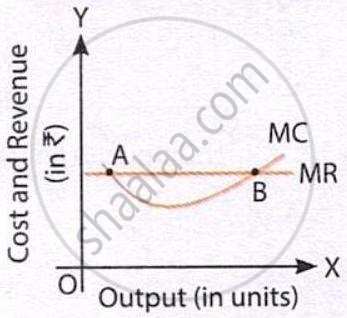
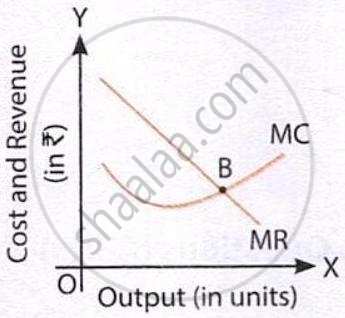
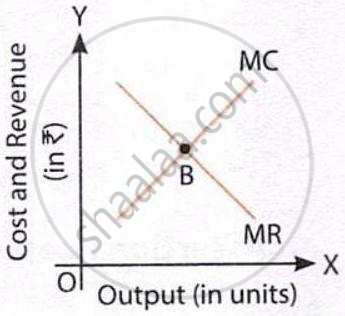
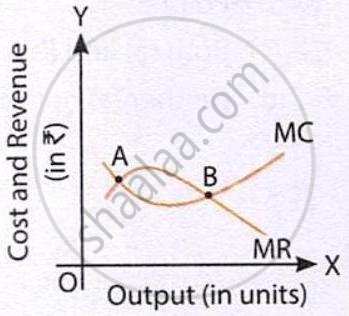
Which of the following diagram correctly depicts the producer’s equilibrium in case of constant prices?
In the following schedule, producer’s equilibrium is at ______.
| Output (Units) | 1 | 2 | 3 | 4 | 5 |
| MR (₹) | 10 | 10 | 10 | 10 | 10 |
| MC (₹) | 12 | 10 | 8 | 10 | 15 |
2 Units
4 Units
3 Units
5 Units
If MR is more than MC at a particular level of output, then producer will ______.
Reduce production
Increase production
Keep the production at current level
None of these
In the given diagram, producer’s equilibrium is achieved at point ______.
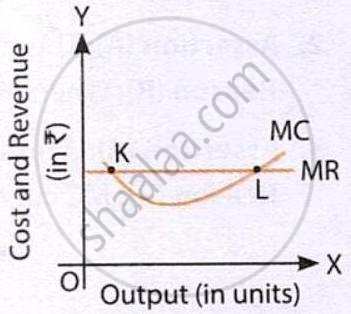
K
L
Both (1) and (2)
Neither (1) nor (2)
Producer’s equilibrium refers to stage of that output level when ______.
Firm earns maximum profits
Firm bears minimum losses
Firm has no inclination to expand or contract the output
All of these
In case of perfect competition, a firm is in equilibrium when ______.
MC = MR
MC cuts MR from below
MC is rising when it cuts MR
All of these
The profits of a firm diminish when ______ exceeds ______.
Marginal Revenue, Marginal Cost
Marginal Cost, Marginal Revenue
Marginal Revenue, Average Cost
Average Revenue, Average Cost
If Marginal Cost = MC and Marginal Revenue = MR, then for achieving equilibrium output ______.
MC Curve should cut MR Curve from above
MC Curve should cut MR Curve from below
MC Curve should not cut MR Curve at all
MC Curve should be tangent to MR Curve
When price falls with rise in output, then Producer’s Equilibrium is achieved at ______.
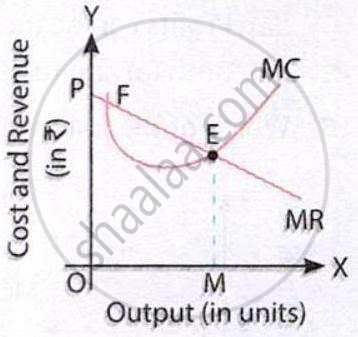
Point E
Point F
Both (1) and (2)
Neither (1) nor (2)
Assertion Reason Questions (ARQs)
In the following Question, read the following statements: Assertion (A) and Reason (R). Choose the correct alternative among them:
Assertion (A): When price remains same at all levels of output, then Price is more than MC at the equilibrium level.
Reason (R): When MC is greater than MR after equilibrium, it means producing more will lead to decline in profits.
Both Assertion (A) and Reason (R) are True and Reason (R) is the correct explanation of Assertion (A).
Both Assertion (A) and Reason (R) are True and Reason (R) is not the correct explanation of Assertion (A).
Assertion (A) is True but Reason (R) is False.
Assertion (A) is False but Reason (R) is True.
In the following Question, read the following statements: Assertion (A) and Reason (R). Choose the correct alternative among them:
Assertion (A): The state of Producer’s Equilibrium either reflects maximum profits or minimum losses.
Reason (R): When MC > MR after equilibrium, it means producing more will lead to rise in profits.
Both Assertion (A) and Reason (R) are True and Reason (R) is the correct explanation of Assertion (A).
Both Assertion (A) and Reason (R) are True and Reason (R) is not the correct explanation of Assertion (A).
Assertion (A) is True but Reason (R) is False.
Assertion (A) is False but Reason (R) is True.
In the following Question, read the following statements: Assertion (A) and Reason (R). Choose the correct alternative among them:
Assertion (A): A firm is at equilibrium when MC = MR and beyond that level of output, MC must be falling.
Reason (R): MC curve should cut MR curve from below to achieve Producer’s Equilibrium.
Both Assertion (A) and Reason (R) are True and Reason (R) is the correct explanation of Assertion (A).
Both Assertion (A) and Reason (R) are True and Reason (R) is not the correct explanation of Assertion (A).
Assertion (A) is True but Reason (R) is False.
Assertion (A) is False but Reason (R) is True.
Statement Based Questions (SBQs)
In the following Question, read the following statements and choose the correct alternative among them:
Statement 1: A producer is said to be in equilibrium when he wishes to expand the output.
Statement 2: The difference between revenue and cost is termed as profit.
Both the Statements are true.
Both the Statements are false.
Statement 1 is true and Statement 2 is false.
Statement 2 is true and Statement 1 is false.
In the following Question, read the following statements and choose the correct alternative among them:
Statement 1: Producer’s Equilibrium refers to stage of that output level at which MC = MR and MC is greater than MR after MC = MR output level.
Statement 2: As long as MC is more than MR, it is profitable for the producer to go on producing more because it adds to its profits.
Both the Statements are true.
Both the Statements are false.
Statement 1 is true and Statement 2 is false.
Statement 2 is true and Statement 1 is false.
In the following Question, read the following statements and choose the correct alternative among them:
Statement 1: Every producer aims to maximize the total profits and profits increase as long as MR exceeds MC.
Statement 2: When price remains same at all levels of output, then Price or AR is equal to MR at equilibrium.
Both the Statements are true.
Both the Statements are false.
Statement 1 is true and Statement 2 is false.
Statement 2 is true and Statement 1 is false.
In the following Question, read the following statements and choose the correct alternative among them:
Statement 1: When more output can be sold only by reducing the prices, then MC is more than price at the equilibrium level.
Statement 2: Equality between MC and MR is the only condition needed to achieve producer’s equilibrium.
Both the Statements are true.
Both the Statements are false.
Statement 1 is true and Statement 2 is false.
Statement 2 is true and Statement 1 is false.
Very Short Answer Type Questions (VSAQs)
What is profit?
What are the two methods for determination of producer’s equilibrium?
What is meant by equilibrium output of a producer?
What is Producer’s Equilibrium?
Is it enough to say that profit is maximised when MC = MR?
At a certain level of output, the marginal cost of a firm is above its marginal revenue. Can this be its equilibrium output?
What is the general profit maximising condition for a producer (MR and MC approach)?
Sandeep Garg solutions for इंट्रोडक्टरी माइक्रोइकोनॉमिक्स [अंग्रेजी] कक्षा ११ 8 Producer's Equilibrium REVISION EXERCISE [Pages 8.15 - 8.18]
Short Answer Type Questions
Explain producer’s equilibrium with the help of a diagram.
“To achieve producer’s equilibrium, MC curve should cut the MR curve from below.” Defend or refute.
“Producer is also not in equilibrium when marginal revenue is more than marginal cost.” Comment.
Explain the conditions of producer’s equilibrium with the help of a numerical example.
Give the meaning of producer’s equilibrium. A producer produces that quantity of his product at which marginal cost and marginal revenue are equal. Is he earning maximum profits? Give reasons for your answer.
Long Answer Type Questions
Explain the conditions of producer’s equilibrium with the help of a schedule, assuming that the producer can sell more at the same price.
OR
Explain the conditions of producer’s equilibrium under perfect competition.
What is Producer’s Equilibrium?
Explain the conditions of producer’s equilibrium through the ‘marginal cost and marginal revenue’ approach. Use diagram.
Explain the conditions of producer’s equilibrium with the help of a schedule, assuming that the producer can sell more only by lowering the price.
Explain the conditions of the producer’s equilibrium with the help of a numerical example. Use marginal cost and marginal revenue approach.
Explain the rationale behind the conditions of equilibrium of a producer.
A producer is producing output at which MC = MR. However, if he produces more, then MC becomes less than MR. Is he in equilibrium? Use diagram.
Unsolved Practicals
From the following schedule find out the level of output at which the producer is in equilibrium, using marginal cost and marginal revenue approach. Give reasons for your answer.
| Price per unit (Rs) | Output (Units) | Total Cost (Rs) |
| 8 | 1 | 6 |
| 7 | 2 | 11 |
| 6 | 3 | 15 |
| 5 | 4 | 20 |
| 4 | 5 | 26 |
The TR and TC values of a firm are given in the following schedule. Calculate MR and MC. Also determine the level of output, at which producer’s equilibrium is achieved?
| Output (Units) | 1 | 2 | 3 | 4 | 5 | 6 | 7 |
| TR (₹) | 20 | 40 | 60 | 80 | 100 | 120 | 140 |
| TC (₹) | 30 | 55 | 78 | 98 | 120 | 150 | 190 |
From the following table, find out the level of output at which the producer will be in equilibrium. Give reasons for your answer.
| Output (Units) | Marginal Revenue (₹) | Marginal Cost (₹) |
| 1 | 8 | 10 |
| 2 | 8 | 8 |
| 3 | 8 | 7 |
| 4 | 8 | 8 |
| 5 | 8 | 9 |
Give reason identify the equilibrium level of output and find and profit at this output using ‘Marginal cost and marginal Revenue’ approach from the following:
| Output (Units) | Total Revenue (₹) | Total Cost (₹) |
| 1 | 8 | 8 |
| 2 | 15 | 13 |
| 3 | 21 | 19 |
| 4 | 26 | 27 |
| 5 | 30 | 36 |
Giving reasons identify the equilibrium level of output and find profit at this output using ‘Marginal Cost and Marginal Revenue’ approach from the following:
| Output (Units) | Total Cost (₹) | Total Revenue (₹) |
| 1 | 7 | 7 |
| 2 | 13 | 14 |
| 3 | 20 | 21 |
| 4 | 28 | 28 |
| 5 | 37 | 35 |
From the following information about a firm, find the firm’s equilibrium output in terms of marginal cost and marginal revenue. Give reasons. Also, find profit at this output.
| Output (units) | Total Revenue (Rs) |
Total Cost (Rs) |
| 1 | 6 | 7 |
| 2 | 12 | 13 |
| 3 | 18 | 17 |
| 4 | 24 | 23 |
| 5 | 30 | 31 |
Giving reasons find out the level of output at which producer will be in equilibrium. (Use marginal cost and marginal revenue approach).
| Output (Units) | 1 | 2 | 3 | 4 | 5 |
| Total Revenue (₹) | 18 | 36 | 54 | 72 | 90 |
| Total Cost (₹) | 21 | 39 | 54 | 72 | 93 |
A producer can sell any quantity of a commodity at a given price of ₹ 10 per unit. His cost schedule is given below:
| Output (Units) | 1 | 2 | 3 | 4 | 5 | 6 |
| Total Cost (₹) | 12 | 22 | 31 | 38 | 48 | 60 |
How many units should he produce to get maximum profits? Explain.
From the following information, determine the output level at which the producer will be in equilibrium.
| Output (Units) | 1 | 2 | 3 | 4 | 5 |
| Price (per unit ₹) | 10 | 9 | 8 | 7 | 6 |
| Marginal Cost (₹) | 10 | 6 | 3 | 4 | 7 |
Given below is the cost schedule of a product produced by a firm. The market price per unit of the product at all levels of output is Rs 12. Using marginal cost and marginal revenue approach, find out the level of equilibrium output. Give reasons for your answer.
| Output (units) | 1 | 2 | 3 | 4 | 5 | 6 |
| Average Cost (Rs.) | 12 | 11 | 10 | 10 | 10.4 | 11 |
From the following total cost and total revenue schedule of a firm, find out the level of output, using marginal cost and marginal revenue approach, at which the firm would be is equilibrium. Give reasons for your answer.
| Output (Units) |
Total Revenue (Rs) |
Total Cost (Rs) |
| 1 | 10 | 8 |
| 2 | 18 | 15 |
| 3 | 24 | 21 |
| 4 | 28 | 25 |
| 5 | 30 | 33 |
Identify the equilibrium level of output using “marginal cost and marginal revenue” approach. Give reasons for your answer.
| Price (₹) | Output (units) | Total Cost (₹) | Marginal Cost (₹) |
| 10 | 1 | 10 | 10 |
| 10 | 2 | 19 | 9 |
| 10 | 3 | 26 | 7 |
| 10 | 4 | 36 | 10 |
| 10 | 5 | 48 | 12 |
Given the following schedule, state at which level of output, will the firm be at equilibrium and why.
| Output (Units) | 0 | 1 | 2 | 3 | 4 | 5 | 6 |
| Price (₹) | 20 | 20 | 20 | 20 | 20 | 20 | 20 |
| Total Cost (₹) | 10 | 50 | 80 | 100 | 105 | 125 | 150 |
Sandeep Garg solutions for इंट्रोडक्टरी माइक्रोइकोनॉमिक्स [अंग्रेजी] कक्षा ११ 8 Producer's Equilibrium REVISION TEST PAPERS (RTPs) [Pages 8.20 - 8.21]
Revision Test Paper - 1
Producer’s Equilibrium is achieved when:
(i) MC = MR and MC > MR after the equality between MR and MC.
(ii) MC = MR and MC < MR after the equality between MR and MC.
(iii) MC = MR and MC curve cuts MR curve from below.
(iv) MC = MR and MC curve cuts MR curve from above.
Alternative:
(i) and (iv)
(i) and (iii)
(ii) and (iii)
(ii) and (iv)
What is the relation between price and MC at equilibrium when price falls with rise in output?
Price = MC
Price < MC
Price > MC
All of the above
Read the following statements carefully and choose the correct alternative from the following:
Statement 1: A firm is at equilibrium when it has no inclination to expand or contract its output.
Statement 2: MR = MC is the only condition necessary for the producer's equilibrium.
Both the Statements are True.
Both the Statements are False.
Statement 1 is True & Statement 2 is False.
Statement 2 is True & Statement 1 is False.
The amount received from the sale of goods is known as ______ (Cost / Revenue), while the expenditure on the production of such goods is termed as ______ (Cost / Profit) and the difference between the two is known as ______ (Profit / Revenue).
Briefly discuss the Producer’s Equilibrium with the help of a schedule, assuming that the producer can sell more at the same price.
Giving reasons, find out the level of output at which the producer will be in equilibrium. (Use marginal cost and marginal revenue approach).
| Output (Units) | 1 | 2 | 3 | 4 | 5 | 6 |
| Total Revenue (₹) | 10 | 20 | 30 | 40 | 50 | 60 |
| Total Cost (₹) | 12 | 22 | 31 | 38 | 48 | 60 |
Revision Test Paper - 2
Producer’s equilibrium is not achieved when ______.
MC < MR
MC = MR
MC > MR
Both (1) and (3)
Producer’s satisfaction is maximised in terms of ______.
Revenue
Profit
Cost
None of the above
Read the following statements carefully and choose the correct alternative from the following:
Statement 1: Producer’s Equilibrium can be at any level of output produced by the firm.
Statement 2: When price remains constant, MC is equal to price at the equilibrium.
Both the Statements are True.
Both the Statements are False.
Statement 1 is True & Statement 2 is False.
Statement 2 is True & Statement 1 is False.
When MC is ______ (Greater / Lesser) than MR after equilibrium, it means producing more will lead to a decline in ______ (Profit / Cost).
Giving reasons, find out the level ofoutput at which the producer will be in equilibrium. (Use marginal cost and marginal revenue approach).
| Output (Units) | 1 | 2 | 3 | 4 | 5 |
| Total Revenue (₹) | 11 | 21 | 30 | 37 | 42 |
| Total Cost (₹) | 5 | 12 | 21 | 33 | 48 |
State the relationship between Price and Marginal Cost at equilibrium when price remains constant.
State the relationship between Price and Marginal Cost at equilibrium when price falls with a rise in output.
Solutions for 8: Producer's Equilibrium
Sandeep Garg solutions for इंट्रोडक्टरी माइक्रोइकोनॉमिक्स [अंग्रेजी] कक्षा ११ chapter 8 - Producer's Equilibrium
Shaalaa.com has the CBSE Mathematics इंट्रोडक्टरी माइक्रोइकोनॉमिक्स [अंग्रेजी] कक्षा ११ CBSE solutions in a manner that help students grasp basic concepts better and faster. The detailed, step-by-step solutions will help you understand the concepts better and clarify any confusion. Sandeep Garg solutions for Mathematics इंट्रोडक्टरी माइक्रोइकोनॉमिक्स [अंग्रेजी] कक्षा ११ CBSE 8 (Producer's Equilibrium) include all questions with answers and detailed explanations. This will clear students' doubts about questions and improve their application skills while preparing for board exams.
Further, we at Shaalaa.com provide such solutions so students can prepare for written exams. Sandeep Garg textbook solutions can be a core help for self-study and provide excellent self-help guidance for students.
Concepts covered in इंट्रोडक्टरी माइक्रोइकोनॉमिक्स [अंग्रेजी] कक्षा ११ chapter 8 Producer's Equilibrium are .
Using Sandeep Garg इंट्रोडक्टरी माइक्रोइकोनॉमिक्स [अंग्रेजी] कक्षा ११ solutions Producer's Equilibrium exercise by students is an easy way to prepare for the exams, as they involve solutions arranged chapter-wise and also page-wise. The questions involved in Sandeep Garg Solutions are essential questions that can be asked in the final exam. Maximum CBSE इंट्रोडक्टरी माइक्रोइकोनॉमिक्स [अंग्रेजी] कक्षा ११ students prefer Sandeep Garg Textbook Solutions to score more in exams.
Get the free view of Chapter 8, Producer's Equilibrium इंट्रोडक्टरी माइक्रोइकोनॉमिक्स [अंग्रेजी] कक्षा ११ additional questions for Mathematics इंट्रोडक्टरी माइक्रोइकोनॉमिक्स [अंग्रेजी] कक्षा ११ CBSE, and you can use Shaalaa.com to keep it handy for your exam preparation.
