Sandeep Garg solutions for इंट्रोडक्टरी माइक्रोइकोनॉमिक्स [अंग्रेजी] कक्षा ११ chapter 6 - Cost [Latest edition]
Chapters
1: Introduction
UNIT 5: Consumer's Equilibrium and Demand
2: Consumer's Equilibrium
3: Demand
4: Elasticity of Demand
UNIT 6: Producer Behaviour and Supply
5: Production Function
▶ 6: Cost
7: Revenue
8: Producer's Equilibrium
9: Supply
UNIT 7: Forms of Market and Price Determination Under Perfect Competition With Simple Applications
Chapter 10: Main Market Forms
Chapter 11: Price Determination and Simple Applications
Advertisements
Advertisements
Solutions for Chapter 6: Cost
Below listed, you can find solutions for Chapter 6 of CBSE Sandeep Garg for इंट्रोडक्टरी माइक्रोइकोनॉमिक्स [अंग्रेजी] कक्षा ११.
Advertisements
Sandeep Garg solutions for इंट्रोडक्टरी माइक्रोइकोनॉमिक्स [अंग्रेजी] कक्षा ११ 6 Cost OBJECTIVE QUESTIONS [Pages 6.37 - 6.50]
Fill in the Blanks
In Economics, cost is the sum total of __________ cost and __________ cost.
Minimum point of MC curve comes __________ the minimum points of AC and AVC curves.
TVC curve is __________ shaped.
__________ refer to those costs which do not vary directly with the level of output.
At zero level of output, total fixed cost is equal to __________ cost.
Average variable cost curve is a __________ shaped curve.
__________ refers to the functional relationship between cost and output.
When AC is more than MC, AC __________ with increase in the output.
__________ Cost is the cost of self supplied factors.
Both AVC and MC curves are U-shaped due to the __________.
__________ Cost is the payment made to outsiders for hiring factor services.
__________ is also known as Supplementary Cost.
Area under MC Curve is equal to __________.
Normal Profits earned by a firm are included in __________.
Salary of Permanent staff is an example of __________ cost.
If the average fixed cost of producing 4 units of output is ₹ 60, then the value of total fixed cost for producing 5 units will be __________.
When marginal cost is more than average variable cost (AVC), then AVC __________ with increase in output.
AC and AVC curves never intersect each other as __________ can never be zero.
MC curve cuts AC and AVC curves at their __________ points.
True or False with Reasons
Average variable cost can fall even when marginal cost is rising.
The difference between total cost and total variable cost falls with increase in output.
Average cost can rise even when marginal cost is falling.
If a machinery has no possible alternative use, its opportunity cost will be very high.
Average variable cost falls when it is more than marginal cost.
The minimum point of average cost curve lies to the right of average variable cost curve.
Average cost and average variable cost curves coincide when average fixed cost is zero.
Total fixed cost remains same even if output is zero.
Total fixed cost is more than total variable cost at zero level of output.
Total fixed cost curve is a vertical straight line, parallel to Y-axis.
Total cost can be obtained as summation of marginal costs.
Total cost of production is the sum total of variable cost and marginal cost.
If 10 units cost ₹ 36 to produce and 12 units cost ₹ 50, then marginal cost is equal to ₹ 14.
Average variable cost curve is a U-shaped curve.
Marginal cost is not affected by total fixed cost.
AFC curve is a rectangular hyperbola curve.
Both total cost and total fixed cost curves start from the same point.
Marginal cost changes at a rate faster than average cost.
When we consider costs in economics, we include explicit cost only.
Average cost falls only when marginal cost falls.
Total cost can never be constant.
Costs that have been already incurred are important factors in making production decisions.
As output is increased, the difference between average total cost and average variable cost falls and ultimately becomes zero.
The marginal cost curve can intersect the average cost curve at any point.
The difference between average total cost and average variable cost decreases with decrease in the level of output.
Explicit cost includes opportunity cost of resources owned and used by the firm’s owners.
When marginal cost rises, average cost also rises.
MC is minimum at point where TC start increasing at an increasing rate.
As soon as marginal cost starts rising, average variable cost also starts rising.
Average cost must exceed marginal cost at the point when average cost is minimum.
Insurance premium on factory building paid to Oriental Insurance is a fixed cost.
Average fixed cost curve touches the Y-axis because at zero output, average fixed cost is zero.
The MC curve may be rising or falling just before it becomes equal to AVC and ATC curves.
All per unit cost curves (i.e. AC, AVC and AFC curves) are U-shaped.
With increase in level of output, average fixed cost goes on falling till it reaches zero.
Total cost rises only when marginal cost rises.
Total cost curve and Total variable cost curve are parallel to each other.
The difference between average cost and average variable cost is always constant.
As output increases the difference between average cost and average variable cost decreases.
Average cost curve cuts Average variable cost curve at its minimum level.
Matching Type Questions
From the set of statements given in Column I and Column II, choose the correct pair of statements:
Column I Column II (a) Total Variable Cost (i) Horizontal straight line parallel to the X-axis Column I Column II (b) Average Fixed Cost (ii) Rectangular Hyperbola Column I Column II (c) Total Fixed Cost (iii) Inversely S-shaped Curve Column I Column II (d) Average Variable Cost (iv) Inversely U-shaped Curve
Match the statements given under (A) with the correct options given under (B).
| (A) | (B) |
|---|---|
| (i) Marginal Cost | a. TCn − TCn + 1 |
| b. TCn − TCn − 1 |
Match the statements given under A with the correct options given under B.
| (A) | (B) |
|---|---|
| (i) Total Variable Cost | a. It cannot be changed in the short run |
| (ii) Total Fixed Cost | b. It can be changed in the short run |
Match the statements given under A with the correct options given under B.
| (A) | (B) |
|---|---|
| (i) Explicit Cost | a. Supplementary Cost |
| (ii) Cost Function | b. `(triangleTC)/(triangleQ)` |
| (iii) MC | c. Wages paid to the employees |
| (iv) Fixed Cost | d. Functional relationship between cost and output |
Match the statements given under A with the correct options given under B.
| (A) | (B) |
|---|---|
| (i) Variable cost | a. Cost of self supplied factors. |
| (ii) TC | b. Rectangular Hyperbola |
| (iii) Implicit Cost | c. Horizontal straight line parallel to X-axis |
| (iv) AFC Curve | d. Prime Cost |
| (v) TFC Curve | e. AC × Q |
Match the statements given under A with the correct options given under B.
| (A) | (B) |
|---|---|
| (i) TFC | a. TVCn + TVCn − 1 |
| (ii) MC | b. TC − TVC |
| c. TVC − TC | |
| d. TVC + TC | |
| e. TVCn − TVCn + 1 | |
| f. TVCn − TVCn − 1 |
Multiple Choice Questions (MCQs)
Identify the two cost curves which start from the same point on the Y-axis:
TVC and TFC
TFC and AVC
TFC and TC
TFC and AFC
“Salary of Permanent staff” is which type of cost?
Variable and Implicit Cost
Fixed and Implicit Cost
Fixed and Explicit Cost
Variable and Explicit Cost
The cost curve, which is inversely S-shaped is ______.
Average Cost Curve
Total Fixed Cost Curve
Total Variable Cost Curve
Marginal Cost Curve
Which curve is not affected by fixed cost?
MC Curve
TC Curve
AC Curve
AFC Curve
The cost schedule of a firm is given as:
| Output (units) | 1 | 2 | 3 | 4 |
| Marginal Cost (₹) | 70 | 60 | 62 | 72 |
In the given case, average variable cost at 3rd level of output will be:
70
66
65
64
Marginal cost refers to addition to the total cost when one more unit of output is ______:
Wasted
Produced
Employed
Sold
MC can be directly derived from ______.
TFC
TVC
AC
AFC
Average fixed cost ______.
Remains same at all levels of output
Increases as output increases
Decreases as output increases
Initially increases and then decreases
All the curves except ______ are U shaped curves.
Average Fixed Cost Curve
Average Variable Cost Curve
Average Cost Curve
Marginal Cost Curve
Cost schedule is given as:
| Output (in units) | 6 | 5 | 4 | 3 | 2 |
| Total Cost (₹) | 120 | 75 | 55 | 45 | 40 |
In the given case, marginal cost at \(4^{\text {th }}\) level of output will be:
10
5
45
20
Area under MC Curve is equal to ______.
TVC
AFC
AVC
AC
When AC is decreasing, then status of MC in comparison to AC is ______.
MC > AC
MC = AC
MC < AC
None of these
The cost schedule of a firm, whose total fixed cost is ₹ 12, is given as:
| Output (units) | 1 | 2 | 3 | 4 | 5 | 6 |
| Marginal Cost (₹) | 9 | 7 | 2 | 4 | 8 | 12 |
In the given case, total cost at 2nd level of output will be:
16
28
9
7
Normal Profits earned by a firm are included in ______.
Implicit Cost
Explicit Cost
Fixed Cost
Variable Cost
The shape of total fixed cost curve is ______.
U-shaped
Downward sloping
Inversely S-shaped
Horizontal straight line parallel to x-axis
Cost function is a ______ concept.
Economical
Functional
Financial
Technical
Nishant, Tavleen and Manas are confused with the formula for deriving TC:
- Nishant says: TC = TVC + TFC
- Tavleen says: TC = AC × Output
- Manas says: TC = ΣMC + TFC
Identify who amongst them is correct.
Nishant
Manas
Tavleen
All of them
TFC is ₹ 20 at 2nd unit of output and MC at 3rd unit is ₹ 5. TFC at 3rd unit of output will be ______.
₹ 15
₹ 20
₹ 25
₹ 5
Which diagram correctly depicts total variable cost curve?
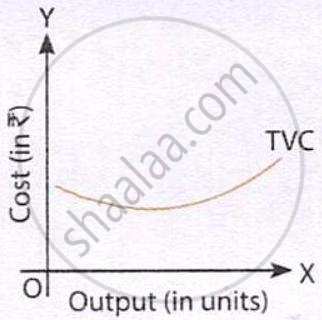
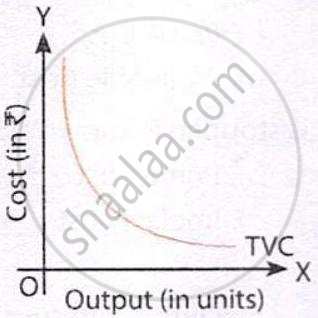
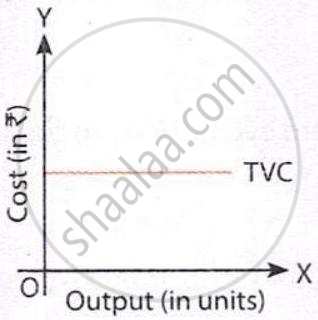
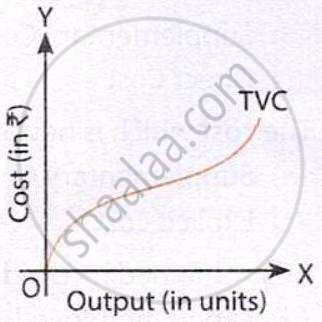
The curve in the following diagram is the most similar to a typical:
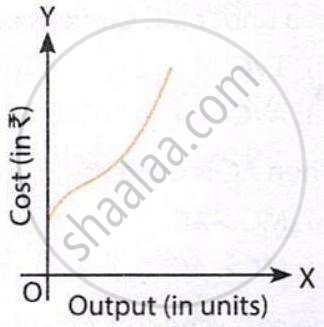
Total Variable Cost Curve
Marginal Cost Curve
Total Cost Curve
Average Variable Cost Curve
MC curve intersects AC curve at its ______ point and AVC curve at its ______ point.
Maximum, Minimum
Minimum, Minimum
Minimum, Maximum
Maximum, Maximum
AC, AVC and MC curves are ‘U’ shaped because of ______.
Law of Diminishing Marginal Utility
Law of Diminishing Returns
Law of Variable Proportions
None of these
Which two curves are intersected by MC curve at their minimum points?
AC and AVC
AVC and AFC
AC and AFC
AC and TVC
Minimum point of MC curve comes before the minimum point of ______.
AC Curve
AVC Curve
Both (1) and (2)
Neither (1) nor (2)
AVC can fall even when MC is rising, provided ______.
MC < AVC
MC > AVC
MC = AVC
None of these
Which condition is incorrect?
AC can rise when MC is falling
AC can fall when MC is rising
AVC can fall when MC is rising
AC can rise when MC is rising
Ishaan, Piyush and Bhavya are three friends talking about the relationship between marginal cost (MC) and average cost (AC).
- Ishaan says, “MC curve intersects AC curve from above”
- Bhavya says, “MC curve does not intersect AC curve at all”
- Piyush says, “MC curve intersects AC curve from below”
Out of the three, who is correct?
Piyush
Ishaan
Bhavya
All of them
Which one of the following is also known as fixed cost?
Supplementary Cost
Prime Cost
Direct Cost
Avoidable Cost
The cost which is never zero even when production is stopped is known as ______.
Supplementary Cost
Prime Cost
Explicit cost
Implicit cost
AC is obtained by dividing TC by the level of ______.
Labour employed
Output produced
Units consumed
Output sold
When change in total cost is divided by change in output, we get ______.
Average cost
Total variable cost
Marginal cost
Average variable cost
Which of the following cost curves is rectangular hyperbola?
Average cost curve
Marginal cost curve
Average variable cost curve
Average fixed cost curve
When AC is rising MC is ______.
Equal to AC
More than AC
Less than AC
Constant
Minimum point of AC occurs to the right of minimum point of ______.
TC
TVC
AFC
AVC
MC curve is common to both ______.
AFC and TFC
AC and AVC
AVC and AFC
AC and AFC
In the short run, total cost curve starts from ______.
Origin
Positive vertical intercept
Positive horizontal intercept
None of these
Identify the correct mathematical expression.
TC = TFC − TVC
TVC = TFC − TC
TFC = TC − TVC
TC = TVC − TFC
AFC curve ______.
Touches the X-axis
Touches the Y-axis
Touches both X-axis and Y-axis
Does not touch either of the axes
As output arises ______.
AVC curve and AC curve move away from each other
AVC curve and AC curve come closer and closer to each other
AVC curve and AC curve meet after sometime
AVC curve and AC curve come closer and closer to each other, but do not meet
A firm producing 6 units of output has average total cost of ₹ 150 and has to pay ₹ 240 to its fixed factors of production. In the given case, average variable cost at 6 units of output will be ______.
₹ 150
₹ 900
₹ 110
₹ 1,440
Which cost increases continuously with increase in production?
Average cost
Marginal cost
Variable cost
Fixed cost
Which of the following is an example of implicit cost? (Choose the correct alternative)
Wages paid
Cost of Raw material
Interest on owner’s capital
None of the above
A firm has a variable cost of ₹ 1,000 at five units of output. If fixed costs are ₹ 400, what will be the average total cost at five units of output?
₹ 280
₹ 80
₹ 200
₹ 1,400
Which of the following is the variable cost for a firm?
Interest on loan
Monthly rent
Insurance premium
Wages to employees
A firm’s average fixed cost (AFC) is ₹ 20 at six units of output. What will be AFC at four units of output?
₹ 20
₹ 30
₹ 40
₹ 50
Which of the following statement is true?
ATC = AFC − AVC
AVC = AFC + ATC
AFC = ATC + AVC
AFC = ATC − AVC
______ cost refers to actual payment made by the entrepreneur to the providers of factor services.
Explicit
Implicit
Variable
Fixed
The distinction drawn between fixed and variable costs is based on ______.
Whether the costs can or cannot be changed during the life of the plant
Whether the costs do or do not vary with the output produced in the long run
Whether the costs do not enter the calculation of total costs
Whether the costs do or do not vary with the output produced in the short run
Which of the following is an example of “Implicit cost”?
Interest that could have been earned on retained earnings used by the firm to finance expansion.
Payment of Rent by the Firm.
Interest payment made by the firm for funds borrowed from a Bank.
Payment of Wages by the Firm.
If a resource can be put only to a particular use, then opportunity cost is ______.
Applicable and quantifiable
Applicable but not quantifiable
Not applicable at all
None of these
If a Firm produces zero output in the short period, then ______.
Total Cost will be zero
Variable Cost will be positive
Fixed Cost will be positive
Marginal Cost will be positive
With which of the following, the concept of marginal cost is closely related?
Variable Cost
Fixed Cost
Opportunity Cost
Implicit cost
Initially, even when there is an increase in AVC, AC may still decline because ______.
Fall in AFC < Rise in AVC
Fall in AFC > Rise in AVC
Fall in AFC = Rise in AVC
None of these
MC Curve cuts the AVC and ATC Curves ______.
From above
From below
Either (1) or (2)
Neither (1) nor (2)
The total cost at 5 units of output is ₹ 30. The fixed cost is ₹ 5. The average variable cost at 5 units of output is ______.
₹ 25
₹ 6
₹ 5
₹ 1
The average fixed cost at 4 units of output is ₹ 20. Average variable cost at 5 units of output is ₹ 40. Average cost of producing 5 units is ______.
₹ 20
₹ 40
₹ 56
₹ 60
The relationship between AC, AVC and MC is rightly shown by:
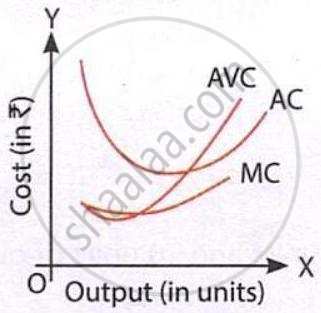
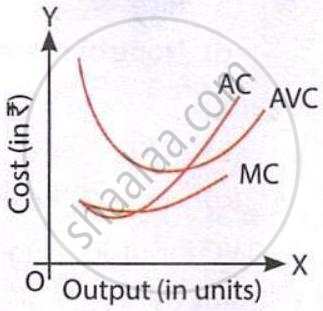
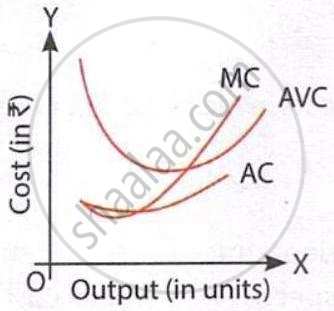
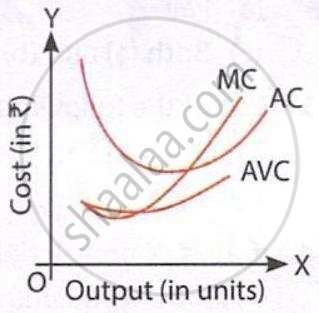
Identify the following curve:
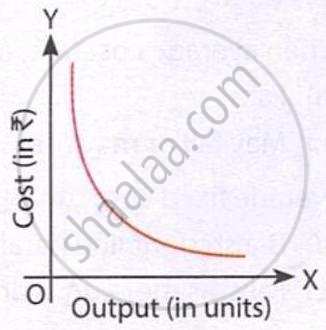
Average Variable Cost Curve
Total Variable Cost Curve
Average Fixed Cost Curve
Average Cost Curve
Which of the following diagram correctly depicts the relationship between TC, TFC and TVC?
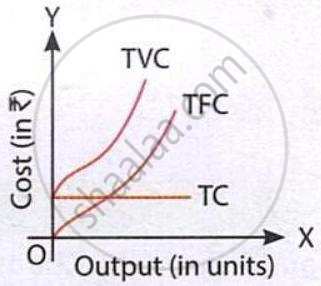
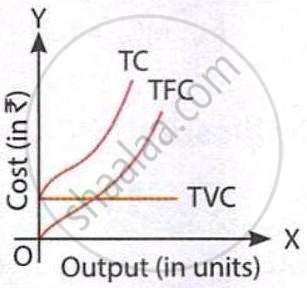
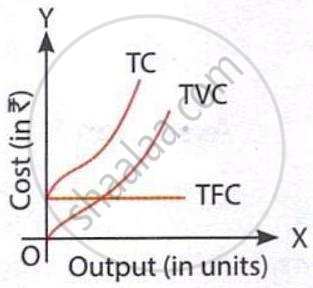
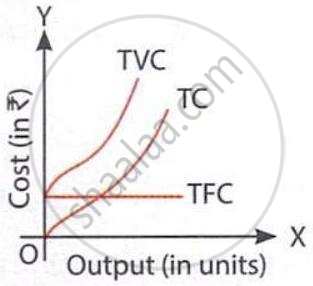
The area under the following curve is equal to:
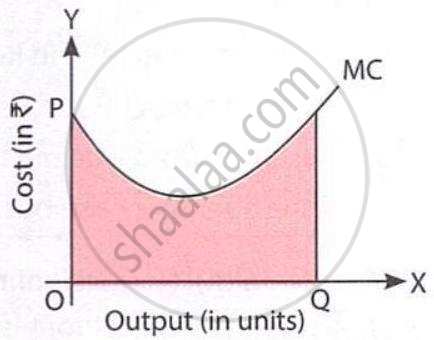
Total Cost
Average Cost
Average Variable Cost
Total Variable Cost
Which of the following diagram correctly depicts the relation between AC and MC?
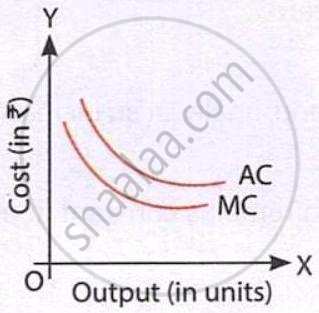
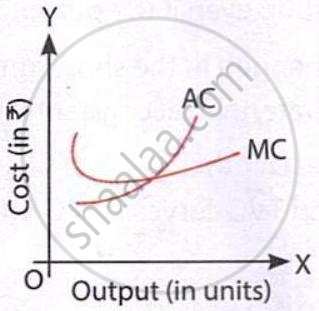
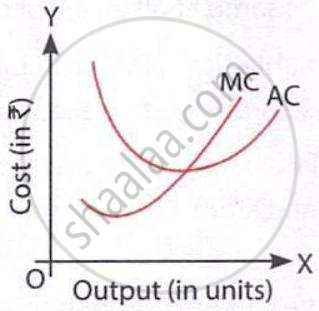
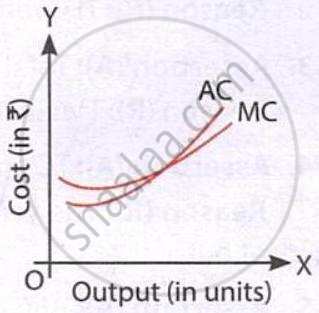
When AC > MC, then MC can ______.
Fall
Rise
Both (1) and (2)
None of these
Out of the following costs, which cost can never be zero ______.
AFC
AVC
TVC
None of these
If a firm’s production department data says that the TVC for producing 8 units and 10 units of output is ₹ 2,500 and ₹ 3,000 respectively, marginal cost of 10th unit will be ______.
₹ 100
₹ 150
₹ 500
₹ 250
When average cost falls, marginal cost ______.
Falls
Rises
May fall or may rise
Neither falls nor rises
Average fixed cost curve ______.
Is a straight line parallel to X-axis
Is straight line parallel to Y-axis
Falls, as more units are produced
Rises, as more units are produced
Which of the following formula is correct for calculating marginal cost? (Choose the correct alternative)
MCn = TFCn − TFCn − 1
MCn = ACn − ACn − 1
MCn = AVCn − AVCn − 1
MCn = TCn − TCn − 1
Assertion Reason Questions (ARQs)
In the following Question, read the following statements: Assertion (A) and Reason (R). Choose the correct alternative among them:
Assertion (A): Normal Profit is a part of Implicit Cost.
Reason (R): Normal Profit is the imputed value of entrepreneurial services provided by the owner.
Both Assertion (A) and Reason (R) are True and Reason (R) is the correct explanation of Assertion (A).
Both Assertion (A) and Reason (R) are True and Reason (R) is not the correct explanation of Assertion (A).
Assertion (A) is True but Reason (R) is False.
Assertion (A) is False but Reason (R) is True.
In the following Question, read the following statements: Assertion (A) and Reason (R). Choose the correct alternative among them:
Assertion (A): TFC curve is a vertical straight line parallel to the Y-axis.
Reason (R): TFC remains same at all levels of output, even if the output is zero.
Both Assertion (A) and Reason (R) are True and Reason (R) is the correct explanation of Assertion (A).
Both Assertion (A) and Reason (R) are True and Reason (R) is not the correct explanation of Assertion (A).
Assertion (A) is True but Reason (R) is False.
Assertion (A) is False but Reason (R) is True.
In the following Question, read the following statements: Assertion (A) and Reason (R). Choose the correct alternative among them:
Assertion (A): Total Variable Cost (TVC) can be changed in the short run.
Reason (R): TVC increases initially at a decreasing rate, then at constant rate and, finally, at an increasing rate.
Both Assertion (A) and Reason (R) are True and Reason (R) is the correct explanation of Assertion (A).
Both Assertion (A) and Reason (R) are True and Reason (R) is not the correct explanation of Assertion (A).
Assertion (A) is True but Reason (R) is False.
Assertion (A) is False but Reason (R) is True.
In the following Question, read the following statements: Assertion (A) and Reason (R). Choose the correct alternative among them:
Assertion (A): TC and TVC curves are parallel to each other.
Reason (R): The vertical distance between TC and TVC curves is TFC, which remains constant at all levels of output.
Both Assertion (A) and Reason (R) are True and Reason (R) is the correct explanation of Assertion (A).
Both Assertion (A) and Reason (R) are True and Reason (R) is not the correct explanation of Assertion (A).
Assertion (A) is True but Reason (R) is False.
Assertion (A) is False but Reason (R) is True.
In the following Question, read the following statements: Assertion (A) and Reason (R). Choose the correct alternative among them:
Assertion (A): AFC curve can never touch the Y-axis.
Reason (R): TFC can never be zero.
Both Assertion (A) and Reason (R) are True and Reason (R) is the correct explanation of Assertion (A).
Both Assertion (A) and Reason (R) are True and Reason (R) is not the correct explanation of Assertion (A).
Assertion (A) is True but Reason (R) is False.
Assertion (A) is False but Reason (R) is True.
Statement Based Questions (SBQs)
In the following Question, read the following statements and choose the correct alternative among them:
Statement 1: The sum of explicit cost and implicit cost is the total cost of production of a commodity.
Statement 2: Explicit Cost is in the nature of contractual payment, while no contractual obligation for payment is required in case of implicit cost.
Both the Statements are true.
Both the Statements are false.
Statement 1 is true and Statement 2 is false.
Statement 2 is true and Statement 1 is false.
In the following Question, read the following statements and choose the correct alternative among them:
Statement 1: Fixed Cost is also known as Supplementary Cost.
Statement 2: Total Fixed Cost (TFC) curve is a vertical straight line parallel to the Y-axis because TFC remains same at all levels of output, even if the output is zero.
Both the Statements are true.
Both the Statements are false.
Statement 1 is true and Statement 2 is false.
Statement 2 is true and Statement 1 is false.
In the following Question, read the following statements and choose the correct alternative among them:
Statement 1: Total Variable Cost Curve is S-shaped as it initially increases at increasing rate and later it increases at decreasing rate.
Statement 2: Variable Costs are incurred till there is production and become zero at zero level of output.
Both the Statements are true.
Both the Statements are false.
Statement 1 is true and Statement 2 is false.
Statement 2 is true and Statement 1 is false.
In the following Question, read the following statements and choose the correct alternative among them:
Statement 1: The change in Total Cost (TC) is entirely due to Total Variable Cost (TVC) as Total Fixed Cost (TFC) is constant at all levels of output.
Statement 2: The vertical distance between TFC curve and TC curve is equal to TVC and it goes on decreasing with increase in the output.
Both the Statements are true.
Both the Statements are false.
Statement 1 is true and Statement 2 is false.
Statement 2 is true and Statement 1 is false.
In the following Question, read the following statements and choose the correct alternative among them:
Statement 1: AFC curve is a U-shaped due to the application of Law of Variable Proportions.
Statement 2: As the output increases, the gap between AC and AVC curves also increases
Both the Statements are true.
Both the Statements are false.
Statement 1 is true and Statement 2 is false.
Statement 2 is true and Statement 1 is false.
In the following Question, read the following statements and choose the correct alternative among them:
Statement 1: MC is affected by change in TVC and is independent of TFC.
Statement 2: MC is a U-shaped curve due to operations of returns to a factor input.
Both the Statements are true.
Both the Statements are false.
Statement 1 is true and Statement 2 is false.
Statement 2 is true and Statement 1 is false.
Very Short Answer Type Questions (VSAQs)
Give the meaning of cost.
What is explicit cost?
What is meant by implicit costs?
What is opportunity cost?
What are the 2 broad divisions of short run costs?
Define Fixed Cost.
What is meant by supplementary costs?
Define variable cost.
What is the meaning of prime costs?
What is meant by total cost?
Why are TC and TVC curves parallel to each other?
How does the total fixed cost change when output changes?
How is average fixed cost curve shaped?
Why does average fixed cost fall as output rises?
What is meant by average variable cost?
What is the shape of the AVC curve?
What is meant by marginal cost?
How is MC related to TFC?
How is TVC derived from MC?
What does the area under the marginal cost curve show?
When AC curve slopes downwards, what will be the position of MC curve?
What happens to AC when MC is equal to AC?
Can AC and AVC curves touch each other?
A producer spent a sum of ₹ 12,000 towards the fixed inputs to produce 200 units of commodity X. What will be the total fixed if the producer wants to produce 300 units?
Why is average total cost greater than average variable cost?
What is the behaviour of average fixed cost as output increases?
What is the behaviour of Total Variable Cost as output increases?
Give two examples of fixed costs.
Give two examples of variable costs.
At what level of production is total cost equal to total fixed cost?
Give two examples of implicit cost.
What is the relation between marginal cost and average variable cost when marginal cost is rising and average variable cost is falling?
What is the relation between marginal cost and average cost when average cost is constant?
What is the relation between marginal cost and average cost when average cost is rising?
What is the relation between Average Variable Cost and Average Total Cost, if Total Fixed Cost is zero?
What happens to the difference between Average Total Cost and Average Variable Cost as production is increased?
What happens to the difference between Total Cost and Total Variable Cost as output is increased?
A producer borrows money to run a business but manages the business himself. Identify implicit cost.
A farmer invests his own saving in doing farmings but hires labour to do work. Identify implicit cost.
If it is given that the total variable cost for producing 15 units of output is ₹ 3,000 and for 16 units is ₹ 3,500. Find the value of Marginal Cost.
An owner withdraws ₹ 10,000 from his personal bank account and purchases a machinery for the business. Identify the explicit cost and implicit cost.
Why average cost falls upto a greater output level as compared to average variable cost?
Sandeep Garg solutions for इंट्रोडक्टरी माइक्रोइकोनॉमिक्स [अंग्रेजी] कक्षा ११ 6 Cost REVISION EXERCISE [Pages 6.50 - 6.58]
Short Answer Type Questions
Giving examples, explain the meaning of cost in economics.
Explain the following with an example:
opportunity cost.
Distinguish between implicit costs and explicit costs.
What is Fixed Cost?
Draw a fixed cost curve with the help of an imaginary schedule. Also, give two examples of fixed cost.
Explain, in brief, the meaning of variable cost with the help of a hypothetical schedule and diagram.
Distinguish between Fixed cost and Variable cost.
Define the following:
Average fixed cost
Discuss the shape of AFC curve with the help of a schedule and a diagram.
What is meant by average variable cost?
Why is the AVC curve U-shaped?
Explain the concept of marginal cost with the help of a hypothetical schedule and diagram.
Why does the vertical distance between AC curve and AVC curve gradually decline?
What is the relationship between marginal cost and average variable cost?
Explain the relation between marginal cost and average cost.
Draw average total cost, average variable cost and marginal cost curves in a single diagram.
Explain the relationship between ATC and AVC.
State the relation between total cost and marginal cost.
Discuss the relationship between TVC and MC.
OR
Draw a diagram showing TVC in terms of the area under MC curve.
State the behaviour of Total Variable Cost.
Draw total Variable Cost, Total Cost, and Total Fixed Cost curves in a single diagram.
Why is the Total Fixed Cost curve parallel to the horizontal axis (x-axis)?
What is the behaviour of average fixed cost as output is increased? Why is it so?
Define cost.
State the relation between marginal cost and average variable cost.
What is the behaviour of (a) Average Fixed Cost and (b) Average Variable Cost as more and more units of a good are produced?
State the behaviour of: (a) Total Fixed Cost and (b) Total Variable Cost as output is increased.
Justify the statement, ‘In economics, normal profits are always a part of total cost’.
Explain the behaviour of Average Fixed Cost. Use diagram.
Long Answer Type Questions
Distinguish between Fixed cost and Variable cost.
Explain the relationship between average variable cost and marginal cost with the help of a diagram.
Draw Average Variable Cost, Average Total Cost ad Marginal Cost curves in a single diagram.
Explain the relationship between TC, TVC and TFC with the help of a hypothetical schedule and diagram.
Why does the difference between Average Total Cost and Average Variable Cost decrease with an increase in the level of output? Can these two be equal at some level of output? Explain.
Define the following:
Average fixed cost
Define the following:
Average variable cost
Define the following:
Average cost
Draw a diagram with the help of an imaginary schedule and discuss the shapes of AFC, AVC and AC curves.
What is the relationship between marginal cost and average variable cost?
State the relation between total cost and marginal cost.
Unsolved Practicals
Calculate Total Fixed Cost (TFC) and Total Variable Cost (TVC).
| Output (units) | 0 | 1 | 2 | 3 | 4 | 5 |
| TC (₹) | 40 | 100 | 120 | 130 | 150 | 190 |
Find TFC and TVC.
| Output (units) | 0 | 1 | 2 | 3 | 4 | 5 | 6 | 7 |
| TC(₹) | 50 | 70 | 85 | 110 | 150 | 195 | 240 | 280 |
Determine TFC and TVC from the following particulars:
| Output (units) | 0 | 1 | 2 |
| TC (₹) | 100 | 120 | 130 |
Estimate total cost, given that TFC at 0 level of output is ₹ 60.
| Output (units) | 0 | 1 | 2 | 3 | 4 | 5 |
| TVC (₹) | 0 | 16 | 22 | 29 | 42 | 48 |
Complete the following table:
| Units of Output | TC (₹) | TFC (₹) | TVC (₹) | MC (₹) |
|---|---|---|---|---|
| 0 | 100 | – | – | – |
| 1 | 120 | – | – | – |
| 2 | 130 | – | – | – |
Given that fixed costs is ₹ 30, calculate: (a) Marginal Cost and (b) Total Cost from the following:
| Output (units) | 0 | 1 | 2 | 3 |
| Total Variable Cost (₹) | 0 | 20 | 50 | 100 |
The table given below shows the total cost of a firm at different levels of output. Calculate marginal cost and average variable cost at each level of output.
| Output (units) | 0 | 1 | 2 | 3 | 4 |
| Total Cost (₹) | 100 | 160 | 212 | 280 | 356 |
Calculate TVC and MC at each given level of output.
| Outputs (Units) | 0 | 1 | 2 | 3 | 4 |
| Total cost (₹) | 40 | 60 | 78 | 97 | 124 |
Calculate TFC, TVC, AFC, AVC and MC.
| Output (units) | 0 | 1 | 2 | 3 | 4 | 5 | 6 |
| TC (₹) | 120 | 150 | 170 | 186 | 200 | 220 | 270 |
Calculate TVC and AVC from the following table:
| Output (units) | 0 | 1 | 2 | 3 |
| TC (₹) | 50 | 150 | 230 | 290 |
Compute TFC, TVC, AVC, AFC, AC and MC.
| Output (units) | 0 | 1 | 2 | 3 | 4 | 5 | 6 |
| TC (₹) | 40 | 80 | 110 | 126 | 128 | 135 | 180 |
Given that fixed costs is ₹ 20, calculate: (a) Total Variable Cost and (b) Total Cost from the following:
| Output (units) | 1 | 2 | 3 |
| Marginal Cost (₹) | 10 | 15 | 25 |
Fixed costs of a firm are ₹ 30. Its total variable cost at different levels of output is given below. Calculate total cost and marginal cost at each level of output.
| Output (units) | 1 | 2 | 3 | 4 |
| Total Variable Cost (₹) | 20 | 38 | 60 | 86 |
Find MC from the following data:
| Output (units) | 1 | 2 | 3 | 4 | 5 | 6 |
| AC (₹) | 60 | 40 | 30 | 26.25 | 28 | 35 |
Calculate total cost and average variable cost of a firm at each given level of output from its cost schedule given below:
| Output (Units) | Average Fixed Cost (₹) | Marginal Cost (₹) |
| 1 | 60 | 32 |
| 2 | 30 | 30 |
| 3 | 20 | 28 |
| 4 | 15 | 30 |
| 5 | 12 | 35 |
| 6 | 10 | 43 |
Calculate Marginal Cost and Average Variable Cost from the following cost schedule of a firm whose Total Fixed Costs are ₹ 10:
| Output (Units) | Total Cost (₹) |
| 1 | 18 |
| 2 | 24 |
| 3 | 31 |
| 4 | 42 |
A firm’s fixed cost is ₹ 400. Compute TC, TVC, AFC, AVC and AC from the following table:
| Output (units) | 1 | 2 | 3 | 4 | 5 | 6 |
| MC (₹) | 150 | 110 | 130 | 150 | 210 | 310 |
Calculate Total Variable Cost and Marginal Cost from the following cost schedule of a firm whose Total Fixed Costs are ₹ 12:
| Output (units) | 1 | 2 | 3 | 4 |
| Total Cost (₹) | 20 | 26 | 31 | 38 |
Assuming that the total fixed cost is ₹ 24, complete the following table:
| Output (units) | 1 | 2 | 3 |
| ATC (₹) | 50 | 40 | 45 |
| TVC (₹) | - | - | - |
| MC (₹) | - | - | - |
Determine AC and MC:
| Output (units) | 0 | 1 | 2 | 3 | 4 | 5 |
| TC (₹) | 40 | 100 | 120 | 130 | 150 | 190 |
A firm’s average fixed cost, when it produces 2 units, is ₹ 30. Its average total cost schedule is given below. Calculate its marginal cost and average variable cost at each level of output.
| Output (units) | 1 | 2 | 3 |
| Average Total Cost (₹) | 80 | 48 | 40 |
Suppose that TFC is ₹ 120, find out: (i) TC and TVC; and (ii) MC from the following data:
| Output (units) | 1 | 2 | 3 | 4 | 5 |
| ATC (₹) | 240 | 160 | 140 | 160 | 180 |
Find AC and TC from the following table:
| Output (units) | 1 | 2 | 3 |
| MC(₹) | 10 | 8 | 6 |
Find TC and MC, given TFC is ₹ 60.
| Output (units) | 0 | 1 | 2 | 3 |
| AVC (₹) | - | 20 | 15 | 20 |
Find TC and AVC, given TFC is ₹ 120.
| Output (units) | 1 | 2 | 3 | 4 |
| MC (₹) | 60 | 52 | 56 | 64 |
Calculate AVC at each level of output.
| Output (units) | 1 | 2 | 3 | 4 |
| MC(₹) | 40 | 30 | 35 | 39 |
The information about the total cost for a firm is given below:
| Output (units) | 0 | 1 | 2 | 3 | 4 | 5 |
| Total Cost (₹) | 150 | 155 | 170 | 192 | 228 | 275 |
From this information find out: (a) Average fixed cost of producing 3 units; (b) Marginal cost of producing 4th unit; (c) Output level when marginal cost is the greatest; (d) Total variable cost of producing 5 units; (e) Average variable cost of producing 3 units; (f) Average total cost of producing 4 units.
Calculate MC and TC from the following cost schedule of a firm whose total fixed costs are ₹ 15.
| Output (Units) | 1 | 2 | 3 | 4 |
| TVC (₹) | 10 | 19 | 29 | 40 |
Find out the missing figures from the table given below:
| Output (units) | 0 | 1 | 2 | 3 | 4 | 5 | 6 |
| TC (₹) | 50 | - | 100 | - | - | - | - |
| AC (₹) | - | - | - | - | - | - | - |
| MC (₹) | - | 20 | - | 51 | 56 | 60 | 70 |
Find out the missing figure from the table given below:
| Output (units) | 1 | 2 | 3 | 4 | 5 |
| TFC (₹) | 10 | - | - | - | - |
| TVC (₹) | 50 | - | - | - | - |
| TC (₹) | - | - | - | 270 | - |
| MC (₹) | - | 30 | - | - | - |
| AFC (₹) | - | - | - | - | - |
| AVC (₹) | - | - | 40 | - | - |
| AC (₹) | - | - | - | - | 70 |
Complete the following table:
| Output (units) | AFC (₹) | MC (₹) | TC (₹) |
| 1 | - | - | 72 |
| 2 | - | 10 | - |
| 3 | 20 | 8 | - |
| 4 | - | - | 99 |
| 5 | 12 | 10 | - |
Find AVC and MC at each level of output.
| Output (units) | 0 | 1 | 2 | 3 |
| TC (₹) | 60 | 100 | 130 | 150 |
A firm is producing 20 units. At this level of output, ATC and AVC are respectively equal to ₹ 40 and ₹ 37. Find out the total fixed cost of the firm.
Output increases from 3 units to 4 units. As a result, TC rises from ₹ 19.60 to ₹ 24.50. Find out MC.
Calculate AC, AVC and the amount of profit that the firm will earn, if it sells the entire output at ₹ 60 per unit.
| Particulars | |
| Wages Bill | ₹ 20,000 |
| Value of raw materials | ₹ 60,000 |
| Interest | ₹ 6,000 |
| Fuel consumption | ₹ 10,000 |
| Rent | ₹ 4,000 |
| Units of output produced | 2,000 |
Complete the following table:
| Output (units) | AFC (₹) | AC (₹) | AVC (₹) | MC (₹) |
| 1 | - | 140 | - | 50 |
| 2 | - | - | 45 | - |
| 3 | - | - | - | 45 |
| 4 | 22.5 | - | 48 | - |
| 5 | 18 | - | 52 | - |
Complete the following table:
| Output (Units) | Average Cost (₹) | Marginal Cost (₹) |
| 1 | 12 | - |
| 2 | 10 | - |
| 3 | - | 10 |
| 4 | 10.5 | - |
| 5 | 11 | - |
| 6 | - | 17 |
Calculate marginal cost at each level of output:
| Output (units) | 1 | 2 | 3 | 4 | 5 | 6 |
| Average variable cost (₹) | 13 | 11 | 10 | 10 | 11 | 12 |
Calculate marginal cost at each level of output:
| Output (units) | 1 | 2 | 3 | 4 | 5 | 6 |
| Average variable cost (₹) | 26 | 22 | 20 | 20 | 22 | 24 |
Calculate average variable cost at each level of output:
| Output (units) | 1 | 2 | 3 | 4 | 5 | 6 |
| Marginal cost (₹) | 24 | 20 | 16 | 12 | 18 | 30 |
Complete the following table:
| Output (Units) | Total Cost | Average Variable Cost | Marginal Cost | Average Fixed Cost |
| 0 | 30 | |||
| 1 | - | - | 20 | - |
| 2 | 68 | - | - | - |
| 3 | 84 | 18 | - | - |
| 4 | - | - | 18 | - |
| 5 | 125 | 19 | - | 6 |
Complete the following table:
|
Output (Units) |
Average Fixed Cost (Rs ) |
Marginal Cost (Rs) |
Average Variable Cost (Rs) |
Average Cost (Rs) |
| 1 | 60 | 20 | ... | ... |
| 2 | ... | ... | 19 | ... |
| 3 | 20 | ... | 18 | ... |
| 4 | ... | 18 | ... | ... |
| 5 | 12 | ... | ... | 31 |
Complete the following cost schedule:
| Quantity (in Units) | 0 | 1 | 2 | 3 | 4 |
| Total Cost (in ₹) | 200 | - | - | - | 490 |
| Total Variable Cost (in ₹) | 0 | - | 180 | - | - |
| Average Variable Cost (in ₹) | - | 100 | - | 80 | - |
Sandeep Garg solutions for इंट्रोडक्टरी माइक्रोइकोनॉमिक्स [अंग्रेजी] कक्षा ११ 6 Cost REVISION TEST PAPERS (RTPs) [Pages 6.62 - 6.64]
Revision Test Paper - 1
______ curve is common to both AVC and AC curves.
MC
TVC
TC
AFC
Which of the following are examples of explicit cost?
(i) Payment of rent
(ii) Rent of own land
(iii) Payment of Insurance Premium
(iv) Payment of wages
(v) Interest on Capital
Alternatives:
(ii) and (iv)
(ii), (iii) and (iv)
(i), (iii) and (iv)
(i) and (v)
If the average variable cost of six units is ₹ 200 and fixed costs are ₹ 600, then the average total cost of six units will be:
₹ 1,800
₹ 600
₹ 300
₹ 100
Which of the following statements are correct about Total Cost (TC), Total Fixed Cost (TFC) and Total Variable Cost (TVC)?
(i) TFC curve is a vertical straight line parallel to y-axis.
(ii) TC and TVC curves are inversely S-shaped.
(iii) At zero level of output, TC is equal to TFC.
(iv) Both TC and TVC curves start from the origin.
(v) The vertical distance between TFC curve and TC curve is equal to TVC.
Alternatives:
(ii), (iii) and (v)
(i) and (iv)
(i), (iii) and (iv)
(ii) and (iv)
Total Fixed Cost is also known as Avoidable Cost. (True / False)
______ (Total Fixed Cost / Average Fixed Cost) falls with a rise in output because constant ______ (Total Fixed Cost / Average Fixed Cost) is divided by increasing output.
Read the following statements carefully and choose the correct alternative from the following:
Statement 1: TVC can be obtained as a summation of MC’s of all the units produced.
Statement 2: Salaries paid to the employees is an example of implicit cost.
Both the Statements are True.
Both the Statements are False.
Statement 1 is True & Statement 2 is False.
Statement 2 is True & Statement 1 is False.
Why does the average cost curve always lie above the average variable cost curve?
Calculate Average Variable Cost (AVC) at each level of output:
| Output (units) | 1 | 2 | 3 | 4 | 5 | 6 |
| Marginal Cost (₹) | 8 | 6 | 4 | 2 | 6 | 10 |
‘Average Cost depends on the nature of Marginal Cost’. Defend or Refute.
Revision Test Paper - 2
Which of the following statements are incorrect about AC and MC?
(i) When MC < AC, AC will fall
(ii) When MC = AC, AC will rise
(iii) When MC > AC, AC is constant
Alternatives:
(i) and (ii)
(ii) and (iii)
(iii) only
(i) only
Fixed Cost is also known as:
(i) Overhead Cost
(ii) Prime Cost
(iii) Indirect Cost
(iv) General Cost
(v) Direct Cost
(vi) Supplementary Cost
Alternatives:
(ii), (iii) and (v)
(i), (iii), (iv) and (vi)
(ii) and (v)
(i), (ii), (v) and (vi)
______ curve is steeper as compared to ______ curve.
AFC, TVC
AFC, MC
MC, AC
None of the above
Which of the following statements are incorrect about the Average Cost (AC) and Average Variable Cost (AVC)?
(i) Both AC and AVC curves are inversely S-shaped.
(ii) AC and AVC curves never intersect each other.
(iii) The minimum point of AVC curve always lies to the right of the minimum point of AC curve.
(iv) Vertical distance between AC and AVC curves continues to fall with an increase in output.
Alternatives:
(i) and (iii)
(ii) and (iv)
(i), (ii) and (iii)
(ii), (iii) and (iv)
The Average Fixed Cost curve can touch the x-axis as the Total Fixed Cost can be zero. (True / False)
When ______ (Average Variable Cost / Average Cost) is at its minimum point, ______ (Average Fixed Cost / Average Cost) is still falling because of falling ______ (Average Variable Cost / Average Fixed Cost).
Read the following statements carefully and choose the correct alternative from the following:
Statement 1: Average Fixed Cost curve is a horizontal straight line parallel to the x-axis.
Statement 2: Total Fixed Cost remains the same, whether the output is large, small or even zero.
Both the Statements are True.
Both the Statements are False.
Statement 1 is True and Statement 2 is False.
Statement 2 is True and Statement 1 is False.
Why does average cost not rise when marginal cost is falling?
Calculate Average Variable Cost (AVC) at each level of output:
| Output (units) | 1 | 2 | 3 | 4 | 5 | 6 |
| Marginal Cost (₹) | 8 | 6 | 4 | 2 | 6 | 10 |
Solutions for 6: Cost
Sandeep Garg solutions for इंट्रोडक्टरी माइक्रोइकोनॉमिक्स [अंग्रेजी] कक्षा ११ chapter 6 - Cost
Shaalaa.com has the CBSE Mathematics इंट्रोडक्टरी माइक्रोइकोनॉमिक्स [अंग्रेजी] कक्षा ११ CBSE solutions in a manner that help students grasp basic concepts better and faster. The detailed, step-by-step solutions will help you understand the concepts better and clarify any confusion. Sandeep Garg solutions for Mathematics इंट्रोडक्टरी माइक्रोइकोनॉमिक्स [अंग्रेजी] कक्षा ११ CBSE 6 (Cost) include all questions with answers and detailed explanations. This will clear students' doubts about questions and improve their application skills while preparing for board exams.
Further, we at Shaalaa.com provide such solutions so students can prepare for written exams. Sandeep Garg textbook solutions can be a core help for self-study and provide excellent self-help guidance for students.
Concepts covered in इंट्रोडक्टरी माइक्रोइकोनॉमिक्स [अंग्रेजी] कक्षा ११ chapter 6 Cost are .
Using Sandeep Garg इंट्रोडक्टरी माइक्रोइकोनॉमिक्स [अंग्रेजी] कक्षा ११ solutions Cost exercise by students is an easy way to prepare for the exams, as they involve solutions arranged chapter-wise and also page-wise. The questions involved in Sandeep Garg Solutions are essential questions that can be asked in the final exam. Maximum CBSE इंट्रोडक्टरी माइक्रोइकोनॉमिक्स [अंग्रेजी] कक्षा ११ students prefer Sandeep Garg Textbook Solutions to score more in exams.
Get the free view of Chapter 6, Cost इंट्रोडक्टरी माइक्रोइकोनॉमिक्स [अंग्रेजी] कक्षा ११ additional questions for Mathematics इंट्रोडक्टरी माइक्रोइकोनॉमिक्स [अंग्रेजी] कक्षा ११ CBSE, and you can use Shaalaa.com to keep it handy for your exam preparation.
