Advertisements
Online Mock Tests
Chapters
1: Bricks, Beads And Bones: The Harappan Civilisation
2: Kings, Farmers And Towns: Early States and Economies
▶ 3: Kinship, Caste And Class: Early Societies
4: Thinkers, Beliefs And Buildings: Cultural Developments
Part 2
5: Through The Eyes Of Travellers: Perceptions of Society
6: Bhakti –Sufi Traditions: Changes in Religious Beliefs and Devotional Texts
7: An Imperial Capital: Vijayanagara
8: Peasants, Zamindars And The State: Agrarian Society and the Mughal Empire
Part 3
9: Colonialism And The Countryside: Exploring Official Archives
10: Rebels And The Raj: 1857 Revolt and its Representations
11: Mahatma Gandhi And The Nationalist Movement: Civil Disobedience and Beyond
12: Framing The Constitution: The Beginning of a New Era
![NCERT solutions for थीम्स इन इंडियन हिस्ट्री पार्ट I, II, एण्ड III [अंग्रेजी] कक्षा १२ chapter 3 - Kinship, Caste And Class: Early Societies - Shaalaa.com](/images/themes-in-indian-history-part-i-ii-and-iii-english-class-12_6:81c2d22dfccf437dbdcef1d2cd896e40.jpg "NCERT solutions for थीम्स इन इंडियन हिस्ट्री पार्ट I, II, एण्ड III [अंग्रेजी] कक्षा १२ chapter 3 - Kinship, Caste And Class: Early Societies")
Advertisements
Solutions for Chapter 3: Kinship, Caste And Class: Early Societies
Below listed, you can find solutions for Chapter 3 of CBSE NCERT for थीम्स इन इंडियन हिस्ट्री पार्ट I, II, एण्ड III [अंग्रेजी] कक्षा १२.
NCERT solutions for थीम्स इन इंडियन हिस्ट्री पार्ट I, II, एण्ड III [अंग्रेजी] कक्षा १२ 3 Kinship, Caste And Class: Early Societies Intext Question [Pages 56 - 77]
|
Here is an excerpt of a mantra from the Rigveda, which was probably inserted in the text c. 1000 BCE, to be chanted by the priest while conducting the marriage ritual. It is used in many Hindu weddings even today: I free her from here, but not from there. I have bound her firmly there, so that through the grace of Indra she will have fine sons and be fortunate in her husband’s love. Indra was one of the principal deities, a god of valour, warfare and rain. “Here” and “there” refer to the father’s and husband’s house respectively. |
In the context of the mantra, discuss the implications of marriage from the point of view of the bride and groom. Are the implications identical, or are there differences?
|
This is an excerpt from the Adi Parvan (literally, the first section) of the Sanskrit Mahabharata, describing why conflicts arose amongst the Kauravas and Pandavas: The Kauravas were the … sons of Dhritarashtra, and the Pandavas … were their cousins. Since Dhritarashtra was blind, his younger brother Pandu ascended the throne of Hastinapura (see Map 1) … However, after the premature death of Pandu, Dhritarashtra became king, as the royal princes were still very young. As the princes grew up together, the citizens of Hastinapura began to express their preference for the Pandavas, for they were more capable and virtuous than the Kauravas. This made Duryodhana, the eldest of the Kauravas, jealous. He approached his father and said, “You yourself did not receive the throne, although it fell to you, because of your defect. If the Pandava receives the patrimony from Pandu, his son will surely inherit it in turn, and so will his son, and his. We ourselves with our sons shall be excluded from the royal succession and become of slight regard in the eyes of the world, lord of the earth!” Passages such as these may not have been literally true, but they give us an idea about what those who wrote the text thought. Sometimes, as in this case, they contain conflicting ideas. |
Read the passage and list the different criteria suggested for becoming king. Of these, how important was birth in a particular family? Which of these criteria seem justified? Are there any that strike you as unjust?
|
Here are the first, fourth, fifth and sixth forms of marriage from the Manusmriti: First: The gift of a daughter, after dressing her in costly clothes and honouring her with presents of jewels, to a man learned in the Veda whom the father himself invites. Fourth: The gift of a daughter by the father after he has addressed the couple with the text, “May both of you perform your duties together”, and has shown honour to the bridegroom. Fifth: When the bridegroom receives a maiden, after having given as much wealth as he can afford to the kinsmen and to the bride herself, according to his own will. Sixth: The voluntary union of a maiden and her lover … which springs from desire … |
For each of the forms, discuss whether the decision about the marriage was taken by
- the bride,
- the bridegroom,
- the father of the bride,
- the father of the bridegroom,
- any other person.
|
These are the names of several generations of Satavahana rulers, recovered from inscriptions. Note the uniform title raja. Also note the following word, which ends with the term puta, a Prakrit word meaning “son”. The term Gotami-puta means “son of Gotami”. Names like Gotami and Vasithi are feminine forms of Gotama and Vasistha, Vedic seers after whom gotras were named. raja Gotami-puta Siri-Satakani raja Vasithi-puta (sami-) Siri-Pulumayi raja Gotami-puta sami-Siri-Yana-Satakani raja Madhari-puta svami-Sakasena raja Vasathi-puta Chatarapana-Satakani raja Hariti-puta Vinhukada raja Gotami-puta Siri-Vijaya- Satakani |
How many Gotami-putas and how many Vasithi (alternative spelling Vasathi)-putas are there?
|
The Mahabharata describes how, when war between the Kauravas and the Pandavas became almost inevitable, Gandhari made one last appeal to her eldest son Duryodhana: By making peace you honour your father and me, as well as your well-wishers … it is the wise man in control of his senses who guards his kingdom. Greed and anger drag a man away from his profits; by defeating these two enemies a king conquers the earth … You will happily enjoy the earth, my son, along with the wise and heroic Pandavas … There is no good in a war, no law (dharma) and profit (artha), let alone happiness; nor is there (necessarily) victory in the end – don’t set your mind on war … Duryodhana did not listen to this advice and fought and lost the war. |
Does this passage give you an idea about the way in which mothers were viewed in early Indian societies?
Discuss
How are children named today? Are these ways of naming similar to or different from the ancient practice of using metronymics (maternal names) by the Satavahana rulers?
|
To justify their claims, Brahmanas often cited a verse from a hymn in the Rigveda known as the Purusha sukta, describing the sacrifice of Purusha, the primeval man. All the elements of the universe, including the four social categories, were supposed to have emanated from his body: The Brahmana was his mouth, of his arms was made the Kshatriya. His thighs became the Vaishya, of his feet the Shudra was born. |
Why do you think the Brahmanas quoted this verse frequently?
|
Here is a story from the Adi Parvan of the Mahabharata: Once Drona, a Brahmana who taught archery to the Kuru princes, was approached by Ekalavya, a forest-dwelling nishada (a hunting community). When Drona, who knew the dharma, refused to have him as his pupil, Ekalavya returned to the forest, prepared an image of Drona out of clay, and, treating it as his teacher, began to practise on his own. In due course, he acquired great skill in archery. One day, the Kuru princes went hunting and their dog, wandering in the woods, came upon Ekalavya. When the dog smelt the dark nishada wrapped in black deer skin, his body caked with dirt, it began to bark. Annoyed, Ekalavya shot seven arrows into its mouth. When the dog returned to the Pandavas, they were amazed at this superb display of archery. They tracked down Ekalavya, who introduced himself as a pupil of Drona. Drona had once told his favourite student Arjuna that he would be unrivalled amongst his pupils. Arjuna now reminded Drona about this. Drona approached Ekalavya, who immediately acknowledged and honoured him as his teacher. When Drona demanded his right thumb as his fee, Ekalavya unhesitatingly cut it off and offered it. But thereafter, when he shot with his remaining fingers, he was no longer as fast as he had been before. Thus, Drona kept his word: no one was better than Arjuna. |
- What message do you think this story was meant to convey to the nishadas?
- What message would it convey to Kshatriyas?
- Do you think that Drona, as a Brahmana, was acting according to the Dharmasutras when he was teaching archery?
|
Here is an excerpt from the inscription, which is in Sanskrit: Some are intensely attached to music (so) pleasing to the ear; others, being proud of (the authorship of) a hundred excellent biographies, are conversant with wonderful tales; (others), filled with humility, are absorbed in excellent religious discourses; … some excel in their own religious rites; likewise by others, who were self-possessed, the science of (Vedic) astronomy was mastered; and others, valorous in battle, even today forcibly cause harm to the enemies. |
Do you think the silk weavers were following the occupation laid down for them in the Shastras?
|
This is a summary of a story from the Adi Parvan of the Mahabharata: The Pandavas had fled into the forest. They were tired and fell asleep; only Bhima, the second Pandava, renowned for his prowess, was keeping watch. A man-eating rakshasa caught the scent of the Pandavas and sent his sister Hidimba to capture them. She fell in love with Bhima, transformed herself into a lovely maiden and proposed to him. He refused. Meanwhile, the rakshasa arrived and challenged Bhima to a wrestling match. Bhima accepted the challenge and killed him. The others woke up hearing the noise. Hidimba introduced herself and declared her love for Bhima. She told Kunti: “I have forsaken my friends, my dharma and my kin; and good lady, chosen your tiger-like son for my man … whether you think me a fool, or your devoted servant, let me join you, great lady, with your son as my husband.” Ultimately, Yudhisthira agreed to the marriage on condition that they would spend the day together but that Bhima would return every night. The couple roamed all over the world during the day. In due course, Hidimba gave birth to a rakshasa boy named Ghatotkacha. Then the mother and son left the Pandavas. Ghatotkacha promised to return to the Pandavas whenever they needed him. Some historians suggest that the term rakshasa is used to describe people whose practices differed from those laid down in Brahmanical texts. |
Identify the practices described in this passage which seem non-Brahmanical.
|
Did chandalas resist the attempts to push them to the bottom of the social order? Read this story, which is part of the Matanga Jataka, a Pali text, where the Bodhisattva (the Buddha in a previous birth) is identified as a chandala. Once, the Bodhisattva was born outside the city of Banaras as a chandala’s son and named Matanga. One day, when he had gone to the city on some work, he encountered Dittha Mangalika, the daughter of a merchant. When she saw him, she exclaimed, “I have seen something inauspicious”, and washed her eyes. The angry hangers-on then beat him up. In protest, he went and lay down at the door of her father’s house. On the seventh day they brought out the girl and gave her to him. She carried the starving Matanga back to the chandala settlement. Once he returned home, he decided to renounce the world. After attaining spiritual powers, he returned to Banaras and married her. A son named Mandavya Kumara was born to them. He learnt the three Vedas as he grew up and began to provide food to 16,000 Brahmanas every day. One day, Matanga, dressed in rags, with a clay alms bowl in his hand, arrived at his son’s doorstep and begged for food. Mandavya replied that he looked like an outcaste and was unworthy of alms; the food was meant for the Brahmanas. Matanga said: “Those who are proud of their birth and are ignorant do not deserve gifts. On the contrary, those who are free from vices are worthy of offerings.” Mandavya lost his temper and asked his servants to throw the man out. Matanga rose in the air and disappeared. When Dittha Mangalika learnt about the incident, she followed Matanga and begged his forgiveness. He asked her to take a bit of the leftover from his bowl and give it to Mandavya and the Brahmanas … |
Identify elements in the story that suggest that it was written from the perspective of Matanga.
Which of the historical and literary sources from early Indian society (c. 600 BCE – 600 CE) suggest that people followed the occupations laid down by Brahmanas? Which sources suggest other possibilities?
|
Draupadi is supposed to have asked Yudhisthira whether he had lost himself before staking her. Two contrary opinions were expressed in response to this question. One, that even if Yudhisthira had lost himself earlier, his wife remained under his control, so he could stake her. Two, that an unfree man (as Yudhisthira was when he had lost himself) could not stake another person. The matter remained unresolved; ultimately, Dhritarashtra restored to the Pandavas and Draupadi their personal freedom. |
Do you think that this episode suggests that wives could be treated as the property of their husbands?
|
For men, the Manusmriti declares, there are seven means of acquiring wealth: inheritance, finding, purchase, conquest, investment, work, and acceptance of gifts from good people. For women, there are six means of acquiring wealth: what was given in front of the fire (marriage) or the bridal procession, or as a token of affection, and what she got from her brother, mother or father. She could also acquire wealth through any subsequent gift and whatever her “affectionate” husband might give her. |
Compare and contrast the ways in which men and women could acquire wealth.
|
This story, based on a Buddhist text in Pali known as the Majjhima Nikaya, is part of a dialogue between a king named Avantiputta and a disciple of the Buddha named Kachchana. While it may not be literally true, it reveals Buddhist attitudes towards varna. Avantiputta asked Kachchana what he thought about Brahmanas who held that they were the best caste and that all other castes were low; that Brahmanas were a fair caste while all other castes were dark; that only Brahmanas were pure, not non-Brahmanas; that Brahmanas were sons of Brahma, born of his mouth, born of Brahma, formed by Brahma, heirs to Brahma. Kachchana replied: “What if a Shudra were wealthy … would another Shudra …or a Kshatriya or a Brahmana or a Vaishya … speak politely to him?” Avantiputta replied that if a Shudra had wealth or corn or gold or silver, he could have as his obedient servant another Shudra to get up earlier than he, to go to rest later, to carry out his orders, to speak politely; or he could even have a Kshatriya or a Brahmana or a Vaishya as his obedient servant. Kachchana asked: “This being so, are not these four varnas exactly the same?” Avantiputta conceded that there was no difference amongst the varnas on this count. |
Read Avantiputta’s first statement again. What are the ideas in it that are derived from Brahmanical texts/traditions? Can you identify the source of any of these? What, according to this text, explains social difference?
|
In this composition from the Puranaruru, one of the anthologies of poems of the Tamil Sangam literature (c. first century CE), a bard describes his patron to other poets thus: He (i.e. the patron) doesn’t have the wealth to lavish on others every day Nor does he have the pettiness to say that he has nothing and so refuse! ... he lives in Irantai (a place) and is generous. He is an enemy to the hunger of bards! If you wish to cure your poverty, come along with me, bards whose lips are so skilled! If we request him, showing him our ribs thin with hunger, he will go to the blacksmith of his village And will say to that man of powerful hands: “Shape me a long spear for war, one that has a straight blade!” |
- What are the strategies which the bard uses to try and persuade the chief to be generous?
- What is the chief expected to do to acquire wealth in order to give some to the bards?
Discuss
How do social relationships operate in present-day societies? Are there any similarities or differences with patterns of the past?
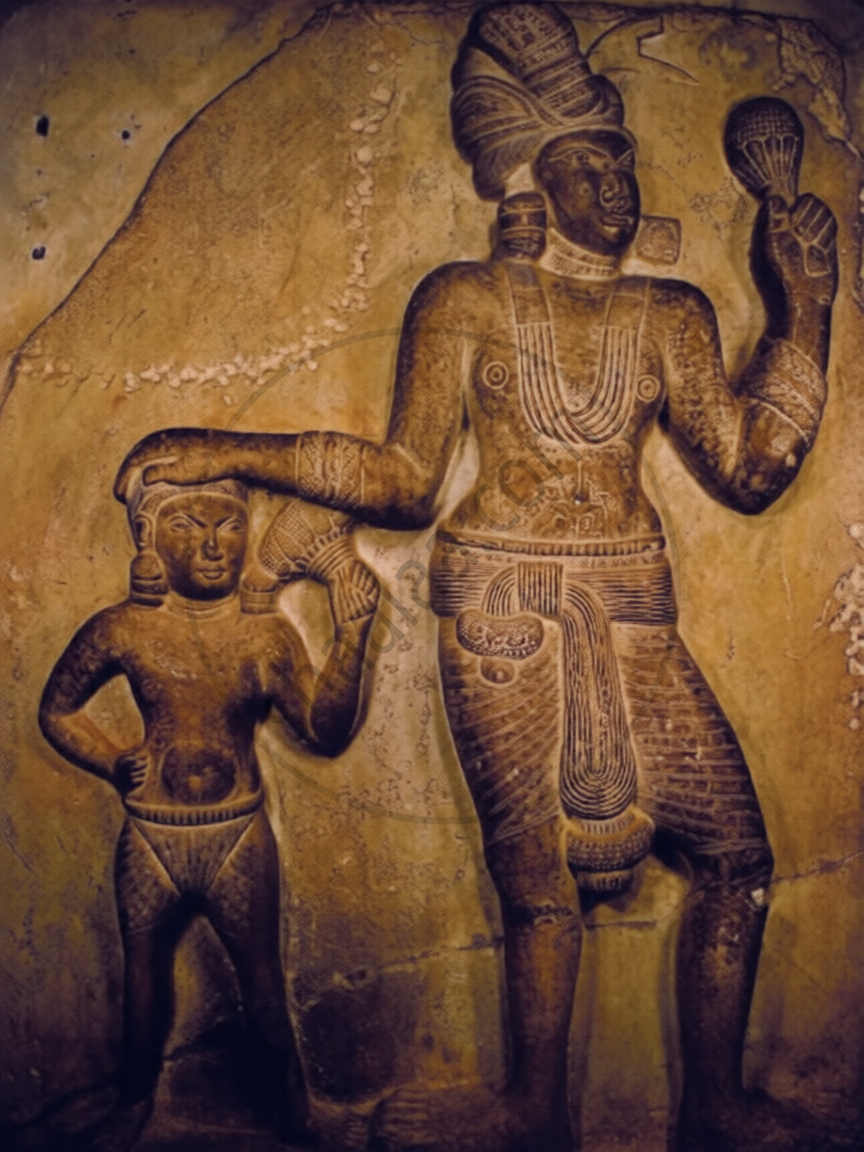
How has the sculptor shown the difference between the chief and his follower?
|
This is how the city is described in the Adi Parvan of the Mahabharata: The city, bursting like the ocean, packed with hundreds of mansions, displayed with its gateways, arches and turrets like massing clouds the splendour of Great Indra’s city. |
Do you think Lal’s finds match the description of Hastinapura in the epic?
|
Drupada, the king of Panchala, organised a competition where the challenge was to string a bow and hit a target; the winner would be chosen to marry his daughter Draupadi. Arjuna was victorious and was garlanded by Draupadi. The Pandavas returned with her to their mother Kunti, who, even before she saw them, asked them to share whatever they had got. She realised her mistake when she saw Draupadi, but her command could not be violated. After much deliberation, Yudhisthira decided that Draupadi would be their common wife. When Drupada was told about this, he protested. However, the seer Vyasa arrived and told him that the Pandavas were in reality incarnations of Indra, whose wife had been reborn as Draupadi, and they were thus destined for each other. Vyasa added that in another instance a young woman had prayed to Shiva for a husband, and in her enthusiasm, had prayed five times instead of once. This woman was now reborn as Draupadi, and Shiva had fulfilled her prayers. Convinced by these stories, Drupada consented to the marriage. |
Why do you think the author(s) offered three explanations for a single episode?
Discuss
Read the excerpts from the Mahabharata included in “Kinship, Caste And Class: Early Societies” once more. For each of these, discuss whether they could have been literally true. What do these excerpts tell us about those who composed the text? What do they tell us about those who must have read or heard the epic?
NCERT solutions for थीम्स इन इंडियन हिस्ट्री पार्ट I, II, एण्ड III [अंग्रेजी] कक्षा १२ 3 Kinship, Caste And Class: Early Societies Exercises [Pages 80 - 81]
Answer in 100-150 words
Explain why patriliny may have been particularly important among elite families.
Answer in 100-150 words
Discuss whether kings in early states invariably were Kshatriyas.
Answer in 100-150 words
Compare and contrast the dharma or norms mentioned in the stories of Drona, Hidimba and Matanga.
Answer in 100-150 words
In what ways was the Buddhist theory of a social contract different from the Brahmanical view of society derived from the Purusha Sukta?
Answer in 100-150 words
The following is an excerpt from the Mahabharata in which Yudhisthira, the eldest Jandava, speaks to Sanjaya, a messenger:
Sanjaya, convey my respectful greetings to all the Brahmanas and the chief priest of the house of Dhritarashtra. I bow respectfully to teacher Drona … I hold the feet of our preceptor Kripa … (and) the chief of the Kurus, the great Bhishma. I bow respectfully to the old king (Dhritarashtra). I greet and ask after the health of his son Duryodhana and his younger brother ... Also greet all the young Kuru warriors who are our brothers, sons and grandsons … Greet above all him, who is to us like father and mother, the wise Vidura (born of a slave woman) ... I bow to the elderly ladies who are known as our mothers. To those who are our wives you say this, “I hope they are well-protected”… Our daughters-inlaw born of good families and mothers of children greet on my behalf. Embrace for me those who are our daughters … The beautiful, fragrant, well-dressed courtesans of ours you should also greet. Greet the slave women and their children, greet the aged, the maimed (and) the helpless …
Try and identify the criteria used to make this list – in terms of age, gender, kinship ties. Are there any other criteria? For each category, explain why they are placed in a particular position in the list.
Write a short essay (about 500 words) on the following:
This is what a famous historian of Indian literature, Maurice Wintemitz, wrote about the Mahabharata: “Just because the Mahabharata represents more of an entire literature…. and contains so many kinds of things….(it) give(s) us an insight into the most profound depths of the soul of the Indian folk.” Discuss.
Write a short essay (about 500 words) on the following:
Discuss whether the Mahabharata could have been the work of a single author.
Write a short essay (about 500 words) on the following:
How important were gender differences in early societies? Give reasons for your answer.
Write a short essay (about 500 words) on the following:
Discuss the evidence tliat suggests that Brahmanical prescriptions about kinship and F marriage were not universally followed.
Map work
Compare the map in this chapter with Map 1 in Chapter 2. List the mahajanapadas and cities located near the Kuru-Panchala lands.
Map 1 of Chapter 2(Kings, Farmers and Towns)

Map 1 of Chapter 3(Kinship, Caste and Class)

Find out about retellings of the Mahabharata in other languages. Discuss how they handle any two of the episodes of the text described in “Kinship, Caste And Class: Early Societies,” explaining any similarities or differences that you notice.
Imagine that you are an author and rewrite the story of Ekalavya from a perspective of your choice.
Solutions for 3: Kinship, Caste And Class: Early Societies
NCERT solutions for थीम्स इन इंडियन हिस्ट्री पार्ट I, II, एण्ड III [अंग्रेजी] कक्षा १२ chapter 3 - Kinship, Caste And Class: Early Societies
Shaalaa.com has the CBSE Mathematics थीम्स इन इंडियन हिस्ट्री पार्ट I, II, एण्ड III [अंग्रेजी] कक्षा १२ CBSE solutions in a manner that help students grasp basic concepts better and faster. The detailed, step-by-step solutions will help you understand the concepts better and clarify any confusion. NCERT solutions for Mathematics थीम्स इन इंडियन हिस्ट्री पार्ट I, II, एण्ड III [अंग्रेजी] कक्षा १२ CBSE 3 (Kinship, Caste And Class: Early Societies) include all questions with answers and detailed explanations. This will clear students' doubts about questions and improve their application skills while preparing for board exams.
Further, we at Shaalaa.com provide such solutions so students can prepare for written exams. NCERT textbook solutions can be a core help for self-study and provide excellent self-help guidance for students.
Concepts covered in थीम्स इन इंडियन हिस्ट्री पार्ट I, II, एण्ड III [अंग्रेजी] कक्षा १२ chapter 3 Kinship, Caste And Class: Early Societies are The Critical Edition of the Mahabharata, Kinship and Marriage: Many Rules and Varied Practices, Social Differences: Within and Beyond the Framework of Caste, Beyond Birth Resources and Status, Explaining Social Differences: a Social Contract, Handling Texts Historians and the Mahabharata, A Dynamic Text, Overview of Kinship, Caste and Class, Overview of Kinship, Caste and Class.
Using NCERT थीम्स इन इंडियन हिस्ट्री पार्ट I, II, एण्ड III [अंग्रेजी] कक्षा १२ solutions Kinship, Caste And Class: Early Societies exercise by students is an easy way to prepare for the exams, as they involve solutions arranged chapter-wise and also page-wise. The questions involved in NCERT Solutions are essential questions that can be asked in the final exam. Maximum CBSE थीम्स इन इंडियन हिस्ट्री पार्ट I, II, एण्ड III [अंग्रेजी] कक्षा १२ students prefer NCERT Textbook Solutions to score more in exams.
Get the free view of Chapter 3, Kinship, Caste And Class: Early Societies थीम्स इन इंडियन हिस्ट्री पार्ट I, II, एण्ड III [अंग्रेजी] कक्षा १२ additional questions for Mathematics थीम्स इन इंडियन हिस्ट्री पार्ट I, II, एण्ड III [अंग्रेजी] कक्षा १२ CBSE, and you can use Shaalaa.com to keep it handy for your exam preparation.
