Advertisements
Chapters
1: World Geography: Some Glimpses
Theme B - Tapestry of the Past
2: India’s Long Road to Independence
Theme C - Our Cultural Heritage and Knowledge Traditions
3: A Journey Through Indian Architecture
Theme D - Governance and Democracy
4: The Role of the Judiciary in Our Society
5: Citizenship: Rights and Duties
Theme E - Economic Life Around Us
6: Dynamics of Population
7: India’s Urban Landscape
▶ 8: Cultural Currents: 13th to 17th Centuries
![NCERT solutions for सोशल साइंस एक्सपलोरींग सोसाइटी इंडिया एण्ड बिऑन्ड पार्ट २ [अंग्रेजी] कक्षा ८ chapter 8 - Cultural Currents: 13th to 17th Centuries - Shaalaa.com](/images/social-science-exploring-society-india-and-beyond-part-2-english-class-8_6:d01fdcd1fdf244fc869f361ef89f5af3.png "NCERT solutions for सोशल साइंस एक्सपलोरींग सोसाइटी इंडिया एण्ड बिऑन्ड पार्ट २ [अंग्रेजी] कक्षा ८ chapter 8 - Cultural Currents: 13th to 17th Centuries")
Advertisements
Solutions for Chapter 8: Cultural Currents: 13th to 17th Centuries
Below listed, you can find solutions for Chapter 8 of CBSE NCERT for सोशल साइंस एक्सपलोरींग सोसाइटी इंडिया एण्ड बिऑन्ड पार्ट २ [अंग्रेजी] कक्षा ८.
NCERT solutions for सोशल साइंस एक्सपलोरींग सोसाइटी इंडिया एण्ड बिऑन्ड पार्ट २ [अंग्रेजी] कक्षा ८ 8 Cultural Currents: 13th to 17th Centuries Intext Questions [Pages 215 - 247]
How did Indian culture endure and continue to grow richer during this period despite invasions and an unstable political context?
What were the major cultural trends and movements of the time?
How did the various cultural currents of this period interact and mingle?
LET’S EXPLORE
ābā phir kāsī bhayā, Ram bhayā re Rahīm
moṭ chūn maida bhayā baiṭhi Kabīrā jīm
When wheat is ground into flour, all distinctions between individual grains disappear; they become one substance. Similarly, when one realises the divine, all differences between Ram and Rahim dissolve.
For Kabir, once everything becomes one (like flour), he peacefully “sits to eat”. What is the message of this dohā or couplet?
Why do you think music and dance played a significant role in spreading the message of bhakti?
DON’T MISS OUT
Note that some of the paintings you see here were created almost two centuries after the lives of the sants, indicating that their influence continued much longer. In fact, the bhajans composed during that time continue to be sung today. Observe that the bhakti saints were often accompanied by musical instruments.
LET’S EXPLORE
What are the traditions of story-telling in your region? Explore, with your teachers and parents, the possibility of inviting practitioners to your school for a talk and demonstration.
DON’T MISS OUT
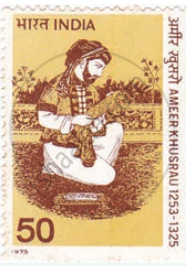
Amīr Khusro (also spelt Amīr Khusrau) was an Indo-Persian Sufi poet and singer who lived from the mid-13th century to the early 14th century. He is credited with developing the qawwālī, a form of Sufi devotional song fusing Indian, Persian, and Arabic singing traditions.
LET’S EXPLORE
Observe all the miniature paintings featured here. What are the similarities you notice? What are the features that have changed, and which have been retained?
Observe all the miniature paintings featured here. What are the differences you notice? What are the features that have changed, and which have been retained?
Take up a group project. Identify the local forms of art and craft in your area. Are they being continued? How are the knowledge and skills in these being transferred from generation to generation?
LET’S REMEMBER
Recall the names of other women from history that you have met so far who went against the grain. What was their motivation?
LET’S EXPLORE
From the chronicle of the Portuguese traveller to India, Fernão Nunes, who visited the Vijayanagar Empire: “He [the King] has also women who wrestle, and others who are astrologers and soothsayers; and he has women who write all the accounts of expenses that are incurred inside the gates, and others whose duty it is to write all the affairs of the kingdom and compare their books with those of the writers outside; he has women also for music, who play instruments and sing.”
What are the different vocations women were involved in as a part of the King’s staff?
What conclusions can we draw from such acts about the economic and social status of these women?
Imagine that you are a historian in the 22nd century looking at the lives and status of girls and women in 21st-century society. What are the different aspects you would write about? Exchange your thoughts with your classmates. How similar or different are they?
DON’T MISS OUT
In the case of Vijayanagara, the rulers were guided by pūrvamaryade, a Kannada word meaning ‘following previously established practices of dharma and social norms’. Hence, support for institutions such as temples and mathās enabled education to continue.
THINK ABOUT IT
What impact do you think the destruction of major universities like Nālandā and Vikramaśhilā had on the development of education and knowledge in India and around the world?
DON’T MISS OUT
The Banarasi saris have a Geographical Indication (GI) tag that gives the weavers of the area rights over the knowledge they hold, and restriction on who can call their saris ‘Banarasi’. Brocades from only some districts can be called ‘Banarasi’.
LET’S EXPLORE
Over this period loan words from Persian also began to enter regional languages and literature. Today we can hardly identify them as having Persian roots. Create a list of words in your regional language that might have Persian roots. You may be surprised by your findings!
Make a list of popular dishes in your region. Explore their origins and discover various cross-cultural influences.
What are your observations about continuity and change in clothing styles today? What might be the reasons for the changes we see?
NCERT solutions for सोशल साइंस एक्सपलोरींग सोसाइटी इंडिया एण्ड बिऑन्ड पार्ट २ [अंग्रेजी] कक्षा ८ 8 Cultural Currents: 13th to 17th Centuries Questions and activities [Pages 248 - 249]
What is the path to mokṣha that became popular in the period from the 13th to 17th centuries?
Name three bhakti saints from different regions of India and identify the key messages they promoted.
Kabir’s doha compares wheat being ground into flour with the unity of Ram and Rahim. Why do you think he used this everyday example?
The chapter mentions that while major universities like Nalanda were destroyed, education continued through decentralised systems like gurukulas, temple schools, and apprenticeships. What advantages might these smaller, local systems have had in surviving political turmoil?
Women’s roles changed differently across regions during this period. What factors mentioned in the chapter might explain why the same historical events affected women differently in different regions?
The chapter describes how Indian culture sometimes “adopted or adapted” external influences. Why do you think adaptation (changing something to fit local tastes) might be more successful for cultural survival than simply copying or completely rejecting new ideas?
What are some examples of cultural interactions that led to the creation of new art forms?
Research one bhakti or Sufi saint mentioned in the chapter (Kabir, Mirabai, Ravidas, Tukaram, Chishti or others). Find one of their poems or bhajans in translation, and prepare a three-minute presentation where you:
- Share the poem/song,
- Explain its main message,
- Describe why it might have appealed to common people during that time, and
- Discuss whether its message is still relevant today.
Choose one aspect of culture from the chapter (architecture, clothing, food, music, education, or gardens) and create a group project to study how it appears in your region. Try to enquire into:
What has changed and what has remained the same over time?
What are your thoughts on why certain elements continued while others changed?
You can present your report in any form as an illustrated report, or digital presentation, or in any other creative way.
Solutions for 8: Cultural Currents: 13th to 17th Centuries
NCERT solutions for सोशल साइंस एक्सपलोरींग सोसाइटी इंडिया एण्ड बिऑन्ड पार्ट २ [अंग्रेजी] कक्षा ८ chapter 8 - Cultural Currents: 13th to 17th Centuries
Shaalaa.com has the CBSE Mathematics सोशल साइंस एक्सपलोरींग सोसाइटी इंडिया एण्ड बिऑन्ड पार्ट २ [अंग्रेजी] कक्षा ८ CBSE solutions in a manner that help students grasp basic concepts better and faster. The detailed, step-by-step solutions will help you understand the concepts better and clarify any confusion. NCERT solutions for Mathematics सोशल साइंस एक्सपलोरींग सोसाइटी इंडिया एण्ड बिऑन्ड पार्ट २ [अंग्रेजी] कक्षा ८ CBSE 8 (Cultural Currents: 13th to 17th Centuries) include all questions with answers and detailed explanations. This will clear students' doubts about questions and improve their application skills while preparing for board exams.
Further, we at Shaalaa.com provide such solutions so students can prepare for written exams. NCERT textbook solutions can be a core help for self-study and provide excellent self-help guidance for students.
Concepts covered in सोशल साइंस एक्सपलोरींग सोसाइटी इंडिया एण्ड बिऑन्ड पार्ट २ [अंग्रेजी] कक्षा ८ chapter 8 Cultural Currents: 13th to 17th Centuries are .
Using NCERT सोशल साइंस एक्सपलोरींग सोसाइटी इंडिया एण्ड बिऑन्ड पार्ट २ [अंग्रेजी] कक्षा ८ solutions Cultural Currents: 13th to 17th Centuries exercise by students is an easy way to prepare for the exams, as they involve solutions arranged chapter-wise and also page-wise. The questions involved in NCERT Solutions are essential questions that can be asked in the final exam. Maximum CBSE सोशल साइंस एक्सपलोरींग सोसाइटी इंडिया एण्ड बिऑन्ड पार्ट २ [अंग्रेजी] कक्षा ८ students prefer NCERT Textbook Solutions to score more in exams.
Get the free view of Chapter 8, Cultural Currents: 13th to 17th Centuries सोशल साइंस एक्सपलोरींग सोसाइटी इंडिया एण्ड बिऑन्ड पार्ट २ [अंग्रेजी] कक्षा ८ additional questions for Mathematics सोशल साइंस एक्सपलोरींग सोसाइटी इंडिया एण्ड बिऑन्ड पार्ट २ [अंग्रेजी] कक्षा ८ CBSE, and you can use Shaalaa.com to keep it handy for your exam preparation.
