Advertisements
Chapters
1: Natural Resources and Their Use
Theme B - Tapestry of the Past
2: Reshaping India’s Political Map
3: The Rise of the Marathas
▶ 4: The Colonial Era in India
Theme D - Governance and Democracy
5: Universal Franchise and India’s Electoral System
6: The Parliamentary System: Legislature and Executive
Theme E - Economic Life Around Us
7: Factors of Production
![NCERT solutions for सोशल साइंस एक्सपलोरींग सोसाइटी इंडिया एण्ड बिऑन्ड पार्ट १ [अंग्रेजी] कक्षा ८ chapter 4 - The Colonial Era in India - Shaalaa.com](/images/social-science-exploring-society-india-and-beyond-part-1-english-class-8_6:3e627fd65b524f34acf9d20b9e3e4ded.jpg "NCERT solutions for सोशल साइंस एक्सपलोरींग सोसाइटी इंडिया एण्ड बिऑन्ड पार्ट १ [अंग्रेजी] कक्षा ८ chapter 4 - The Colonial Era in India")
Advertisements
Solutions for Chapter 4: The Colonial Era in India
Below listed, you can find solutions for Chapter 4 of CBSE NCERT for सोशल साइंस एक्सपलोरींग सोसाइटी इंडिया एण्ड बिऑन्ड पार्ट १ [अंग्रेजी] कक्षा ८.
NCERT solutions for सोशल साइंस एक्सपलोरींग सोसाइटी इंडिया एण्ड बिऑन्ड पार्ट १ [अंग्रेजी] कक्षा ८ 4 The Colonial Era in India Intext Questions [Pages 83 - 112]
The Big Questions
What is meant by colonialism?
What drew European powers to India?
What was India’s economic standing before and during the colonial period?
What was India’s geopolitical standing before and during the colonial period?
How did the British colonial domination of India impact the country?
LET’S EXPLORE
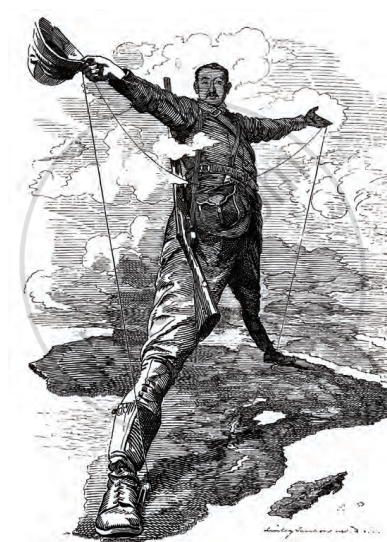
What do you think the cartoon Fig. is trying to express? (Keep in mind that the telegraph, which permitted instant communications for the first time, was then a recent invention.) Analyse different elements of the drawing.
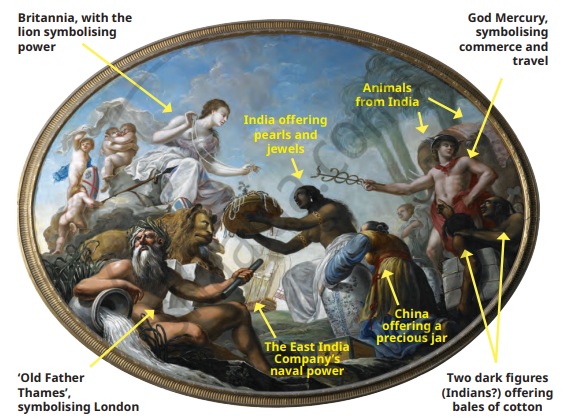
Before you read further, have a good look at the painting on the first page of this chapter. It was specially ordered for the London headquarters of the East India Company and is over three metres long. Observe every aspect of it the people in it, the objects, the symbols and the attitudes. Form groups of four or five students and let each group present its conclusions as regards the messages the painting conveys.
(You will find our answers a few pages down when we return to the painting, but avoid looking at them right now!)
Why do you think Dadabhai Naoroji means by ‘un-British rule in India’? (Hint: he was an MP in the House of Commons in 1892.)
THINK ABOUT IT
Let us return to this painting, Fig., but now with some clues to its symbolism. Note how Britannia (a symbolic figure for Britain) sits higher than the colonies, pointing to her superior power; contrast with the lower position and bent posture of the colonies. Did they really ‘offer’ their wealth? Or did Britain seize it by force or ruse? Note also the Indians’ dark complexion (in contrast with that of Britannia), reflecting the belief in the superiority of white people over the dark-skinned ‘natives’.
LET’S EXPLORE
Do you understand all the terms used above to list and describe Indian textiles? If not, form groups of four or five and try to find out more, then compare your findings with the help of your teacher.
THINK ABOUT IT
What exactly did Macaulay mean when he wrote that “a single shelf of a good European library was worth the whole native literature of India and Arabia”? And why should he want to make Indians “English in taste, in opinions, in morals, and in intellect”? How does this relate to the ‘civilising mission’ mentioned at the start of the chapter? Ask your teacher to guide a class debate on these questions.
What is meant by “the sun never sets on the British Empire”? Do you think this was a correct statement?
LET’S EXPLORE
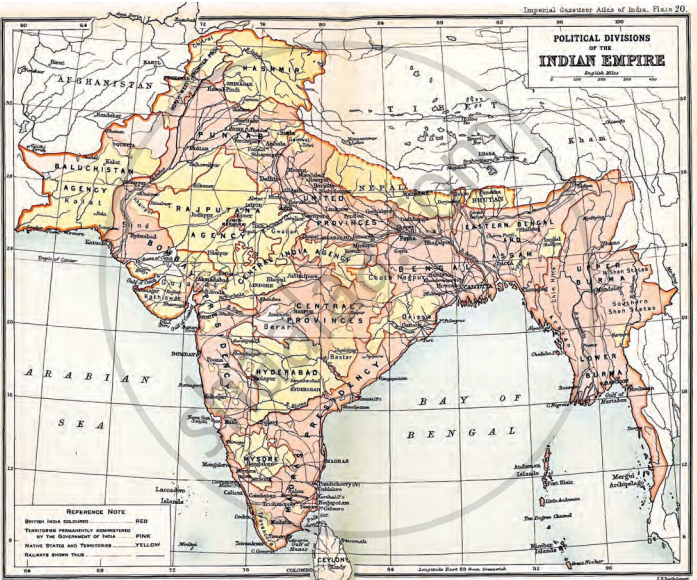
Examine the map. What are the main differences with the map of today’s India, in terms both of borders and of names?
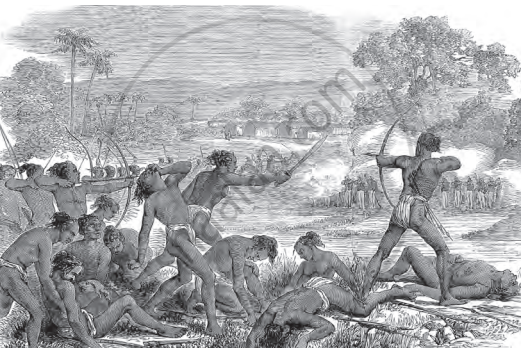
Note how the Santhals are depicted in the 1856 sketch Fig. drawn from an artist’s imagination: observe their complexion, dress, weapons and draw your conclusions as regards the image this depiction would create in the popular mind in Britain.
Indigo is a natural deep blue pigment used in dyeing. Can you think of other natural substances that have been traditionally used in India to dye cloth?
Why do you think was the term ‘Sepoy Mutiny’ rejected after Indian Independence? Write one paragraph explaining your reasons.
In the sentence “It opened (or re-opened) India to the world and the world to India”, why do you think we added ‘re-opened’?
Some argue that stolen cultural heritage has been better preserved abroad than it would have been in India. What is your view on its repatriation? Discuss in groups.
NCERT solutions for सोशल साइंस एक्सपलोरींग सोसाइटी इंडिया एण्ड बिऑन्ड पार्ट १ [अंग्रेजी] कक्षा ८ 4 The Colonial Era in India Questions and activities [Pages 114 - 115]
What is meant by colonialism?
Give three different definitions based on the chapter or on your knowledge.
Colonial rulers often claimed that their mission was to ‘civilise’ the people they ruled. Based on the evidence in this chapter, do you think this was true in the case of India? Why or why not?
How was the British approach to colonising India different from earlier European powers like the Portuguese or the French?
“Indians funded their own subjugation.” What does this mean in the context of British infrastructure projects in India like the railway and telegraph networks?
What does the phrase ‘divide and rule’ mean? Give examples of how this was used by the British in India?
Area of Indian life: agriculture. How was it affected by colonial rule? Can you find any signs of those changes still with us today? Express your ideas through a short essay, a poem, a drawing, or a painting.
Area of Indian life: education. How was it affected by colonial rule? Can you find any signs of those changes still with us today? Express your ideas through a short essay, a poem, a drawing, or a painting.
Area of Indian life: trade. How was it affected by colonial rule? Can you find any signs of those changes still with us today? Express your ideas through a short essay, a poem, a drawing, or a painting.
Area of Indian life: village life. How was it affected by colonial rule? Can you find any signs of those changes still with us today? Express your ideas through a short essay, a poem, a drawing, or a painting.
Imagine you are a reporter in 1857. Write a brief news report on Rani Lakshmibai’s resistance at Jhansi. Include a timeline or storyboard showing how the rebellion began, spread, and ended, highlighting key events and leaders.
Imagine an alternate history where India was never colonised by European powers. Write a short story of about 300 words exploring how India might have developed on its own path.
Role-play: Enact a historical discussion between a British official and an Indian personality like Dadabhai Naoroji on the British colonial rule in India.
Explore a local resistance movement (tribal, peasant, or princely) from your state or region during the colonial period. Prepare a report or poster describing:
- What was the specific trigger, if any?
- Who led the movement?
- What were their demands?
- How did the British respond?
- How is this event remembered today (e.g., local festivals, songs, monuments)?
Solutions for 4: The Colonial Era in India
NCERT solutions for सोशल साइंस एक्सपलोरींग सोसाइटी इंडिया एण्ड बिऑन्ड पार्ट १ [अंग्रेजी] कक्षा ८ chapter 4 - The Colonial Era in India
Shaalaa.com has the CBSE Mathematics सोशल साइंस एक्सपलोरींग सोसाइटी इंडिया एण्ड बिऑन्ड पार्ट १ [अंग्रेजी] कक्षा ८ CBSE solutions in a manner that help students grasp basic concepts better and faster. The detailed, step-by-step solutions will help you understand the concepts better and clarify any confusion. NCERT solutions for Mathematics सोशल साइंस एक्सपलोरींग सोसाइटी इंडिया एण्ड बिऑन्ड पार्ट १ [अंग्रेजी] कक्षा ८ CBSE 4 (The Colonial Era in India) include all questions with answers and detailed explanations. This will clear students' doubts about questions and improve their application skills while preparing for board exams.
Further, we at Shaalaa.com provide such solutions so students can prepare for written exams. NCERT textbook solutions can be a core help for self-study and provide excellent self-help guidance for students.
Concepts covered in सोशल साइंस एक्सपलोरींग सोसाइटी इंडिया एण्ड बिऑन्ड पार्ट १ [अंग्रेजी] कक्षा ८ chapter 4 The Colonial Era in India are .
Using NCERT सोशल साइंस एक्सपलोरींग सोसाइटी इंडिया एण्ड बिऑन्ड पार्ट १ [अंग्रेजी] कक्षा ८ solutions The Colonial Era in India exercise by students is an easy way to prepare for the exams, as they involve solutions arranged chapter-wise and also page-wise. The questions involved in NCERT Solutions are essential questions that can be asked in the final exam. Maximum CBSE सोशल साइंस एक्सपलोरींग सोसाइटी इंडिया एण्ड बिऑन्ड पार्ट १ [अंग्रेजी] कक्षा ८ students prefer NCERT Textbook Solutions to score more in exams.
Get the free view of Chapter 4, The Colonial Era in India सोशल साइंस एक्सपलोरींग सोसाइटी इंडिया एण्ड बिऑन्ड पार्ट १ [अंग्रेजी] कक्षा ८ additional questions for Mathematics सोशल साइंस एक्सपलोरींग सोसाइटी इंडिया एण्ड बिऑन्ड पार्ट १ [अंग्रेजी] कक्षा ८ CBSE, and you can use Shaalaa.com to keep it handy for your exam preparation.
