Advertisements
Chapters
▶ 1: Natural Resources and Their Use
Theme B - Tapestry of the Past
2: Reshaping India’s Political Map
3: The Rise of the Marathas
4: The Colonial Era in India
Theme D - Governance and Democracy
5: Universal Franchise and India’s Electoral System
6: The Parliamentary System: Legislature and Executive
Theme E - Economic Life Around Us
7: Factors of Production
![NCERT solutions for सोशल साइंस एक्सपलोरींग सोसाइटी इंडिया एण्ड बिऑन्ड पार्ट १ [अंग्रेजी] कक्षा ८ chapter 1 - Natural Resources and Their Use - Shaalaa.com](/images/social-science-exploring-society-india-and-beyond-part-1-english-class-8_6:3e627fd65b524f34acf9d20b9e3e4ded.jpg "NCERT solutions for सोशल साइंस एक्सपलोरींग सोसाइटी इंडिया एण्ड बिऑन्ड पार्ट १ [अंग्रेजी] कक्षा ८ chapter 1 - Natural Resources and Their Use")
Advertisements
Solutions for Chapter 1: Natural Resources and Their Use
Below listed, you can find solutions for Chapter 1 of CBSE NCERT for सोशल साइंस एक्सपलोरींग सोसाइटी इंडिया एण्ड बिऑन्ड पार्ट १ [अंग्रेजी] कक्षा ८.
NCERT solutions for सोशल साइंस एक्सपलोरींग सोसाइटी इंडिया एण्ड बिऑन्ड पार्ट १ [अंग्रेजी] कक्षा ८ 1 Natural Resources and Their Use Intext Questions [Pages 2 - 11]
The Big Questions
How do we categorise natural resources?
What is the connection between the distribution of natural resources and different aspects of life?
What are the implications of unsustainable use/overexploitation of natural resources?
DON’T MISS OUT
In many indigenous traditions of the world, Nature is considered sacred. You have read about this. In such traditions, Nature is a nurturer and nourisher.
Do you know of practices that reflect this?
THINK ABOUT IT
Take a pause. Look at yourself and the things around you. What is the origin of each of them? At some point they all lead to Nature; even the plastic button on your shirt.
What might be the different criteria we can use to categorise natural resources?
DON’T MISS OUT
Traditionally, communities had a system of regulating (or refraining from) fishing during the spawning season to enable the maintenance of the fish population. However, the commercialisation of fishing resulted in over-fishing. In the case of a type of fish called tuna, for example, the rapid and extensive decline in their population led to some agreements on control of fishing. Nevertheless, this important type of fish that keeps the ocean ecosystem in balance by consuming smaller fish, shrimps, etc., is on a decline.
Do you know of other traditional practices that help the ecosystem to stay in balance?
Identify human actions in your surroundings that result in Nature losing her ability to restore and regenerate.
What types of interventions can be undertaken to restore nature's cycle?
LET’S EXPLORE
Take up a small research study to assess the types of renewable resources in your region; you may discuss with your teacher the geographical area of your study and sources to access information that you may need. What has been the change in their status over time? Make a small report that identifies the reasons for the change and what may be done.
What are the non-renewable resources that you use daily, directly or indirectly?
What are the possible renewable substitutes?
What are some of the steps we can take to transition to renewables?
Observe the map in Fig. Notice the uneven distribution of important minerals. What types of resources are available in your region? How are they distributed?
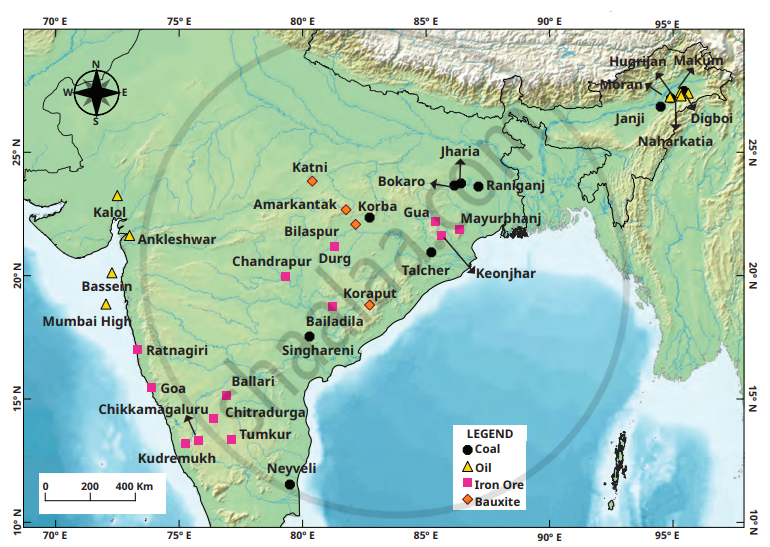
Select any two natural resources. Gather information about their availability across different parts of India. Mark them on a map. What do you observe about their distribution? What are the types of economic activities connected with them?
Discuss the implications of extracting the natural resources in those parts for current and future generations. Suggest ways in which we can use Nature’s gifts in responsible ways.
Find out about such a conflict in the international context. Discuss your findings in the class.
What do you think are the different inputs required to enable the use of the natural resources available in different geographical areas?
NCERT solutions for सोशल साइंस एक्सपलोरींग सोसाइटी इंडिया एण्ड बिऑन्ड पार्ट १ [अंग्रेजी] कक्षा ८ 1 Natural Resources and Their Use Questions and activities [Page 19]
What can make what is today a renewable resource nonrenewable tomorrow? Describe some actions that can prevent this from happening.
Name five ecosystem functions that serve humans
What are renewable resources?
How are renewable resources different from non-renewable resources?
How can we ensure renewable resources remain available? Give two examples.
Identify cultural practices in your home and neighbourhood that point to mindfulness in the use of natural resources.
What are some considerations to keep in mind in the production of goods for our current use?
Solutions for 1: Natural Resources and Their Use
NCERT solutions for सोशल साइंस एक्सपलोरींग सोसाइटी इंडिया एण्ड बिऑन्ड पार्ट १ [अंग्रेजी] कक्षा ८ chapter 1 - Natural Resources and Their Use
Shaalaa.com has the CBSE Mathematics सोशल साइंस एक्सपलोरींग सोसाइटी इंडिया एण्ड बिऑन्ड पार्ट १ [अंग्रेजी] कक्षा ८ CBSE solutions in a manner that help students grasp basic concepts better and faster. The detailed, step-by-step solutions will help you understand the concepts better and clarify any confusion. NCERT solutions for Mathematics सोशल साइंस एक्सपलोरींग सोसाइटी इंडिया एण्ड बिऑन्ड पार्ट १ [अंग्रेजी] कक्षा ८ CBSE 1 (Natural Resources and Their Use) include all questions with answers and detailed explanations. This will clear students' doubts about questions and improve their application skills while preparing for board exams.
Further, we at Shaalaa.com provide such solutions so students can prepare for written exams. NCERT textbook solutions can be a core help for self-study and provide excellent self-help guidance for students.
Concepts covered in सोशल साइंस एक्सपलोरींग सोसाइटी इंडिया एण्ड बिऑन्ड पार्ट १ [अंग्रेजी] कक्षा ८ chapter 1 Natural Resources and Their Use are .
Using NCERT सोशल साइंस एक्सपलोरींग सोसाइटी इंडिया एण्ड बिऑन्ड पार्ट १ [अंग्रेजी] कक्षा ८ solutions Natural Resources and Their Use exercise by students is an easy way to prepare for the exams, as they involve solutions arranged chapter-wise and also page-wise. The questions involved in NCERT Solutions are essential questions that can be asked in the final exam. Maximum CBSE सोशल साइंस एक्सपलोरींग सोसाइटी इंडिया एण्ड बिऑन्ड पार्ट १ [अंग्रेजी] कक्षा ८ students prefer NCERT Textbook Solutions to score more in exams.
Get the free view of Chapter 1, Natural Resources and Their Use सोशल साइंस एक्सपलोरींग सोसाइटी इंडिया एण्ड बिऑन्ड पार्ट १ [अंग्रेजी] कक्षा ८ additional questions for Mathematics सोशल साइंस एक्सपलोरींग सोसाइटी इंडिया एण्ड बिऑन्ड पार्ट १ [अंग्रेजी] कक्षा ८ CBSE, and you can use Shaalaa.com to keep it handy for your exam preparation.
