Advertisements
Chapters
1: Interpretation of Topographical Maps
2: Contours
3: Scales and Direction
4: Map Reading and Interpretation
5: Map of India
PART II - GEOGRAPHY OF INDIA
6: Location, Extent and Physical Features
7: Climate
8: Soil Resources
9: Natural Vegetation
10: Water Resources
11: Mineral Resources
▶ 12: Conventional Sources of Energy
13: Non-Conventional Sources of Energy
14: Agriculture - I
15: Agriculture - II: Food Crops
16: Agriculture - III: Cash Crops (1)
17: Agriculture - IV: Cash Crops (2)
18: Manufacturing Industries (Agro-Based)
19: Mineral Based Industry
20: Transport
Chapter 21: Waste Management - I: Impact of Waste Accumulation
Chapter 22: Waste Management - II: Safe Disposal of Waste
![Morning Star solutions for टोटल जियोग्राफी [अंग्रेजी] कक्षा १० आईसीएसई chapter 12 - Conventional Sources of Energy - Shaalaa.com](/images/total-geography-english-class-10-icse_6:9033996325ef4d37a61a084b4444e2b2.jpg "Morning Star solutions for टोटल जियोग्राफी [अंग्रेजी] कक्षा १० आईसीएसई chapter 12 - Conventional Sources of Energy")
Advertisements
Solutions for Chapter 12: Conventional Sources of Energy
Below listed, you can find solutions for Chapter 12 of CISCE Morning Star for टोटल जियोग्राफी [अंग्रेजी] कक्षा १० आईसीएसई.
Morning Star solutions for टोटल जियोग्राफी [अंग्रेजी] कक्षा १० आईसीएसई 12 Conventional Sources of Energy EXERCISES [Pages 151 - 154]
Choose the correct option:
Which types of resources of energy are coal, petroleum and natural gas?
conventional sources
non-renewable sources
non-conventional sources
Both conventional sources and non-renewable sources
______ coal has ______ per cent of carbon content and is the most preferred variety of coal.
Lignite, 40
Peat, 50
Anthracite, 90
Bituminous, 80
Bituminous coal is also known as ______.
coking coal
Peat
Steam oven
Gas stove
Assertion (A): Natural gas is an eco-friendly fuel.
Reason (R): It is lighter than air and tends to dissipate in case of leakage.
Both A and R are true and R is the correct explanation of A.
Both A and R are true but R does not explain A.
A is true but R is false.
A is false but R is true.
Anthracite is ideal for domestic use as it is ______.
smokeless
high calorific value
high carbon content
All of them
Name the brown low grade coal.
Peat
Lignite
Anthracite
Bituminous
______ is the oldest coalfield in India.
Raniganj
Jharia
Korba
Singrauli
Gondwana coal has variable quantities of ______.
Low moisture
Small sulphur
Small variable quantity of phosphorus
All of the above
Assertion (A): Hydel power is the cheapest form of renewable energy.
Reason (R): Once the project is operational it does not produce waste or green house gases.
Both A and R are true and R is the correct explanation of A.
Both A and R are true but R does not explain A.
A is true but R is false.
A is false but R is true.
The Neyveli Lignite coal field in ______ is the largest lignite deposit field in South India.
Andhra Pradesh
Telangana
Puducherry
Tamil Nadu
The liquid petroleum is called ______.
Crude oil
Liquid oil
Natural gas
Natural oil
Light distillates : gasoline : : middle distillates : ______.
diesel
Lubricating oils
naphtha
LPG
Petroleum is used ______.
as a fuel
as raw material
for power generation
All of the above
Name the main component of LPG.
Methane
Butane
Propane
Ethane
Countries are phasing out fossil-fuel based energy sources because ______.
they contribute to increase in green house gases.
they are non-renewable.
they are expensive.
All of the above.
You see this sticker on the front windshield of a car. What does it mean?

The car is a commercial vehicle.
The car uses Compressed Natural Gas as fuel.
The car is not fuel efficient.
The car uses Cooled Nitrogen Gas as fuel.
Answer the following questions:
What is meant by conventional sources of energy?
Name any two conventional sources of energy.
Name two main coal bearing areas in India.
Give geographical reasons for the following:
Anthracite is used for domestic purposes.
Give geographical reasons for the following:
Oil refineries are located close to oil fields or near ports.
Give geographical reasons for the following:
The location of coal fields is an important factor in industrial development.
Name the varieties of coal found in India. Give a characteristic of each type of coal.
How is Gondwana coalfield different from tertiary coalfield in terms of location and quality?
Name the coalfield that is the oldest in India.
Name the coalfield that is the largest in India.
Why is petroleum often referred to as “liquid gold”?
Give a geographical reason for the following:
Natural gas is a fossil fuel.
Give a geographical reason for the following:
CNG is an eco-friendly fuel.
State two advantages of coal as a source of power.
Where is the oldest oilfield located in India?
What is natural gas?
Name two variants of natural gas.
Where is natural gas found in India?
Name two coastal oil-refineries in India.
Name two inland oil-refineries in India.
Why do the natural gas deposits mostly accompany oil deposits?
What is added to domestic gas cylinders, which gives a foul smell? Why?
Mention the advantages of natural gas.
Give one disadvantage of natural gas.
Name one important area that has large coal deposits in Jharkhand.
Name one important area that has large coal deposits in West Bengal.
State any one disadvantage of coal found in India.
Name two states that have deposits of the Gondwana coal.
Name two industries that use large quantity of coal.
Which state is the largest producer of mineral oil?
Mention any two advantages of hydel power.
Why does India have to import oil?
Name one refinery which belongs to the private sector.
Name one refinery which belongs in the public sector.
Where are the deposits of petroleum normally located?
Name the two coastal oil-refineries, one on the west coast of India and the other on the east coast of India. Name one inland oil refinery. List the sources of crude oil for these refineries.
Give two uses of petroleum besides being used as a fuel.
Name four products that are obtained during the refining process of petroleum.
State any two advantages of using petroleum as a source of power.
State any three disadvantages of using petroleum.
State any three disadvantages of hydel power.
Where is Mumbai High?
What is Sagar Samrat?
Why is coal often used near the source of its mining whereas mineral oil is transported to great distances?
Name the region in which India’s main coalfields are located. What is the quality of coal found here? What are its uses?
State three advantage of dams.
Name the power generated in the picture. Briefly explain the process involved in power generation in this case.
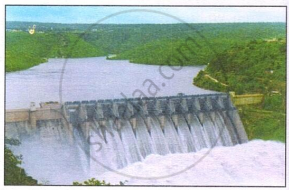
With reference to the Bhakra Nangal Dam, answer the following:
Name the river on which it has been constructed.
With reference to the Bhakra Nangal Dam, answer the following:
Name two states that benefit from this project.
On which river is Hirakud Dam located?
Give any two uses of Hirakud dam.
State three disadvantages of building a big dam.
Map Work
On the outline map of India mark and name two centres where each of these minerals are found:
- Coal
- Petroleum
- Natural Gas
- Hydel Power
Thinking Skills
Suppose you are involved in the printing industry. Which conventional source of energy would you be using and for what? How is this resource affecting the lives of people in India?
Name one fuel which has been developed as an alternative to petrol and diesel for use in vehicles. Name the fossil fuel from which it is derived and is preferred than the conventional source of energy from which it is derived?
Imagine that you live in an area where a dam is being constructed. What advantages and disadvantages do you foresee once this hydro-project is completed?
Study the graphs given below showing primary source of energy for lighting in both rural and urban areas. What do you infer?

Solutions for 12: Conventional Sources of Energy
Morning Star solutions for टोटल जियोग्राफी [अंग्रेजी] कक्षा १० आईसीएसई chapter 12 - Conventional Sources of Energy
Shaalaa.com has the CISCE Mathematics टोटल जियोग्राफी [अंग्रेजी] कक्षा १० आईसीएसई CISCE solutions in a manner that help students grasp basic concepts better and faster. The detailed, step-by-step solutions will help you understand the concepts better and clarify any confusion. Morning Star solutions for Mathematics टोटल जियोग्राफी [अंग्रेजी] कक्षा १० आईसीएसई CISCE 12 (Conventional Sources of Energy) include all questions with answers and detailed explanations. This will clear students' doubts about questions and improve their application skills while preparing for board exams.
Further, we at Shaalaa.com provide such solutions so students can prepare for written exams. Morning Star textbook solutions can be a core help for self-study and provide excellent self-help guidance for students.
Concepts covered in टोटल जियोग्राफी [अंग्रेजी] कक्षा १० आईसीएसई chapter 12 Conventional Sources of Energy are Sources of Energy, Conventional Sources of Energy > Coal, Conventional Sources of Energy > Petroleum or Mineral Oil, Oil Refineries in India, Conventional Sources of Energy > Natural Gas, Conventional Sources of Energy > Hydel Power, Bhakra Nangal Dam, Hirakud Project, Non-Conventional Sources > Solar Energy, Non-Conventional Sources > Wind Energy, Non-Conventional Sources > Tidal Energy, Non-Conventional Sources > Geothermal Energy, Non-Conventional Sources > Nuclear Energy, Non-Conventional Sources > Biogas Energy, Major Producers of Minerals and Energy Resources in India, Sources of Energy, Conventional Sources of Energy > Coal, Conventional Sources of Energy > Petroleum or Mineral Oil, Oil Refineries in India, Conventional Sources of Energy > Natural Gas, Conventional Sources of Energy > Hydel Power, Bhakra Nangal Dam, Hirakud Project, Non-Conventional Sources > Solar Energy, Non-Conventional Sources > Wind Energy, Non-Conventional Sources > Tidal Energy, Non-Conventional Sources > Geothermal Energy, Non-Conventional Sources > Nuclear Energy, Non-Conventional Sources > Biogas Energy, Major Producers of Minerals and Energy Resources in India.
Using Morning Star टोटल जियोग्राफी [अंग्रेजी] कक्षा १० आईसीएसई solutions Conventional Sources of Energy exercise by students is an easy way to prepare for the exams, as they involve solutions arranged chapter-wise and also page-wise. The questions involved in Morning Star Solutions are essential questions that can be asked in the final exam. Maximum CISCE टोटल जियोग्राफी [अंग्रेजी] कक्षा १० आईसीएसई students prefer Morning Star Textbook Solutions to score more in exams.
Get the free view of Chapter 12, Conventional Sources of Energy टोटल जियोग्राफी [अंग्रेजी] कक्षा १० आईसीएसई additional questions for Mathematics टोटल जियोग्राफी [अंग्रेजी] कक्षा १० आईसीएसई CISCE, and you can use Shaalaa.com to keep it handy for your exam preparation.
