Advertisements
Chapters
1: Factors of Production
Unit II - Theory of Demand and Supply
2: Elementary Theory of Demand
3: Elasticity of Demand
4: Theory of Supply
Unit III - Market
5: Meaning and Types of Markets
Unit IV - Banking in India
6: Meaning and Functions of Money
7: Commercial Banks
8: Central Bank
9: Introduction to Public Finance
▶ 10: Public Revenue
11: Public Expenditure
12: Public Debt
Unit V - Inflation
13: Inflation
Unit VI - Consumer Awareness
14: Consumer Awareness
![Goyal Brothers Prakashan solutions for इकॉनॉमिक्स [अंग्रेजी] कक्षा १० आईसीएसई chapter 10 - Public Revenue - Shaalaa.com](/images/economics-english-class-10-icse_6:79542639410243508fde8e322c338fd1.jpg "Goyal Brothers Prakashan solutions for इकॉनॉमिक्स [अंग्रेजी] कक्षा १० आईसीएसई chapter 10 - Public Revenue")
Advertisements
Solutions for Chapter 10: Public Revenue
Below listed, you can find solutions for Chapter 10 of CISCE Goyal Brothers Prakashan for इकॉनॉमिक्स [अंग्रेजी] कक्षा १० आईसीएसई.
Goyal Brothers Prakashan solutions for इकॉनॉमिक्स [अंग्रेजी] कक्षा १० आईसीएसई 10 Public Revenue Exercise [Pages 211 - 216]
MULTIPLE CHOICE QUESTIONS
______ is a non-tax revenue.
Fee
Fines and penalties
Escheat
All the above
______ are the receipts by way of prices paid for government produced goods and services.
Administrative revenues
Commercial revenues
Taxes
None of these
Identify administrative revenue from the following:
Licence fee
Postal charges
Tution fees of public education institution
Payment for electricity distributed by the government
The essential feature of a tax.
A compulsory payment
A legal payment
Both Compulsory payment and legal payment.
Neither Compulsory payment nor Legal payment
______ is an example of commercial revenues.
Fees
Special assessment
Railways fares/freights
Gifts and grants
______ are those taxes which are paid by the same person on whom they have been imposed.
Proportional tax
Progressive taxes
Direct taxes
Indirect taxes
The government imposes tax ______.
To raise revenue
To reduce inequalities of income and wealth
Both to raise revenue and to reduce inequalities of income and wealth
Neither to raise revenue nor to reduce inequalities of income and wealth
Which of the following is an advantage of direct taxes?
Convenient to pay
Wide coverage
Levied according to the taxable capacity
No Evasion
Under ______ the rate of tax increases with rise in tax payer's income.
Progressive taxation
Proportional taxation
Regressive taxation
Digressive taxation
Taxes in which the rate of tax remains the same, though the tax bases changes are called ______.
Direct taxes
Indirect taxes
Progressive taxes
Proportional taxes
______ are levied on the value of the commodities.
Specific taxes
Ad valorem taxes
Direct taxes
Taxes on income
The ______ is on the person who pays it in the first instance.
incidence of tax
impact of tax
the burden of GST
None of these
______ is mixture of proportional and progressive tax system.
Specific taxes
Ad valorem taxes
Regressive taxes
Digressive taxes
The revenue derived by the government from public enterprises is also known as ______.
Commercial revenue
Administrative revenue
Specially desired tax
Local tax
Income tax is an example of ______.
Direct tax
Indirect tax
Social tax
Goods and service tax
License fee is an example of ______.
Citizen' revenue
Administrative revenue
Tax revenue
Commercial revenue
Goods and Services Tax (GST) is an example of ______.
Direct tax
Indirect tax
Income tax
Local tax
goods
services
social
Toll tax is an example of ______ revenue of the government.
Administrative
Commercial
Fee
Direct
If the rate of tax falls with an increase in income, it is called as ______.
Regressive
Progressive
Digressive
Proportional
| Mr. Rao needs to pay license fee to the government to start his electric vehicle shop and some documents to meet the safety norms. |
The revenue earned by the government from this process will be called as ______ revenue.
Commercial
Central
GST
Administrative
The rate of tax, which is uniform for all the taxpayers, is termed as ______.
Progressive
Proportional
Regressive
Direct
Direct taxes are regressive in nature.
True
False
Study the relationship in the first pair of words and complete the second pair.
- Revenue earned by the government through railway fares: Commercial revenue
- Revenue earned through Special Assessment: ______.
Direct tax
Indirect tax
Administrative
Commercial
ASSERTION-REASONING & STATEMENT BASED QUESTIONS Read the following statements-Assertion (A) and Reason (R). Choose one of the correct alternatives given below:
Assertion (A): Public revenue means the income of the government through all sources.
Reason (R): Tax is the major source of revenue for the government.
Both Assertion (A) and Reason (R) are true and Reason (R) is the correct explanation of Assertion (A).
Both Assertion (A) and Reason (R) are true and Reason (R) is not the correct explanation of Assertion (A).
Assertion (A) is true but Reason (R) is false.
Assertion (A) is false but Reason (R) is true.
Read the following statements carefully and choose one of the correct alternatives given below:
Statement (1): Taxes include direct as well as indirect taxes.
Statement (2): Fee, penalties, gifts donations, profits of public enterprises are examples of non-tax source of revenue.
Both statements are true.
Both statements are false.
Statement 1 is true but Statement 2 is false.
Statement 2 is true but Statement 1 is false.
Read the following statements-Assertion (A) and Reason (R). Choose one of the correct alternatives given below:
Assertion (A): Direct tax is a regressive tax.
Reason (R): People pay a higher amount of tax as they earn a higher income.
Both Assertion (A) and Reason (R) are true and Reason (R) is the correct explanation of Assertion (A).
Both Assertion (A) and Reason (R) are true and Reason (R) is not the correct explanation of Assertion (A).
Assertion (A) is true but Reason (R) is false.
Assertion (A) is false but Reason (R) is true.
Read the following statements carefully and choose one of the correct alternatives given below:
Statement (1): In case of direct taxes, the tax burden cannot be transferred to another person.
Statement (2): Indirect taxes are charged on the sale or consumption of goods and services.
Both statements are true.
Both statements are false.
Statement 1 is true but Statement 2 is false.
Statement 2 is true but Statement 1 is false.
Statement (1): Postal charges are an example of commercial source of public revenue.
Statement (2): Fares and freights charged by the railways are an example of administrative revenue.
Both statements are true.
Both statements are false.
Statement 1 is true but Statement 2 is false.
Statement 2 is true but Statement 1 is false.
Read the following statements-Assertion(A) and Reason(R). Choose one of the correct alternatives given below:
Assertion (A): A progressive tax takes a larger percentage of income from high income groups.
Reason (R): A regressive tax takes a larger percentage of income from low income groups.
Both Assertion (A) and Reason (R) are true and Reason (R) is the correct explanation of Assertion (A).
Both Assertion (A) and Reason (R) are true and Reason (R) is not the correct explanation of Assertion (A).
Assertion (A) is true but Reason (R) is false.
Assertion (A) is false but Reason (R) is true.
Assertion (A): GST is an indirect tax.
Reason (R): GST was launched in India to eliminate multiple indirect taxes.
Both Assertion (A) and Reason (R) are true and Reason (R) is the correct explanation of Assertion (A).
Both Assertion (A) and Reason (R) are true and Reason (R) is not the correct explanation of Assertion (A).
Assertion (A) is true but Reason (R) is false.
Assertion (A) is false but Reason (R) is true.
Short Answer Type Questions
What is the meaning of public finance?
Give two main features of a tax.
Differentiate between tax revenue and non-tax revenue.
What is the difference between the impact of taxation and incidence of taxation?
What is the difference between price and tax?
Mention any two purposes of taxation.
How can taxes be used for promoting economic growth?
Explain how tax can be used as an instrument to regulate consumption and production in an economy.
Which are the sources of public revenue?
Define direct tax
Give any two examples of direct tax.
Define an Indirect tax with the help of an example.
In what type of tax, shifting of the tax burden is possible? Explain using an example.
Direct taxes are progressive in nature. Briefly explain.
State two differences between income tax and commodity tax.
Classify the following type of tax into direct and indirect taxes:
Sales tax
Direct tax
Indirect tax
Classify the following type of tax into direct and indirect taxes:
Income tax
Direct tax
Indirect tax
State whether the following is a direct or an indirect tax:
Wealth tax
Direct tax
Indirect tax
State whether the following is a direct or an indirect tax:
Excise duty
Direct tax
Indirect tax
State the four merits of a direct tax.
Explain any five demerits of direct tax.
What are the merits of an indirect tax?
State three demerits of an Indirect tax.
Differentiate between progressive taxation and proportional taxation.
Explain the term proportional taxation.
What are proportional taxes?
What are progressive taxes.
Give one example of progressive tax.
Indirect taxes are regressive in nature. How can they be made progressive?
What is a degressive tax?
Give an example of a digressive tax.
Distinguish between a tax and a fee.
Give any two examples of direct tax.
Distinguish between a tax and a subsidy.
How can tax be used as an instrument to bring about equitable distribution of wealth and income?
Progressive taxation is suitable for the Indian economy. Give reasons to support your answer.
Mention one way by which the government can reduce the inequalities of income and wealth in an economy.
A special virtue of indirect taxes is that they sometimes help in social reforms. Explain.
What do you mean by Goods and Services Taxes?
When was GST implemented?
Indirect taxes are regressive in nature. How can they be made progressive?
Give any five points of difference between direct and indirect tax.
Mention any two examples of administrative renenue.
Mention any two objectives of GST.
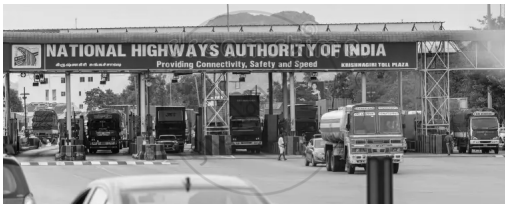
The following image shows, ‘Tolls as a source of revenue for State as well as Central government.’ [4]
Identify and explain the type of revenue mentioned in the above statement. [1]
“Indirect taxes are also called as taxes in the dark.” Justify the statement with the suitable reasons.
Explain the term Incidence of a tax.
Long Answer Type Questions
Explain any five characteristics of the tax.
What are the merits of an indirect tax?
Give any five points of difference between direct and indirect tax.
State the four merits of a direct tax.
Explain any five demerits of direct tax.
Give any five points of difference between direct and indirect tax.
What are the merits of an indirect tax?
State three demerits of an Indirect tax.
Differentiate between progressive taxation and proportional taxation.
What are the merits of an indirect tax?
State three demerits of an Indirect tax.
Define a tax.
State the four merits of a direct tax.
Define a tax.
Give any five points of difference between direct and indirect tax.
Give any five points of difference between direct and indirect tax.
Explain the meaning of the following term:
Impact
Explain the meaning of the following term:
Shifting
Explain the meaning of the following term:
Incidence
To which type of tax are the terms Impact, Shifting, and Incidence relevant?
What are the merits of an indirect tax?
State three demerits of an Indirect tax.
Explain any five demerits of direct tax.
Explain any five demerits of induced taxes.
Goyal Brothers Prakashan solutions for इकॉनॉमिक्स [अंग्रेजी] कक्षा १० आईसीएसई 10 Public Revenue QUESTION BANK [Pages 216 - 219]
Define public revenue.
Define a tax.
Give two main features of a tax.
Define direct tax
Give any two examples of direct tax.
Define Indirect tax
Give an example of Indirect tax.
In what type of tax, shifting of the tax burden is possible? Explain using an example.
What is the difference between the impact of taxation and incidence of taxation?
Distinguish between a tax and a fee.
Define progressive taxation.
Give one example of progressive tax.
What are proportional taxes?
What is meant by regressive taxation?
Give an example of regressive tax.
What is a degressive tax?
What is a degressive tax?
Give an example of a digressive tax.
Give any five points of difference between direct and indirect tax.
Differentiate between tax revenue and non-tax revenue.
Giving reasons classify the following into direct and indirect tax:
Wealth tax
Direct tax
Indirect tax
Classify the following type of tax into direct and indirect taxes:
Income tax
Direct tax
Indirect tax
Giving reasons classify the following into direct and indirect tax:
GST
Direct tax
Indirect tax
Explain how taxation can be used to reduce inequalities of income.
State the four merits of a direct tax.
Explain any five demerits of direct tax.
What are the merits of an indirect tax?
State three demerits of an Indirect tax.
What do you mean by Goods and Services Taxes?
Differentiate between progressive taxation and proportional taxation.
What is the difference between price and tax?
Define a tax.
Explain two merits of progressive tax structure.
Explain two demerits of progressive tax structure.
State two differences between income tax and commodity tax.
Indirect taxes are regressive in nature. How can they be made progressive?
Distinguish between a tax and a subsidy.
GST will lead to better tax compliance. Do you agree?
Agree
Disagree
Define a tax.
Give any five points of difference between direct and indirect tax.
What are the objectives of GST?

Examine the above image. State and explain the source of revenue generated by the government.
By giving valid reasons, explain whether the following will be included in the commercial revenue of the government or not?
Mr. Shah paying License fee for registration of his motor vehicle.
By giving valid reasons, explain whether the following will be included in the commercial revenue of the government or not?
Irrigation charges paid by Mr. Shah as a farmer.
Solutions for 10: Public Revenue
Goyal Brothers Prakashan solutions for इकॉनॉमिक्स [अंग्रेजी] कक्षा १० आईसीएसई chapter 10 - Public Revenue
Shaalaa.com has the CISCE Mathematics इकॉनॉमिक्स [अंग्रेजी] कक्षा १० आईसीएसई CISCE solutions in a manner that help students grasp basic concepts better and faster. The detailed, step-by-step solutions will help you understand the concepts better and clarify any confusion. Goyal Brothers Prakashan solutions for Mathematics इकॉनॉमिक्स [अंग्रेजी] कक्षा १० आईसीएसई CISCE 10 (Public Revenue) include all questions with answers and detailed explanations. This will clear students' doubts about questions and improve their application skills while preparing for board exams.
Further, we at Shaalaa.com provide such solutions so students can prepare for written exams. Goyal Brothers Prakashan textbook solutions can be a core help for self-study and provide excellent self-help guidance for students.
Concepts covered in इकॉनॉमिक्स [अंग्रेजी] कक्षा १० आईसीएसई chapter 10 Public Revenue are Introduction to Public Finance, Nature of Public Finance, Difference Between Public Finance and Private Finance.
Using Goyal Brothers Prakashan इकॉनॉमिक्स [अंग्रेजी] कक्षा १० आईसीएसई solutions Public Revenue exercise by students is an easy way to prepare for the exams, as they involve solutions arranged chapter-wise and also page-wise. The questions involved in Goyal Brothers Prakashan Solutions are essential questions that can be asked in the final exam. Maximum CISCE इकॉनॉमिक्स [अंग्रेजी] कक्षा १० आईसीएसई students prefer Goyal Brothers Prakashan Textbook Solutions to score more in exams.
Get the free view of Chapter 10, Public Revenue इकॉनॉमिक्स [अंग्रेजी] कक्षा १० आईसीएसई additional questions for Mathematics इकॉनॉमिक्स [अंग्रेजी] कक्षा १० आईसीएसई CISCE, and you can use Shaalaa.com to keep it handy for your exam preparation.
