Advertisements
Chapters
1: Factors of Production
Unit II - Theory of Demand and Supply
▶ 2: Elementary Theory of Demand
3: Elasticity of Demand
4: Theory of Supply
Unit III - Market
5: Meaning and Types of Markets
Unit IV - Banking in India
6: Meaning and Functions of Money
7: Commercial Banks
8: Central Bank
9: Introduction to Public Finance
10: Public Revenue
11: Public Expenditure
12: Public Debt
Unit V - Inflation
13: Inflation
Unit VI - Consumer Awareness
14: Consumer Awareness
![Goyal Brothers Prakashan solutions for इकॉनॉमिक्स [अंग्रेजी] कक्षा १० आईसीएसई chapter 2 - Elementary Theory of Demand - Shaalaa.com](/images/economics-english-class-10-icse_6:79542639410243508fde8e322c338fd1.jpg "Goyal Brothers Prakashan solutions for इकॉनॉमिक्स [अंग्रेजी] कक्षा १० आईसीएसई chapter 2 - Elementary Theory of Demand")
Advertisements
Solutions for Chapter 2: Elementary Theory of Demand
Below listed, you can find solutions for Chapter 2 of CISCE Goyal Brothers Prakashan for इकॉनॉमिक्स [अंग्रेजी] कक्षा १० आईसीएसई.
Goyal Brothers Prakashan solutions for इकॉनॉमिक्स [अंग्रेजी] कक्षा १० आईसीएसई 2 Elementary Theory of Demand QUESTIONS [Pages 63 - 71]
MULTIPLE CHOICE QUESTIONS.
______ means a wish to have a commodity or source.
Want
Demand
Effective desire
Desire
Which of the following statement is not true?
Want is an effective desire
Demand is different from want
Demand is always at a price
In economics, the terms - 'desire' 'want' and 'demand' have the same meanings.
Any statement about demand for a good is considered complete only when the following is/are mentioned in it:
Price of the good
Quantity of the good
Period of time
All of the above
Which of the following is not a determinant of demand?
Income of the consumer
Price of the product
Price of related goods
Technology used to produce the goods
Size of population
The demand curve is generally ______.
Downward sloping
Upward sloping
Horizontal parallel to the X-axis
Vertical parallel to the Y-axis
Following is not the assumption of law of demand:
Commodity's own price should remain constant.
Income of the consumers should remain constant.
Price of related good should not change.
There should be no change in consumer's tastes an preference.
If due to fall in the price of good X, demand for Y rises, the two goods are ______.
Substitutes
Complements
Not related
Competitive
What kind of a commodity will have inverse relation between income and demand?
Normal good
Inferior good
Essential good
Luxury good
With an increase in income, the consumption of which good, the consumer reduces ______.
Inferior good
Normal goods
Both (a) and (b)
Neither (a) nor (b)
If with the rise in price of good Y, demand for good X rises, the two goods are:
Substitutes
Complements
Not related
Jointly
What does a downward movement along the same demand curve indicate?
Increase in demand
Decrease in demand
Contraction in demand
Expansion in demand
What does an upward movement along the same demand curve indicate?
Increase in demand
Decrease in demand
Contraction in demand
Expansion in demand
When the demand curve of a product shifts to the right, it represents a situation of ______.
Increase in demand
Expansion in demand
Decrease in demand
Contraction in demand
An increase in the price of electricity will cause the demand for electric appliances to ______.
Rise
Fall
Remain the same
None of these
When at a price of ₹ 5 per unit of a commodity, A’s demand is for 11 units, B’s demand is for 14 units and C’s demand is for 8 units (assuming that there are only three consumers in the market), the market demand is ______.
11 units
14 units
17 units
33 units
A fall in income of the consumer (in the case of normal goods) will cause a/an ______.
Upward movement on the same demand curve
Downward movement on the same demand curve
Rightward shift of the demand curve
Leftward shift of the demand curve
Demand curve of a good shifts from DD' to Demand dd'. This shift can be caused by:

Fall in the price of the good
Rise in the price of the good
Rise in the price of substitute goods
Rise in the price of complementary goods
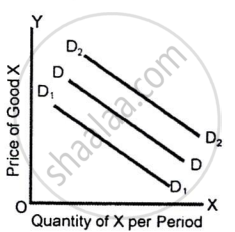
The diagram given below shows the original demand curve (DD) for good X, which is a complement of good Y:
If there is a rise in the price of good Y, which demand curve for good X is relevant?
DD
D1D1
D2D2
None of these
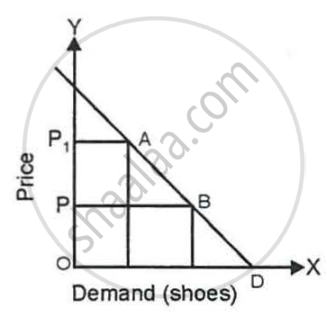
The diagram shows the demand for shoes:
Which of the following would cause a movement from B to A?
An increase in income
An increase in population
An increase in price of shoes
An increase in production
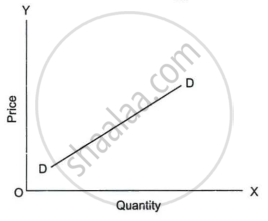
In the following diagram, the demand curve is upward sloping. Under what kind of goods is it possible?
Normal goods
Giffen goods
Veblon goods
Both (b) and (c)
Identify the correct statement from the following alternatives:
Taj Mahal tea and Tata tea are examples of substitute goods.
'A consumer buys 2 litres of milk at a price of ~ 50 per litre per day' is a demand statement
A consumer never buys an inferior good, no matter how cheap it is
Both (a) and (b)
The market demand curve is a ______ summation of all individual demand curves.
Vertical
Horizontal
Downward
None of these
The demand for goods which can be put to several uses is known as ______.
Competitive
Autonomous
Composite
Indirect
In economics demand and price have ______ relationship.
zero
Positive
Direct
Inverse
Car and petrol are examples of ______ demand.
Complementary
Competitive
Substitute
Composite
Electricity is an example of ______ demand.
Complementary demand
Joint demand
Composite demand
Inferior demand
Tea and coffee are examples of ______.
Derived goods
Substitute goods
Inferior goods
All of the above
When income increases, the demand for ______ type of good will increase.
inferior goods
giffen goods
normal goods
coarse goods
Detergent powder and detergent cake are examples of ______.
Substitute goods
Complementary goods
Jointly demanded goods
Inferior goods
The wide gap between the rich and poor with reference to income highlights ______ determinant of the market demand.
Population
Distribution of income
Income of consumer
State Policy
Which is meant by derived demand?
The demand is derived from the income tastes, etc., of sellers.
The demand is derived from the price elasticity of demand.
If a thing is needed for producing some other goods, which we actually need.
The demand is derived in beginning economics classes.
The demand for ______ goods will increase with the increase in the consumers income.
Inferior goods
Substitute goods
Normal goods
Complementary goods
Milk can be put to several uses; therefore, it is called as a ______ good.
Composite
Autonomous
Direct
Indirect
A substitute good is a good:
Of higher quality than another good
That is not used in place of one another
That can be used in place of one another
Of low lower quality than another good
There is a ______ relationship between demand and price.
Direct
inverse
positive
substitute
The demand for rice by all the people in your area will be called as ______ demand.
Individual
Social
Market
Society
Printers and ink cartridge are an example of ______ demand.
Competitive
Composite
Joint
Office
Which of the following is a determinant of market demand?
Taste and preferences
Consumer Credit Facility
Income of the consumer
Government policy
As a result of rise in consumer's income, the demand curve for coarse-grain (inferior good) will:
Move upward along the same demand curve.
Move downward along the same demand curve.
The demand curve will shift to the right.
The demand curve will shift to the left.
Which is an assumption to law of demand?
No change in price of factor input.
No change in size and composition of population.
No change in number of firms operating in a market.
No change in goal of a firm.
If Coke and Fanta are close substitutes to each other, a rise in price of Coke will lead to ______ for Fanta.
Decrease in demand.
Increase in demand.
Increase in quantity supplied.
No change in demand.
As a result of rise in consumer's income, the demand curve for coarse-grain (inferior good) will:
Move upward along the same demand curve.
Move downward along the same demand curve.
The demand curve will shift to the right.
The demand curve will shift to the left.
Identify the factor that affects market demand from the options below:
Price of jointly produced goods
Consumer Credit Facility
Income of the consumer
Government policy
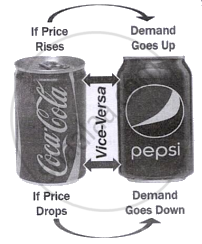
Examine the given image. What does this image depict?
Income effect
Substitution effect
Price effect
Law of demand
On the basis of above visual depiction, identify the correct statement from the following.
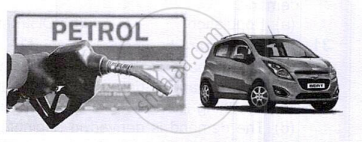
Fall in the price of one good - decreases the demand for the other good.
Rise in the price of one good - increases demand for the other good.
Rise in the price of one good - decreases the demand for the other good.
Rise in price of one does not affect the demand for the other.
Amit buys 1 kg of mangoes at 120 per kg. Other things remaining constant, when the price of mangoes falls to 90 per kg, he buys 2 kg of mangoes. Amit’s choice in the given situation shows which concept?
Demand schedule
Market demand
Contraction of demand
Expansion of demand
Which of the following are examples of substitute goods?
Coke and Coffee
Pencil and Eraser
Tea and Sugar
Apple iPhones and Samsung Smartphones
Goods that can be used in place of one another are ______ goods.
Complementary
Substitute
Composite
Joint

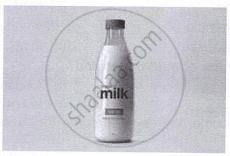
The above image shows a type of demand which has many uses. Identify the type of demand.
Composite
Complementary
Joint
Substitute
ASSERTION-REASONING & STATEMENT BASED QUESTIONS Read the following statements-Assertion(A) and Reason(R). Choose one of the correct alternatives given below:
Assertion (A): If a fall in price of Good X leads to a rise in demand for Good Y, then X and Y are complementary goods.
Reason (R): Complementary goods (say car & petrol) are used together. A fall in the price of petrol is likely to increase the demand of cars.
Both Assertion (A) and Reason (R) are true and Reason (R) is the correct explanation of Assertion (A).
Both Assertion (A) and Reason (R) are true and Reason (R) is not the correct explanation of Assertion (A).
Assertion (A) is true but Reason (R) is false.
Assertion (A) is false but Reason (R) is true.
Read the following statements carefully and choose one of the correct alternatives given below:
Statement (1): Taj Mahal Tea and Tata Tea are examples of substitute goods.
Statement (2): Printer and ink cartridges are examples of complementary goods.
Both the statements are true.
Both the statements are false.
Statement 1 is true and Statement 2 is false.
Statement 2 is true and Statement 1 is false.
Read the following statements carefully and choose one of the correct alternatives given below:
Assertion (A): Demand curve is downward sloping.
Reason (R): Demand curve slopes downwards from left to the right because price and quantity demanded are inversely related.
Both Assertion (A) and Reason (R) are true and Reason (R) is the correct explanation of Assertion (A).
Both Assertion (A) and Reason (R) are true and Reason (R) is not the correct explanation of Assertion (A).
Assertion (A) is true but Reason (R) is false.
Assertion (A) is false but Reason (R) is true.
Read the following statements carefully and choose one of the correct alternatives given below:
Statement (1): Normal goods violate the law of demand.
Statement (2): Law of demand is based on the assumption that the commodity is a normal good and has no status value.
Statement 1 is true and Statement 2 is false.
Statement 2 is true and Statement 1 is false.
Both the statements are true.
Both the statements are false.
Statement (1): There is a rightward shift of demand curve in case of increase in demand.
Statement (2): There is a downward movement along the same demand curve in case of expansion in demand.
Statement 1 is true and Statement 2 is false.
Statement 2 is true and Statement 1 is false.
Both the statements are true.
Both the statements are false.
Read the following statements-Assertion (A) and Reason (R). Choose one of the correct alternatives given below:
Assertion (A): A veblen good is one for which demand increases as the price increases.
Reason (R): Coarse cereals and tonned milk are examples of veblen goods.
Both Assertion (A) and Reason (R) are true and Reason (R) is the correct explanation of Assertion (A).
Both Assertion (A) and Reason (R) are true and Reason (R) is not the correct explanation of Assertion (A).
Assertion (A) is true but Reason (R) is false.
Assertion (A) is false but Reason (R) is true.
Read the following statements carefully and choose one of the correct alternatives given below:
Statement (1): A rightward shift of demand curve indicates expansion of demand.
Statement (2): An upward movement along a demand curve indicates decrease in demand.
Both the statements are true.
Both the statements are false.
Statement 1 is true and Statement 2 is false.
Statement 2 is true and Statement 1 is false.
Short Answer Type Questions
Explain the term demand.
State two factors affecting the market demand for a commodity.
What do you mean by a normal good?
Give two examples of normal goods.
What are inferior goods?
Distinguish between Normal goods and Inferior goods.
Explain the following diagram with reference to the concept of Giffen goods.
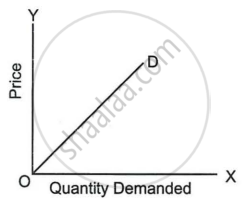
The demand curve can slope upwards from left to right. Give one argument in support of this statement.
If a buyer buys less of a commodity when his income falls, how will his demand curve change? Illustrate your answer with a diagram.
With help of an example explain the term complementary goods.
With suitable examples differentiate between complementary goods and substitute goods.
Explain briefly anyone determinant of an exceptional demand curve.
Briefly explain any one exception to the law of demand.
If price of X increases, then demand for Y too increases. What is the relationship between goods X and Y? Give an example.
Substitute products A and B are produced by different firms. Give a reason why a change in the price of product A will bring about a change in quantity demanded for product B.
If the quantity demanded of commodity X decreases as the householder's income increases. What type of a commodity is X? Give an example.
State the law of demand.
Give two reasons for the operation of the law of demand.
Explain how income effect is responsible for the negative slope of the demand curve.
What is meant by the income effect of a fall in the prices of a commodity?
What will be the effect on demand for tea, if the price of coffee falls?
What will be the effect on demand for cars, if petrol becomes expensive?
Differentiate between individual demand schedule and market demand schedule.
Using hypothetical data show a market demand schedule.
Mention one exception to the law of demand. Give one point only.
What is an expansion of demand?
What is meant by the contraction in demand?
What is meant by an increase in demand?
What is decrease in demand?
The diagram shows the demand for shoes:
Which of the following would cause a movement from B to A?
An increase in income
An increase in population
An increase in price of shoes
An increase in production
Explain the following diagram:
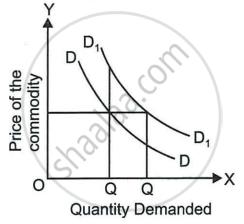
State the impact of the following changes on the demand curve of a commodity:
increase in individual income
State the impact of the following changes on the demand curve of a commodity:
A rise in the price of the commodity
State the impact of the following changes on the demand curve of a commodity:
Increase in the supply of a substitute commodity
State the impact of the following changes on the demand curve of a commodity:
Increase in the price of a complementary commodity
Give two reasons for the shift of the demand curve towards the left.
Mention any two factors that cause a rightward shift of the demand curve.
The bus fare between two cities is reduced. How will this affect the demand curve for bus travel between the two cities?
In order to encourage tourism in Goa, Government of India suggests Indian Airlines to reduce air fares to Goa from four major cities: Chennai, Kolkata, Mumbai and New Delhi. If the Indian Airlines reduces the air fare to Goa, how will this affect the market demand curve for air travel to Goa?
There are train and bus services between New Delhi and Jaipur. Suppose the train fare between the two cities comes down. How will this affect the demand curve for bus travel between the two cities?
Shyam, Sita, Renu, Ahmed and John are five consumers of apples. Their demand for apples is given below. Derive the market demand schedule for apples.
| Price per Kg (in ₹) | Quantity Demanded (Apples) in Kg. | ||||
| Shyam | Sita | Renu | Ahmed | John | |
| 25.00 | 16 | 15 | 12 | 14 | 18 |
| 30.00 | 12 | 11 | 10 | 8 | 15 |
| 35.00 | 10 | 9 | 8 | 6 | 12 |
| 40.00 | 8 | 6 | 4 | 2 | 8 |
Complete the following demand schedule:
| Price (in ₹) | Quantity of mangoes demanded (in kg) |
| 350 | 2 |
| 300 | |
| 250 | |
| 200 | |
| 150 | |
| 100 |
Mention any two examples of composite demand.
‘Mobile phone and laptop are examples of composite demand.’ Justify the statement with a suitable reason.
During recession, economies experience increased unemployment and a reduced level of income. What impact will it have on the demand for new cars?
Long Answer Type Questions
Define the following concept:
Demand
Explain clearly two factors which determine demand.
Explain the term demand.
With the help of a hypothetical table, draw the demand curve of a commodity.
Define the following concept:
Demand
Explain any three factors that affect the demand for a commodity.
Explain any three determinants or factors affecting demand.
Why are prestige good an exception to the law of demand?
Give the meaning of Cross demand.
Explain any four factors which determine the market demand.
State the law of demand.
Briefly explain any two reasons for the occurrence of the law of demand.
State and explain the law of demand with the help of a hypothetical schedule and graph.
Explain four circumstances under which the law of demand does not operate.
With the help of a hypothetical table, draw the demand curve of a commodity.
How is the market demand curve derived from the individual demand curves?
The following table shows the amount of sugar bought by a household at different prices:
| Period | Price (₹ per kg) | Amount Bought (kg) |
| Jan. 2000 | ₹ 15 | 4 |
| Feb. 2000 | ₹ 16 | 5 |
Does the behaviour of household contradict the law of demand? Give reasons in support of your answer.
With the help of a suitable diagram, distinguish between a change in quantity demanded and a change in demand.
With the help of a suitable diagram, distinguish between extension in demand and increase in demand.
Differentiate between decrease in demand and contraction of demand.
State whether the following statement is true or false. Give reasons.
The commodity for which quantity demanded decreases with an increase in income is called inferior commodity.
True
False
State whether the following statement is true or false. Give reasons.
The law of demand states a direct relationship between price and demand.
True
False
State whether the following statement is true or false. Give reasons.
An increase in the demand for a commodity is due to a fall in its price.
State whether the following statement is true or false. Give reasons.
A change in quantity demanded as a result of price change will imply a shift of the demand curve to the right.
True
False
State whether the following statement is true or false. Give reasons.
Contraction of demand is the result of a decrease in the number of consumers.
True
False
Distinguish between “movement along the demand curve” and shift of a demand curve.
State the law of demand.
Briefly explain any three determinants for the negative slope of the demand curve.
Explain the diagram given below.
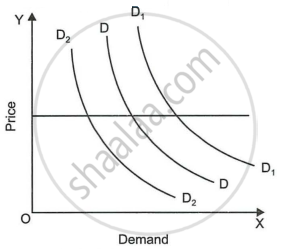
With the help of a suitable diagram, distinguish between extension in demand and increase in demand.
Distinguish between Normal goods and Inferior goods.
With the help of suitable diagram explain the meaning of rightward shift in the demand curve. Explain briefly any two of its determinants.
With the help of a graph explain the increase in demand concept.
The following table shows the demand schedule for 3 consumers in a market.
| Price in (Rs) | Consumer 1 Demand in (kgs) | Consumer 2 Demand in (kgs) | Consumer 3 Demand in (kgs) | Market Demand |
| 10 | 1 | 2 | (i) ______ | 6 |
| 8 | 2 | (ii) ______ | 4 | 9 |
| 6 | 3 | 4 | 5 | 12 |
| 4 | 4 | 5 | 6 | (iii) ______ |
Based on the above hypothetical schedule answer the following questions.
- What is the demand of Consumer 3 priced at Rs 10 (i)?
- What is the demand of Consumer 2 priced at Rs 8 (ii)?
- Calculate the total market demand priced at Rs 4 (iii).
- From the above given table examine the relationship between price and demand.
- Mention any one exception to the law of demand.
The following table represents increase in demand, answer the following questions:
| Price (₹) | Quantity demanded (kgs) |
| 10 | 5 |
| 10 | 7 |
Give a diagrammatic representation based on the above data.
Explain any two factors that affect the increase in demand.
Distinguish between:
Increase in demand and Decrease in demand
Goyal Brothers Prakashan solutions for इकॉनॉमिक्स [अंग्रेजी] कक्षा १० आईसीएसई 2 Elementary Theory of Demand QUESTION BANK [Pages 71 - 75]
Define individual demand.
Define an individual demand schedule.
Define market demand.
Define a market demand schedule.
Define the following concept:
Demand
State two factors affecting the market demand for a commodity.
State 2 types of related goods.
Define substitute goods.
Give two examples of substitute goods.
Define complementary goods.
Give two examples of complementary goods.
What do you mean by a normal good?
What are inferior goods?
Give an example of inferior goods.
What is a demand function?
State the law of demand.
What is an expansion of demand?
What is meant by an increase in demand?
Define contraction of demand (or decrease in quantity demanded).
Define decrease in demand.
What causes an upward movement along a demand curve?
What causes a downward movement along a demand curve?
What does a rightward shift of demand curve indicate?
Mention one exception to the law of demand. Give one point only.
State two circumstances under which the demand curve slopes upwards to the right.
What is a demand schedule?
What is meant by the income effect of a fall in the price of the commodity?
Explain how income effect is responsible for the negative slope of the demand curve.
With the help of a diagram, show how a market demand curve can be obtained from individual demand curves.
Draw a demand curve with the help of a hypothetical individual demand schedule.
Define the following concept:
Demand
Explain any four factors affecting the demand for a commodity.
State the law of demand.
Briefly explain any three determinants for the negative slope of the demand curve.
Why does a demand curve slope downward from left to right?
Briefly explain any three determinants for the negative slope of the demand curve.
Explain four circumstances under which the law of demand does not operate.
Explain four circumstances under which the law of demand does not operate.
Explain the exceptions to the law of demand.
Explain the diagram given below.
With the help of a suitable diagram, distinguish between a change in quantity demanded and a change in demand.
The following table shows a change in the demand. Read the table carefully and answer the question that follows:
| Case I | Case II | ||
| Price (₹) | Quantity | Price (₹) | Quantity |
| 10 | 20 | 10 | 20 |
| 10 | 10 | 5 | 20 |
What type of change is it, decrease in demand or contraction in demand? Give a reason.
With the help of a suitable diagram, explain expansion in demand.
Explain the following diagram.

Give the meaning of Price demand.
Give the meaning of Income demand.
Give the meaning of Cross demand.
State whether the following statement are true or false. Give reasons.
An increase in income leads to a rise in the demand for normal goods.
True
False
State whether the following statement are true or false. Give reasons.
An increase in income leads to a rise in the demand for inferior goods.
True
False
Give two reasons for the shift of the demand curve towards the left.
Give two factors responsible for the shift of the demand curve to the right.
State and explain the law of demand with the help of a hypothetical schedule and graph.
Solutions for 2: Elementary Theory of Demand
Goyal Brothers Prakashan solutions for इकॉनॉमिक्स [अंग्रेजी] कक्षा १० आईसीएसई chapter 2 - Elementary Theory of Demand
Shaalaa.com has the CISCE Mathematics इकॉनॉमिक्स [अंग्रेजी] कक्षा १० आईसीएसई CISCE solutions in a manner that help students grasp basic concepts better and faster. The detailed, step-by-step solutions will help you understand the concepts better and clarify any confusion. Goyal Brothers Prakashan solutions for Mathematics इकॉनॉमिक्स [अंग्रेजी] कक्षा १० आईसीएसई CISCE 2 (Elementary Theory of Demand) include all questions with answers and detailed explanations. This will clear students' doubts about questions and improve their application skills while preparing for board exams.
Further, we at Shaalaa.com provide such solutions so students can prepare for written exams. Goyal Brothers Prakashan textbook solutions can be a core help for self-study and provide excellent self-help guidance for students.
Concepts covered in इकॉनॉमिक्स [अंग्रेजी] कक्षा १० आईसीएसई chapter 2 Elementary Theory of Demand are Individual Demand Function, Market Demand Function, Causes of Operation of Law of Demand, Exceptions to the Law of Demand, Changes in Demand, Causes Behind Shifts of Demand Curve, Law of Demand, Determinants of Demand, Difference Between Extension and Increase in Demand, Demand Curve.
Using Goyal Brothers Prakashan इकॉनॉमिक्स [अंग्रेजी] कक्षा १० आईसीएसई solutions Elementary Theory of Demand exercise by students is an easy way to prepare for the exams, as they involve solutions arranged chapter-wise and also page-wise. The questions involved in Goyal Brothers Prakashan Solutions are essential questions that can be asked in the final exam. Maximum CISCE इकॉनॉमिक्स [अंग्रेजी] कक्षा १० आईसीएसई students prefer Goyal Brothers Prakashan Textbook Solutions to score more in exams.
Get the free view of Chapter 2, Elementary Theory of Demand इकॉनॉमिक्स [अंग्रेजी] कक्षा १० आईसीएसई additional questions for Mathematics इकॉनॉमिक्स [अंग्रेजी] कक्षा १० आईसीएसई CISCE, and you can use Shaalaa.com to keep it handy for your exam preparation.
