Advertisements
Advertisements
The plate current in a triode valve is zero. The temperature of the filament is high. It is possible that ____________ .
(a) Vg > 0, Vp > 0
(b) Vg > 0, Vp < 0
(c) Vg < 0, Vp > 0
(d) Vg < 0, Vp < 0
Concept: undefined >> undefined
The plate current in a triode can be written as \[i_p = k \left( V_g + \frac{V_p}{\mu} \right)^{3/2}\] Show that the mutual conductance is proportional to the cube root of the plate current.
Concept: undefined >> undefined
Advertisements
Concept: undefined >> undefined
A double convex lens is made of a glass of refractive index 1.55, with both faces of the same radius of curvature. Find the radius of curvature required, if the focal length is 20 cm.
Concept: undefined >> undefined
Consider a plane wave front incident on a thin convex lens. Draw a proper diagram to show how the incident wave front traverses through the lens and after refraction focusses on the focal point of the lens, giving the shape of the emergent wave front.
Concept: undefined >> undefined
Use Huygens' principle to verify the laws of refraction.
Concept: undefined >> undefined
Define the distance of closest approach. An α-particle of kinetic energy 'K' is bombarded on a thin gold foil. The distance of the closest approach is 'r'. What will be the distance of closest approach for an α-particle of double the kinetic energy?
Concept: undefined >> undefined
Write two important limitations of Rutherford's nuclear model of the atom.
Concept: undefined >> undefined
How does one explain the emission of electrons from a photosensitive surface with the help of Einstein's photoelectric equation?
Concept: undefined >> undefined
The work function of the following metals is given : Na 2.75 ev, K = 2.3 eV, Mo = 4.17 eV and Ni = 5.15 eV. Which of these metals will not cause photoelectric emission for radiation of wavelength 3300 Å from a laser source placed 1 m away from these metals? What happens if the laser source is brought nearer and placed 50 cm away?
Concept: undefined >> undefined
State Huygens’s principle. Show, with the help of a suitable diagram, how this principle is used to obtain the diffraction pattern by a single slit.
Draw a plot of intensity distribution and explain clearly why the secondary maxima becomes weaker with increasing order (n) of the secondary maxima.
Concept: undefined >> undefined
Huygens' principle of secondary wavelets may be used to
(a) find the velocity of light in vacuum
(b) explain the particle behaviour of light
(c) find the new position of a wavefront
(d) explain Snell's Law
Concept: undefined >> undefined
Light waves travel in vacuum along the X-axis. Which of the following may represent the wave fronts?
Concept: undefined >> undefined
In motor vehicles, a convex mirror is attached near the driver's seat to give him the view of the traffic behind. What is the special function of this convex mirror which a plane mirror can not do?
Concept: undefined >> undefined
If an object far away from a convex mirror moves towards the mirror, the image also moves. Does it move faster, slower or at the same speed as compared to the object?
Concept: undefined >> undefined
Can mirrors give rise to chromatic aberration?
Concept: undefined >> undefined
In image formation from spherical mirrors, only paraxial rays are considered because they
Concept: undefined >> undefined
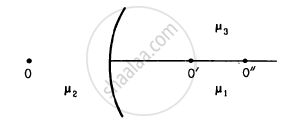
Following figure shows three transparent media of refractive indices \[\mu_1 , \mu_2 \text{ and } \mu_3\]. A point object O is placed in the medium \[\mu_2\]. If the entire medium on the right of the spherical surface has refractive index \[\mu_3\], the image forms at O". In the situation shown,
Concept: undefined >> undefined
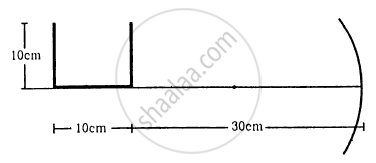
A U-shaped wire is placed before a concave mirror having radius of curvature 20 cm as shown in figure. Find the total length of the image.
Concept: undefined >> undefined
