Please select a subject first
Advertisements
Advertisements
Define the following:
Neuron
Concept: undefined >> undefined
Which one of the following is a characteristic NOT related with the suitability of the roots for absorbing water?
Concept: undefined >> undefined
Advertisements
Name the following:
The process by which water enters root hairs.
Concept: undefined >> undefined
Match the items in column I with those in column II
| Column I | Column II | ||
| (a) | Xylem | (i) | semi - permeable |
| (b) | Phloem | (ii) | permeable |
| (c) | Cell membrane | (iii) | downward flow of sap |
| (d) | Root pressure | (iv) | upward flow of water |
| (e) | Cell wall | (v) | guttation |
Concept: undefined >> undefined
Differentiate between the following:
Guttation and bleeding
Concept: undefined >> undefined
Mention whether the following statement is true or false. Correct the false statement by altering the last word only.
Xylem is the water conducting tissue in plants.
Concept: undefined >> undefined
Mention whether the following statement is true or false. Correct the false statement by altering the last word only.
The cell wall of the root cell is a differentially permeable membrane.
Concept: undefined >> undefined
Give reason for the following:
If you uproot a plant from the soil, its leaves soon wilt.
Concept: undefined >> undefined
Explain the mechanism of closing and opening of the stomata.
Concept: undefined >> undefined
Concentration of mineral nutrient elements is higher inside the root hairs than in the surrounding soil. How do roots take them in from the soil?
Concept: undefined >> undefined
Given below is the diagrammatic representation of the transverse section of a part of a plant. Study it and answer the questions that follow:
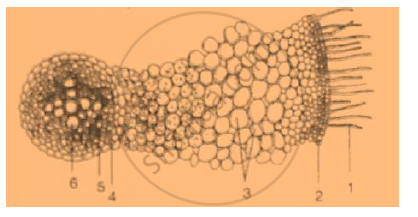
(a) Name the part of the plant that is shown
(b) Label the parts 1 to 6
(c) Write the functions of parts 3 and 5
Concept: undefined >> undefined
Study the diagram given below and answer the questions that follow:

- Name the process being studied in the above experiment.
- Explain the process mentioned in (a) above
- Why is oil placed over water?
- What do we observe with regard to the level of water when this set-up is placed in (1) bright sunlight, (2) humid conditions and (3) windy days?
- Mention any three adaptations found in plants to foster the process mentioned in (a) above
Concept: undefined >> undefined
Differentiate between following pair with reference to the aspect in bracket.
sympathetic nervous system and para – sympathetic nervous system (overall effect on body)
Concept: undefined >> undefined
A gland having endocrine as well as exocrine function is
Concept: undefined >> undefined
Exophthalmic goitre is caused due to the overactivity of ______.
Concept: undefined >> undefined
what do we refer to in the nervous system when we say:
somatic and autonomic …………………..
Concept: undefined >> undefined
What would a child suffer from if there was hyposecretion from his thyroid?
Concept: undefined >> undefined
Choose the odd one out from each series
The glands – thyroid, adrenal, pituitary, prostate
…………………………………………
Concept: undefined >> undefined
Match the items of column I with those of column II
| Column I | Column II | ||
| 1 | β (beta) cells of islets of Langerhans |
a | condition due to undersecretion of thyroxine in adults |
| 2 | Thyroid | b | Glucocorticoids |
| 3 | Cretinism | c | Exophthalmic goitre |
| 4 | Addison's disease | d | Increases heart beat |
| 5 | Hypothyroidism | e | Thyroxine |
| 6 | Myxoedema | f | Adrenal cortex |
| 7 | Adrenaline Under secretion of thyroxine in a child |
h | Under secretion of thyroxine in a child |
Concept: undefined >> undefined
Mention which of the statements are true (T) and which are false (F). Give reason in support of your answer.
There are two kinds of diabetes (mild and severe) related with two different hormones.
Concept: undefined >> undefined
