Please select a subject first
Advertisements
Advertisements
In which orientation, a dipole placed in a uniform electric field is in (i) stable, (ii) unstable equilibrium?
Concept: undefined >> undefined
Deduce the expression for the potential energy of a system of two point charges q1 and q2 brought from infinity to the points `vecr_1`and `vecr_2`respectively in the presence of external electric field `vecE`.
Concept: undefined >> undefined
Advertisements
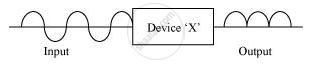
In the figure given below the input waveform is converted into the output waveform by a device ‘X’. Name the device and draw its circuit diagram.
Concept: undefined >> undefined
In a single slit diffraction experiment, when tiny circular obstacle is placed in path of light from a distance source, a bright spot is seen at the centre of the shadow of the obstacle. Explain why?
Concept: undefined >> undefined
State two points of difference between the interference patterns obtained in Young’s double slit experiment and the diffraction pattern due to a single slit.
Concept: undefined >> undefined
Describe briefly, with the help of labelled diagram, working of a step-up transformer.
A step-up transformer converts a low voltage into high voltage. Does it not violate the principle of conservation of energy? Explain.
Concept: undefined >> undefined
Will the diffraction effects from a slit be more or less clearly visible if the slit-width is increased?
Concept: undefined >> undefined
It is said that the separation between the two charges forming an electric dipole should be small. In comparison to what should this separation be small?
Concept: undefined >> undefined
An electric dipole is placed in an electric field generated by a point charge.
Concept: undefined >> undefined
An electric dipole is placed at the centre of a sphere. Mark the correct options.
(a) The flux of the electric field through the sphere is zero.
(b) The electric field is zero at every point of the sphere.
(c) The electric field is not zero anywhere on the sphere.
(d) The electric field is zero on a circle on the sphere.
Concept: undefined >> undefined
A resistor of resistance R is connected to an ideal battery. If the value of R is decreased, the power dissipated in the resistor will ______________ .
Concept: undefined >> undefined
A current passes through a resistor. Let K1 and K2 represent the average kinetic energy of the conduction electrons and the metal ions, respectively.
Concept: undefined >> undefined
A sample of HCI gas is placed in an electric field of 2.5 × 10⁴ NC−1. The dipole moment of each HCI molecule is 3.4 × 10⁻³⁰ Cm. Find the maximum torque that can act on a molecule.
Concept: undefined >> undefined
Two particles A and B, of opposite charges 2.0 × 10⁻⁶ C and −2.0 × 10⁻⁶ C, are placed at a separation of 1.0 cm. Two particles A and B, of opposite charges 2.0 × 10⁻⁶ C and −2.0 × 10⁻⁶ C, are placed at a separation of 1.0 cm.
Concept: undefined >> undefined
Two particles A and B, of opposite charges 2.0 × 10⁻⁶ C and −2.0 × 10⁻⁶ C, are placed at a separation of 1.0 cm. Calculate the electric field at a point on the axis of the dipole 1.0 cm away from the centre.
Concept: undefined >> undefined
Two particles A and B, of opposite charges 2.0 × 10⁻⁶ C and −2.0 × 10⁻⁶ C, are placed at a separation of 1.0 cm. Calculate the electric field at a point on the perpendicular bisector of the dipole and 1.0 m away from the centre.
Concept: undefined >> undefined
Three charges are arranged on the vertices of an equilateral triangle, as shown in the figure. Find the dipole moment of the combination.
Concept: undefined >> undefined
Two particles, carrying charges −q and +q and and of mass m each, are fixed at the ends of a light rod of length a to form a dipole. The rod is clamped at an end and is placed in a uniform electric field E with the axis of the dipole along the electric field. The rod is slightly tilted and then released. Neglecting gravity, find the time period of small oscillations.
Concept: undefined >> undefined
The magnetic field inside a tightly wound, long solenoid is B = µ0 ni. It suggests that the field does not depend on the total length of the solenoid, and hence if we add more loops at the ends of a solenoid the field should not increase. Explain qualitatively why the extra-added loops do not have a considerable effect on the field inside the solenoid.
Concept: undefined >> undefined
A bulb with rating 250 V, 100 W is connected to a power supply of 220 V situated 10 m away using a copper wire of area of cross-section 5 mm2. How much power will be consumed by the connecting wires? Resistivity of copper = 1.7 × 10⁻⁸ Ωm
Concept: undefined >> undefined
