Advertisements
Advertisements
If the law of gravitation, instead of being inverse-square law, becomes an inverse-cube law- ______.
- planets will not have elliptic orbits.
- circular orbits of planets is not possible.
- projectile motion of a stone thrown by hand on the surface of the earth will be approximately parabolic.
- there will be no gravitational force inside a spherical shell of uniform density.
Concept: undefined >> undefined
Molecules in air in the atmosphere are attracted by gravitational force of the earth. Explain why all of them do not fall into the earth just like an apple falling from a tree.
Concept: undefined >> undefined
Advertisements
How is the gravitational force between two point masses affected when they are dipped in water keeping the separation between them the same?
Concept: undefined >> undefined
We can shield a charge from electric fields by putting it inside a hollow conductor. Can we shield a body from the gravitational influence of nearby matter by putting it inside a hollow sphere or by some other means?
Concept: undefined >> undefined
The gravitational force between a hollow spherical shell (of radius R and uniform density) and a point mass is F. Show the nature of F vs r graph where r is the distance of the point from the centre of the hollow spherical shell of uniform density.
Concept: undefined >> undefined
The gravitational force between a hollow spherical shell (of radius R and uniform density) and a point mass is F. Show the nature of F vs r graph where r is the distance of the point from the centre of the hollow spherical shell of uniform density.
Concept: undefined >> undefined
Shown are several curves (Figure). Explain with reason, which ones amongst them can be possible trajectories traced by a projectile (neglect air friction).
Concept: undefined >> undefined
Six point masses of mass m each are at the vertices of a regular hexagon of side l. Calculate the force on any of the masses.
Concept: undefined >> undefined
Modulus of rigidity of ideal liquids is ______.
Concept: undefined >> undefined
Modulus of rigidity of ideal liquids is ______.
Concept: undefined >> undefined
The maximum load a wire can withstand without breaking, when its length is reduced to half of its original length, will ______.
Concept: undefined >> undefined
A spring is stretched by applying a load to its free end. The strain produced in the spring is ______.
Concept: undefined >> undefined
A mild steel wire of length 2L and cross-sectional area A is stretched, well within elastic limit, horizontally between two pillars (Figure). A mass m is suspended from the mid point of the wire. Strain in the wire is ______.

Concept: undefined >> undefined
A rectangular frame is to be suspended symmetrically by two strings of equal length on two supports (Figure). It can be done in one of the following three ways;
| (a) |  |
| (b) |  |
| (c) |  |
The tension in the strings will be ______.
Concept: undefined >> undefined
Consider two cylindrical rods of identical dimensions, one of rubber and the other of steel. Both the rods are fixed rigidly at one end to the roof. A mass M is attached to each of the free ends at the centre of the rods.
Concept: undefined >> undefined
A wire is suspended from the ceiling and stretched under the action of a weight F suspended from its other end. The force exerted by the ceiling on it is equal and opposite to the weight.
- Tensile stress at any cross section A of the wire is F/A.
- Tensile stress at any cross section is zero.
- Tensile stress at any cross section A of the wire is 2F/A.
- Tension at any cross section A of the wire is F.
Concept: undefined >> undefined
A rod of length l and negligible mass is suspended at its two ends by two wires of steel (wire A) and aluminium (wire B) of equal lengths (Figure). The cross-sectional areas of wires A and B are 1.0 mm2 and 2.0 mm2, respectively.
(YAl = 70 × 109 Nm−2 and Ysteel = 200 × 109 Nm–2)

- Mass m should be suspended close to wire A to have equal stresses in both the wires.
- Mass m should be suspended close to B to have equal stresses in both the wires.
- Mass m should be suspended at the middle of the wires to have equal stresses in both the wires.
- Mass m should be suspended close to wire A to have equal strain in both wires.
Concept: undefined >> undefined
Is stress a vector quantity?
Concept: undefined >> undefined
Consider a long steel bar under a tensile stress due to forces F acting at the edges along the length of the bar (Figure). Consider a plane making an angle θ with the length. What are the tensile and shearing stresses on this plane

- For what angle is the tensile stress a maximum?
- For what angle is the shearing stress a maximum?
Concept: undefined >> undefined
The graph between two temperature scales A and B is shown in figure. Between upper fixed point and lower fixed point there are 150 equal division on scale A and 100 on scale B. The relationship for conversion between the two scales is given by ______.
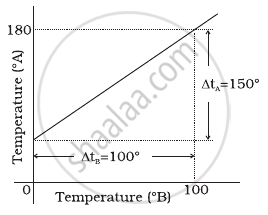
Concept: undefined >> undefined
