Advertisements
Advertisements
प्रश्न
Modulus of rigidity of ideal liquids is ______.
विकल्प
infinity.
zero.
unity.
some finite small non-zero constant value.
Advertisements
उत्तर
Modulus of rigidity of ideal liquids is zero.
Explanation:
Modulus of Rigidity: Within limits of proportionality, the ratio of tangential stress to the shearing strain is called the modulus of rigidity of the material of the body and is denoted by η

i.e. η = `"Shearing stress"/"Shearing strain"`
In this case, the shape of a body changes but its volume remains unchanged.
Consider a cube of material fixed at its lower face and acted upon by a tangential force F at its upper surface having area A.
Only solids can exhibit a shearing as these have a definite shape.
In liquids, η = 0
So, the frictional (viscous) force cannot exist in the case of an ideal fluid and since they cannot sustain shearing stress or tangential forces are zero, there is no stress developed.
APPEARS IN
संबंधित प्रश्न
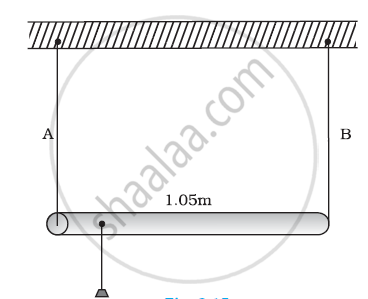
A rod of length 1.05 m having negligible mass is supported at its ends by two wires of steel (wire A) and aluminium (wire B) of equal lengths as shown in Figure. The cross-sectional areas of wires A and B are 1.0 mm2 and 2.0 mm2, respectively. At what point along the rod should a mass m be suspended in order to produce (a) equal stresses and (b) equal strains in both steel and aluminium wires.
A mild steel wire of length 1.0 m and cross-sectional area 0.50 × 10⁻² cm2 is stretched, well within its elastic limit, horizontally between two pillars. A mass of 100 g is suspended from the mid-point of the wire. Calculate the depression at the midpoint.
The ratio stress/strain remain constant for small deformation of a metal wire. When the deformation is made larger, will this ratio increase or decrease?
When the skeleton of an elephant and the skeleton of a mouse are prepared in the same size, the bones of the elephant are shown thicker than those of the mouse. Explain why the bones of an elephant are thicker than proportionate. The bones are expected to withstand the stress due to the weight of the animal.
A steel blade placed gently on the surface of water floats on it. If the same blade is kept well inside the water, it sinks. Explain.
A rope 1 cm in diameter breaks if the tension in it exceeds 500 N. The maximum tension that may be given to a similar rope of diameter 2 cm is
The breaking stress of a wire depends on
A wire can sustain the weight of 20 kg before breaking. If the wire is cut into two equal parts, each part can sustain a weight of
When a metal wire is stretched by a load, the fractional change in its volume ∆V/V is proportional to
Answer in one sentence.
How should be a force applied on a body to produce shearing stress?
A spiral spring is stretched by a weight. The strain will be:
A rod has a radius of 100 mm and a length of 10 cm. A 100 N force compress along its length. Calculate the longitudinal stress developed in the rod.
A wire is suspended from the ceiling and stretched under the action of a weight F suspended from its other end. The force exerted by the ceiling on it is equal and opposite to the weight.
- Tensile stress at any cross section A of the wire is F/A.
- Tensile stress at any cross section is zero.
- Tensile stress at any cross section A of the wire is 2F/A.
- Tension at any cross section A of the wire is F.
A steel wire having a radius of 2.0 mm, carrying a load of 4 kg, is hanging from a ceiling. Given that g = 3.1πms-2, what will be the tensile stress that would be developed in the wire?
If 'S' is stress and 'Y' is young's modulus of the material of a wire, the energy stored in the wire per unit volume is ______.
What is an elastomer?
What is the physical quantity defined as the internal restoring force per unit area of a body?
