Advertisements
Advertisements
प्रश्न
A mild steel wire of length 1.0 m and cross-sectional area 0.50 × 10⁻² cm2 is stretched, well within its elastic limit, horizontally between two pillars. A mass of 100 g is suspended from the mid-point of the wire. Calculate the depression at the midpoint.
Advertisements
उत्तर १
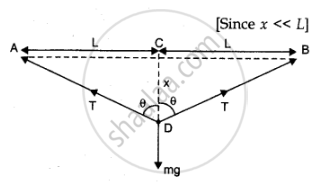
Let AB be a mild steel wire of length 2L = lm and its cross-section area A = 0.50 x 10⁻² cm2. A mass m = 100 g = 0.1 kg is suspended at mid-point C of wire as shown in figure. Let x be the depression at mid-point i.e., CD = x
`:. AD = DB = sqrt((AC^2 + CD^2)) = sqrt(L^2+x^2)`
:. Increase in length `triangleL = (AD+DB) - AB = 2sqrt(L^2+x^2) - 2L`
`= 2L[(1+x^2/L^2)^(1/2) - 1] = 2L.x^2/(2L^2) = x^2/L`
:. Longitudinal strain = `(triangleL)/(2L) = x^2/(2L^2)`
If T be the tension in the wire as shown figure then in equilibrium `2T cos theta = mg`
or `T = "mg"/(2costheta)`
`= "mg"/(2 x/(sqrt(x^2+L^2))) = (mgsqrt(x^2+L^2))/(2x) = "mgL"/(2x)`
:. Stress = `T/A = "mgL"/(2 x A)`
As Young's modulus Y = `"stress"/"strain"`
`=((mgL)/(2 x A))/((x^2)/(2L^2)) = (mgL)/(2 x A) xx (2L^2)/x^2 = (mgL^3)/(Ax^3)`
`=> x = [(mgL^3)/(YA)]^(1/3) = L[(mg)/(YA)]^(1/3)`
`= 1/2[(0.1xx9.8)/(2xx10^11xx0.50xx10^(-2)xx10^(-4))]^(1/3) = 1.074 xx 10^(-2) m`
= 1.074 cm ≈ 1.07 cm or 0.01 m
उत्तर २

Length of the steel wire = 1.0 m
Area of cross-section, A = 0.50 × 10⁻² cm2 = 0.50 × 10⁻⁶ m2
A mass 100 g is suspended from its midpoint.
m = 100 g = 0.1 kg
Hence, the wire dips, as shown in the given figure.
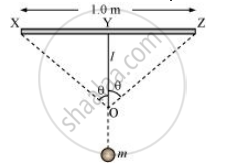
Original length = XZ
Depression = l
The length after mass m is attached to the wire = XO + OZ
Increase in the length of the wire:
Δl = (XO + OZ) – XZ
Where,
XO = OZ = `[(0.5)^2 + l^2]^(1/2)`
`:.triangle l = 2[(0.5)^2 + (l)^2]^(1/2) - 1.0`
`= 2 xx 0.5 [1+(l/0.5)^2]^(1/2) - 1.0`
Expanding and neglecting higher terms, we get
`triangle l = l^2/0.5`
`"Strain" = "Increase in length"/"Original length"`
Let T be the tension in the wire.
∴mg = 2T cosθ
Using the figure, it can be written as:
`cos theta = l/((0.5)^2 + l^2)^(1/2)`
`= l/ ((0.5)(1+(l/0.5)^2)^(1/2))`
Expanding the expression and eliminating the higher terms:
`cos theta = l/((0.5)(1+l^2/(2(0.5)^2)))`
`(1+l^2/(0.5))=~1` for small l
`:. cos theta = l/(0.5)`
`:. T = (mg)/(2(l/(0.5))) = (mgxx 0.5)/(2l) = (mg)/(4l)`
`"Stress" = "Tension"/"Area" = (mg)/(4lxxA)`
`Y = (mg xx 0.5)/(4lxxAxxl^2)`
`l = sqrt((mgxx0.5)/(4YA)) `
Young’s modulus of steel, Y = 2 x 10¹¹ Pa
`:.l = sqrt((0.1xx9.8xx0.5)/(4xx2xx10^11xx0.50xx10^(-6)))`
= 0.0106 m
Hence, the depression at the midpoint is 0.0106 m.
APPEARS IN
संबंधित प्रश्न
Determine the volume contraction of a solid copper cube, 10 cm on an edge, when subjected to a hydraulic pressure of 7.0 ×10⁶ Pa.
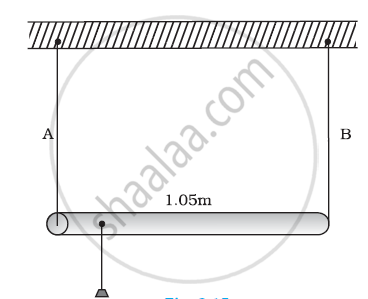
A rod of length 1.05 m having negligible mass is supported at its ends by two wires of steel (wire A) and aluminium (wire B) of equal lengths as shown in Figure. The cross-sectional areas of wires A and B are 1.0 mm2 and 2.0 mm2, respectively. At what point along the rod should a mass m be suspended in order to produce (a) equal stresses and (b) equal strains in both steel and aluminium wires.
The ratio stress/strain remain constant for small deformation of a metal wire. When the deformation is made larger, will this ratio increase or decrease?
A rope 1 cm in diameter breaks if the tension in it exceeds 500 N. The maximum tension that may be given to a similar rope of diameter 2 cm is
Answer in one sentence.
Define strain.
A spiral spring is stretched by a weight. The strain will be:
A rod has a radius of 100 mm and a length of 10 cm. A 100 N force compress along its length. Calculate the longitudinal stress developed in the rod.
Modulus of rigidity of ideal liquids is ______.
Modulus of rigidity of ideal liquids is ______.
The maximum load a wire can withstand without breaking, when its length is reduced to half of its original length, will ______.
A mild steel wire of length 2L and cross-sectional area A is stretched, well within elastic limit, horizontally between two pillars (Figure). A mass m is suspended from the mid point of the wire. Strain in the wire is ______.

A rectangular frame is to be suspended symmetrically by two strings of equal length on two supports (Figure). It can be done in one of the following three ways;
| (a) |  |
| (b) |  |
| (c) |  |
The tension in the strings will be ______.
A wire is suspended from the ceiling and stretched under the action of a weight F suspended from its other end. The force exerted by the ceiling on it is equal and opposite to the weight.
- Tensile stress at any cross section A of the wire is F/A.
- Tensile stress at any cross section is zero.
- Tensile stress at any cross section A of the wire is 2F/A.
- Tension at any cross section A of the wire is F.
Is stress a vector quantity?
The value of tension in a long thin metal wire has been changed from T1 to T2. The lengths of the metal wire at two different values of tension T1 and T2 are l1 and l2 respectively. The actual length of the metal wire is ______.
What is the physical quantity defined as the internal restoring force per unit area of a body?
Strain is defined as the ratio of ______.
What are the dimensions of stress?
