Please select a subject first
Advertisements
Advertisements
We sang our school fight song dozens of times – en route to Arlington National cemetery, and even on an afternoon cruise down the Potomac River. We visited the Lincoln Memorial twice, once in day – light, the second time at dusk. My classmates and I fell silent as we walked in the shadows of those 36 marble columns, one for every state in the Union that Lincoln laboured to preserve. I stood next to Frank at the base of the 19 foot seated statue. Spotlights made the white Georgian marble seem to glow. Together we read famous words from Lincoln’s speech at Gettysburg remembering the most bloody battle in the war between the status : “………….we here highly resolve that these dead shall not have died in vain – that this nation, under God, shall have a new birth of freedom………..”
As Frank motioned me into place to take my picture, I took one last look at Lincoln’s face. He seemed alive and so terribly sad.
The next morning I understand a little better why he wasn’t smiling. “Clifton,” a chaperone said, “could I see you for a moment?”
(1) When did the boys visit Lincoln Memorial?
(2) What made the Georgian marble glow?
(3) What did the words: “………. We here highly resolve that these dead shall not have died in vain – that this nation, under God, shall have a new birth of freedom …………” remind them?
(4) Do you believe in building memorials? What kind should they be, if your answer is ‘yes’? If no, give reasons why you do not believe in memorials?
Concept: Reading Skills
Read the following extract and answer the questions given below:
If you do not get lowered in your own eyes
While you raise yourself in those of others,
If you do not give in to gossips and lies
Rather heed them not, saying, 'who bothers?'
You may be the person I am looking for.
If you crave not for praise when you win
And look not for sympathy while you lose,
If cheers let not your head toss or spin
And after a set-back, you offer no excuse,
You may be the person I and looking for.
(1) What should be your reaction towards gossips and lies?
(2) Who are your role models? Why?
(3) Give the rhyming pairs of words from the first stanza.
(4) Which line is repeated in this extract and what is its effect?
Concept: Reading Skills
Read the follow ing extract and answer the questions given below:
Not gold but only men can make
A people great and strong;
Men who for truth and honor's sake
Stand fast and suffer long.
Brave men who work while others sleep,
Who dare while others fly...
They build a nation's pillars deep
And lift them to the sky.
(1) What makes a nation strong?
(2) According to you, what makes India a strong and powerful nation?.
(3) Write down the rhyme scheme used in the extract.
(4) What does the phrase 'others fly ... ' mean?
Concept: Reading Skills
Read the following extract and answer the questions given below:
While I lay awake in bed,
God's still small voice came to me and said,
"While dealing with a stranger, common courtesy you use,
But the children you love, you seem to abuse.
Look on the kitchen floor,
You'll find some flowers there by the door.
Those are the flowers she brought for you.
She picked them herself, pink, yellow and blue.
She stood quietly not to spoil the surprise,
And you never saw the tears in her eyes."
(1) What did the mother think as she lay sleepless in the bed?
(2) According to you, why shouldn't we hurt the feelings
of others?
(3) Pick out any two pairs of rhyming words from this
extract.
(4) What kind of poem is this? What is its purpose?
Concept: Unseen Poem Comprehension
Read the following extract and answer the questions given below:
How do you know
Peace is a woman?
I know, for
I met her yesterday
on my winding way
to the world's fare.
She had such a wonderful face
just like a golden flower faded
before her prime.
(1) How does the poet describe the face of peace?
(2) Do you think there is a way out of the war-ridden world? What is it?.
(3) Name and explain the figure of speech in the following line:
"I met her yesterday
on my winding way."
(4) The poet asks the question and herself answers it. What effect does it create in the extract?
Concept: Reading Skills
Read the following passage and do the activities.
In the early days of farming, people did not understand how plants obtained essential nutrients. It so happened that wood ash, fish remains and slaughterhouse waste were thrown on vacant land just to get rid of them. Then, people started to notice that the grass, bushes and shrubs on this vacant land began to grow very well. They reasoned that if their farmland were similarly treated, the growth of their crops would also improve. People gradually began to realize that the nutrients required by plants came from the soil and that the amount of nutrients could be increased by the application of such organic remains to the soil. Thus started the manuring process in farming.
The practice of manuring has been practised as early since the seventeenth century. However, the importance of manuring was not properly understood until scientists began to study the nutritional needs of plants and gave birth to fertilizers. Thus, gradually, the use of fertilizers became accepted by farmers.
There are many types of manure and fertilizer currently being used. Manure is a substance derived from animals and plants. The most important advantage of using manure is the fact that they not only supply a wide range of plant
nutrients, but also improve the structure of the soil. It cements together the soil particles to form soil crumbs. The crumb structure is a desirable condition of cultivated soil. The addition of manure to soil will increase the inorganic and humus content which helps to prevent soil erosion and loss of plant nutrients when it rains. The common manure used in farming consists of farmyard manure, compost, blood meal, bone meal and fish meal.
Unlike manure, fertilizers are inorganic substances which do not improve the structure of the soil. They only supply extra amounts of nutrients to the growing plants when applied to the soil. The commercial fertilizers commonly used today
can be classified into three major categories; namely, nitrogen (N), phosphate and potash fertilizers.
Besides knowing the type of fertilizer to use, a farmer also needs to know when to apply the fertilizer and how to apply it. The fertilizer should be applied at the time when the plants need a particular nutrient most. The time and method
of application will determine how profitably the fertilizers have been used in farming. Fertilizers which have not been properly applied cannot be absorbed in large quantities by plant roots. These fertilizers may be washed away by rain
or they may kill the plants. This would mean a definite financial loss for the farmer.
(A1) Choose the correct option and rewrite the sentences.
(a) What did the people not understand in the early days of farming ? (1/2)
(i) how farming is done
(ii) how plants obtained essential nutrients
(iii) how grass, shrubs and bushes grow.
(b) What is manure ? (1/2)
(i) a substance derived from animals and plants.
(ii) the soil particles to form soil crumbs.
(iii) a combination of nitrogen, phosphate and potash.
(c) When should fertilizers be applied ? (1/2)
(i) When the plants get dried.
(ii) When the plants need a particular nutrient most.
(iii) In the early days of farming.
(d) What determines the profitability of the fertilizers ? (1/2)
(i) grass, bushes and shrubs
(ii) nitrogen, phosphate and potash.
(iii) The time and method of application.
(A2) How did the process of adding manure to the soil begin? (2)
(A3) Find out similar words from the passage. (2)
(i) necessary (ii) comprise
(iii) step by step (iv) ascertain
(A4)
(i) They supply extra amount of nutrients to the growing plants (Begin the sentence with ‘Extra amount of.......... ’.)(1)
(ii) It cements together the soil particles to form soil crumbs.
(Choose the correct option to name the tense.)(1)
(i) Simple present tense
(ii) Simple past tense
(iii) Simple future tense
(A5) ‘Agriculture plays important role in Indian economy’. Explain. (2)
(B) Read the passage given in Q. 4 (A) and write the summary of it. Suggest a suitable title to your summary. (5)
Concept: Unseen Passage Comprehension
Read the following passage and do the activities.
The Delhi Metro is a metro system serving Delhi and its satellite cities of Bahadurgarh, Ballabhgarh, Faridabad, Ghaziabad, Gurgaon and Noida in the National Capital Region of India. Delhi Metro Rail Corporation Limited
(DMRC), a State-owned company with equal equity participation from the Government of India and the Government of Delhi, built and operates the Delhi
Metro. It is the second oldest metro in India after the Kolkata Metro.
The Delhi Metro is the largest and busiest metro in India, and the world’s 9th longest metro system in length and 16th largest in ridership. A member of CoMET, the network consists of eight colour-coded regular lines, with a total
length of 317 kilometres, serving 231 stations including 6 on Airport Express line and interchange stations. The system has a mix of underground, at-grade, and elevated stations using both broad-gauge and standard-gauge. DMRC operates over 2,700 trips daily. In the financial year 2016–17, the Delhi Metro had an average daily ridership of 2.76 million passengers and served 100 crore (1.0 billion) riders.
The Delhi Metro Rail Corporation was certified by the United Nations in 2011 as the first metro rail and rail-based system in the world to get “carbon credits for reducing greenhouse gas emissions” and helping in reducing pollution levels in the city by 630,000 tonnes every year. Planning for the metro started in 1984 when the Delhi Development Authority and the Urban Arts Commission came up with a proposal for developing a multi-modal transport system for the city. Delhi Metro Rail Corporation (DMRC) was incorporated in May 1995, construction started in 1998, and the first section, on the Red Line, opened in 2002. The development of the network was divided into phases, Phase I containing 3 lines was completed by 2006, and Phase II in 2011. Phase III is scheduled to be mostly complete by 2018.
(A1) Name the following.
(a) The Government authority which built and operates the Delhi Metro -
(b) The first and the oldest Metro in India -
(c) The satellite cities nearby Delhi -
(d) The largest and busiest metro in India -
(A2) The salient features of Delhi Metro are -
(A3) Find out antonyms from the passage for the following.
(i) shortest ´ (ii) increasing ´
(iii) irregular ´ (iv) ended ´
(A4) The Delhi Metro is the largest and busiest metro in India.
(Complete the following sentences with the help of the given sentence.)
(i) No other metro................................
(ii) The Delhi Metro is larger.......................
(A5) “Transportation is the backbone of Indian economy’’ - Elaborate
(B) Read the passage given in Q. 4 (A) and write the summary of it. Suggest a suitable title to your summary.
Concept: Unseen Passage Comprehension
Read the following passage and do the activities.
Galaxies are vast clusters of thousands of millions of stars, planets, gases and dust, which are held together by gravity. There are over one thousand million galaxies, and each is a very long way from its nearest neighbour.
Galaxies were formed during the Big Bang explosion about 15,000 million years ago. When this phenomenon occurred, everything that was in the universe flew out in different directions. Scientists believe that the galaxies were formed from lumps of matter that resulted. However, the process is nowhere near complete. The universe is still expanding, galaxies are still moving away from each other, new stars are still being created.
Galaxies are classified according to their shapes. There are three main types. The most common type of galaxy is The Spiral. This has several spiral arms radiating out from the center. Spiral galaxies have a large cluster of stars in their nucleus. The second type is the Barred spiral. In this type of galaxy, the spiral arms curve away from the opposite ends of a sort of bar going through the middle of the nucleus. These contain large amounts of gas and dust as well stars. The third type of galaxy is electrical. These consist almost entirely of stars and contain very little gas or dust. Some galaxies have irregular, uneven shapes and cannot be classified.
(A1) State whether the following statements are true or false. 02
(1) The most common type of galaxy is the barred spiral.
(2) Galaxies are clusters, held by gravity.
(3) Scientists do not believe in the Big Bang explosion.
(4) Galaxies are moving from each other.
(A2) Complete the web chart. 02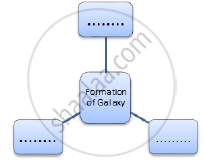
(A3)
(a) Find out similar words from the passage. 01
(i) mass (ii) happenings
(b) Give the verb form of the given words. 01
(i) classified (ii) directions
(A4) Identify and name the clause. 02
Scientists believe that the galaxies were formed from the lumps of matter.
(A5) Can there be life in another galaxy? Give reasons for your answer. 02
(B) Read the passage given in Q. 4 (A) and write the summary of it. Suggest a suitable title to your summary. (05)
Concept: Unseen Passage Comprehension
Read the following poem and write an appreciation of it with the help of the given points in a paragraph format:
|
The Pulley When God at first made Man, So strength first made a way; For if I should (said He) Yet let him keep the rest, |
- The title of the poem (1)
- The poet (1)
- Central idea/theme (2)
- Rhyme scheme (1)
- Figure of speech (1)
- Special features (2)
- Favourite line/lines (1)
- Why I like/don’t like the poem (1)
Concept: Unseen Poem Comprehension
Read the following passage and do the given activities :
A1. Fill up the blanks with virtues of dogs : (2)
(1) __________
(2) __________
(3) __________
(4) __________
| Human and dogs are inseparable for thousands of years and they are dependent on each other for protection and survival. Relationship between humans and dogs is often characterized by strong emotional bonds which run both way. Dogs are very popular as pets and companions. Dog is the ‘Man’s Best Friend’ and a family member. The dog is one of the most loyal, faithful and devotee animal. In earlier days dogs were kept mainly for hunting and guarding; now they are kept for companionship, protection and showmanship. There are millions of people all over the world who are dog lovers Puppies need more attention at the, early age. As much as possible try many methods of socialization, such as playing with them, taking them for walk, expose them to crowds, make them to obey the orders etc. |
A2. Methods of socialization of puppies are : (2)
(1) …......................
(2) …......................
(3) …......................
(4) …......................
A3. Cross out the odd man : (2)
(i) Inseparable, dependent, protection, popular.
(ii) Hunting. guarding, playing, petting.
(iii) Earlier, human, relationship, family
(iv) Often, mainly, now, emotional
A4.
(1) There are millions of people all over the world. (1)
(Pick out the determiners and write them)
(2) Puppies need more attention. (1)
(Rewrite the sentence without changing its meaning beginning with : Puppies don’t ….....)
A5. Should we ban keeping pets ? Justify. (2)
Concept: Unseen Passage Comprehension
Read the following passage and complete the activities given below:
Concept: Reading Skills
Read the passage and complete the activities given below
B1 Complete the table :
A few facts about the Mehendi rituals during marriage ceremonies are given below :
Write them into appropriate columns :
(i) A simple family affair.
(ii) Song and dance performances accompanied by lavish food and entertainment.
(iii) Creative family members, apply Mehendi to the bride.
(iv) Beauticians are appointed to apply Mehendi to the bride.
Fill in the table as :
| Yesteryears | Present times |
| (i) | (i) |
| (ii) | (ii) |
Mehendi enjoys special attention during the wedding. In India, the day before the wedding is devoted exclusively to the elaborate ritual of applying Mehendi on the hands and feet of the bride. This practice is followed in Arab countries as well, except that it is held a few days prior to the wedding day. Songs are woven around the healing properties and lucky omens associated with mehndi are sung by the bride’s family and friends. An age-old belief handed down to generations lays great emphasis on the color of the bride’s Mehendi – a darker color suggests bountiful love and affection from the future in-laws and husband, and for this reason, brides take the pain to ensure that only the best quality henna is used for her wedding day.
The ritual of adorning the bride with henna is a sacred one and in some communities requires the initiation by the mother-in-law. A popular game during marriage function is the search for their names, by the bride and groom hidden within the elaborate pattern on the bride’s hands.
In certain parts of India, the bridegroom has his hands decorated with henna. The Mehendi function during marriages has evolved from simple family affairs of yesteryears to elaborate events of today. A lavish spread of food and entertainment in the form of song and dance performances have transformed it from a small function to a gala prelude. In earlier days, the task of applying Mehendi on the bride was the sole prerogative of creative family members. The demand for intricate and different style now, sees this job outsourced to beauticians skilled in this art. Beauty salons charge according to the style and complexity of pattern desired by the clients.
B2 What is the age-old belief related to the bride’s Mehendi color and its significance?
B3 Find the words :
Find the words from the passage :
| Noun | Verd | Adjectives |
| (i) attention | attend | _______________ |
| (ii) creation | _________________ | creative |
A lot of money is spent nowadays on marriage ceremonies. What is your opinion about it?
Concept: Reading Skills
Read the following passage and complete the activities given below :
A1 Find out :
Find from the passage the related words to the sea and write them.

ON FIERCE monsoon nights, about one and a quarter-mile off the Mumbai harbor, there have been occasions when 52-year-old Bikaji Ramchandra Dhuri is the only man on the sea. From the watchtower of the Prongs Reef Lighthouse, which is surrounded on all sides by the Arabian Sea, he has heard the sea rage like a possessed spirit – the darkness dispelled only by the beam of light flung across the waters from the tower he mans.
Dhuri is one of the last breeds of lighthouse keepers on the Indian coast, as a majority of the 182 lighthouses in the country are now unmanned. Built-in 1871, the Prongs Reef lighthouse was modeled on Scotland’s Skerryvore Rocks Lighthouse and is located at a strategic spot on the western coast, marking the entrance to the busy Mumbai Harbour. It was meant to stem the number of shipwrecks off the harbor, which the lone Colaba lighthouse could not illumine on its own. “Even now, during nights, for fishing vessels without any gadgets, it’s the soft light from this tower which directs us to Mumbai,” says Vinayak Koli, a boatsman who helps ferry people and also goes on fishing expeditions.
Throughout the year, Dhuri lives in the lighthouse for 15 days at a stretch, when he is relieved by another keeper. In the monsoon, it becomes his home for three months. “We call it the Kalapana as we are alone in the middle of the sea for days, with basic supplies – and the revolving light that keeps the sea awake,” he says.
A2 Fill in the following information using words from the passage :
(i) The Prongs Reef lighthouse was modeled on _______.
(ii) Dhuri lives in the lighthouse for _______ at a stretch.
(iii) _______ is one of the last breeds of lighthouse keepers on the Indian coast.
(iv) The majority of the _______ lighthouses in the country are now unmanned.
| Violent | Scattered | Place of shelter for ships | Shine light |
A4
A5 Personal Response
Imagine you have to spend a night in a lighthouse. Narrate your experience.
Concept: Reading Skills
Read the passage and complete the activities given below :
B1 Pick out
The correct answers from the statements given below:
B2 Fill in the gaps with the information given in the passage :
Concept: Reading Skills
Read the following extract carefully and complete the activities given below :
A1 Complete the following :
(i) Books were found on the _____________ and ____________.
(ii) The tales are described as ______________ and __________.
|
Have you forgotten? Don't you know?
We'll say it very loud and slow:
THEY ... USED ... TO ... READ! They'd READ and READ,
AND READ and READ, and then proceed
To READ some more. Great Scott! Gadzooks!
One-half of their lives was reading books!
The nursery shelves held books galore!
Books cluttered up the nursery floor!
And in the bedroom, by the bed,
More books were waiting to be read!
Such wondrous, fine, fantastic tales
Of dragons, gypsies, queens, and whales
And treasure isles, and distant shores
Where smugglers rowed with muffled oars,
And pirates wearing purple pants,
And sailing ships and elephants,
And cannibals crouching 'round the pot,
Stirring away at something hot.
(It smells so good, what can it be?
Good gracious, it's Penelope.)
|
Concept: Reading Skills
Read the following extract of the poem and complete the activities given below :
B1 State which of the following statements are
True or False :
(i) The elderly are nearest to our own exalted personality.
(ii) The elderly are those persons whose growth is stunted.
(iii) We should know our elderly people well, in order to receive guidance.
(iv) The elderly hold on to the frivolous aspects of life.
Elderly people should be around us. Justify.
(b) abb
(c) abba
Concept: Reading Skills
Read the passage carefully and complete the activities given below :
A1 True or False
A2 Mention the two things that were found when the tall grass was hacked.
A3 The narrator prayed that Rex should not make any sudden movements meets. Explain giving reasons.
Concept: Reading Skills
Read the extract and do the following activities:
A1 Complete :
| Night |
Morning |
| (i) | (i) |
| (ii) | (ii) |
There was a roaring in the wind all night;
The rain came heavily and fell in floods;
But now the sun is rising calm and bright,
The birds are singing in the distant woods;
Over his own sweet voice the Stock-dove broods;
The Jay makes answer as the Magpie chatters;
And all the air is filled with pleasant noise of waters
All things that love the sun are out of doors;
The sky rejoices in the morning’s birth;
The grass is bright with raindrops-on the moors
The hare is running races in her mirth;
And with her feet she from the plashy earth
Raises a mist; that, glittering in the sun,
Runs with her all the way, wherever she doth run.
A2 What do the different birds do? Discuss.
A3 The sky rejoices in the morning’s birth. (Name and explain the figure of speech)
Concept: Reading Skills
Read the following passage and do the given activities.
A1. State whether the following statements are true or false:
i. The narrator writes comics.
ii. Sudhir qualified as a friend.
iii. The narrator met Sudhir in Dehra.
iv. Friendship is all about disintegration.
FRIENDSHIP IS ALL ABOUT DOING THINGS TOGETHER. IT MAY BE Climbing a mountain, fishing in a mountain stream, cycling along a country road, camping in a forest clearing or simply traveling together and sharing the experiences that a new place can bring.
On at least two of these counts, Sudhir qualified as a friend, albeit a troublesome one, given to involving me in his adolescent escapades.
I met him in Dehra soon after my return from England. He turned up at my room, saying he’d heard I was a writer and did I have any comics to lend him?
“I don’t write comics”, I said; but there were some comics lying around, leftover from my own boyhood collection. So I gave these to the lanky youth who stood smiling in the doorway, and he thanked me and said he’d bring them back. From my window, I saw him cycling off in the general direction of Dalanwala.
He turned up again a few days later and dumped a large pile of new-looking comics on my desk. “Here are all the latest”, he announced. “You can keep them for me. I’m not allowed to read comics at home”.
A2. Complete the web chart with the information from the passage:

A3. Find out four compound words from the passage.
A4. Do as directed:
i. I am not allowed to read comics at home.
(Pick out the infinitive)
ii. From my window, I saw him cycling.
(Use ‘when’ and rewrite the sentence)
A5. According to you, what are the qualities of a good friend?
Concept: Unseen Passage Comprehension
Read the following passage and do the activities:
A1 True or False:
Rewrite the following statements and state whether they are ‘true’ or ‘false’.
(i) Mashelkar’s mother did menial work to bring him up.
(ii) Mashelkar’s father died when he was twelve.
(iii) Mashelkar was born in a very rich family.
(iv) Tatas added much value to Mashelkar’s life.
I start with my greatest guru-my mother. I was born in a very poor family and my father died when I was six. We moved to Mumbai and my mother did menial work to bring me up. Two meals a day was a tough challenge. I studied under street lights and I walked barefoot until, I think, I was twelve. I remember when I passed the seventh standard and I wanted to go into the eighth standard, our poverty was such that even to secure 21 rupees for secondary school admission became a big challenge. We had to borrow from a lady, who was a housemaid in Chaupati in Mumbai. That was the tough life I had.
In fact, I remember, my passing the SSC Examination-i.e. 11th standard. Those days it used to be not 10th standard or 12th standard but 11th standard. I stood 11th among 1,35,000 but I was about to leave higher education and find a job. What helped me was the scholarship by Sir Dorab Tata Trust. It was just 60 rupees per month and would you believe that 60 rupees per month from Tatas added so much value to my life that I have been able to stand here today before you to speak to you.
I am on the Board of Tatas now and it is very interesting that the same Bombay House where I used to go to collect that 60 rupees per month now one goes and sits there like a Director on the Board of Tata Motors. The turn that these 40 years have taken is very interesting. It has all been possible because of the chance I got to do higher studies at the insistence of my mother. She gave me the values of my life. She was one of the noblest parents I have met in my life.
So, my greatest guru was my mother. My second guru was Principal Bhave, about whom I made a mention earlier. He taught us Physics. Because it was a poor school, I remember, it had to innovate to convey to the young students the message of Science.
A2 Complete:
Complete the following sentences and write:
(i) Mashelkar was inspired by his greatest guru _______
(ii) Mashelkar studied under _______
(iii) Principal Bhave taught _______
(iv) The scholarship by _______ Trust helped him in higher education.
A3 Find the meaning:
Choose the appropriate meaning of the underlined words from the given alternatives:
(i) We moved to Mumbai and my mother did menial work.
(a) skilled
(b) hard
(c) unskilled
(d) of low status
(ii) Because it was a poor school, it had to innovate to convey to the young students the message of science.
(a) do a cheap experiment
(b) introduce new things
(c) avoid
(d) try hard
(iii) I got to do higher studies at the insistence of my mother.
(a) firm saying
(b) being inspired
(c) being inspected
(d) being instigated
(iv) That was the tough life I had.
(a) difficult
(b) soft
(c) cheap
(d) simple
A4 Match:
Match the following sentences with their tags:
| 'A' | 'B' | ||
| (i) | I stood 11th among 1,35,000 |
(a) | aren’t I? |
| (ii) | I am on the Board of Tatas | (b) | didn’t we? |
| (iii) | It was a poor school | (c) | didn’t I? |
| (iv) | We moved to Mumbai | (d) | wasn’t it? |
A5 Personal Response:
“Mother is the greatest Guru.” Discuss.
Concept: Reading Skills
