Advertisements
Advertisements
प्रश्न
Read the following poem and write an appreciation of it with the help of the given points in a paragraph format:
|
The Pulley When God at first made Man, So strength first made a way; For if I should (said He) Yet let him keep the rest, |
- The title of the poem (1)
- The poet (1)
- Central idea/theme (2)
- Rhyme scheme (1)
- Figure of speech (1)
- Special features (2)
- Favourite line/lines (1)
- Why I like/don’t like the poem (1)
Read the 'The Pulley' poem and write an appreciation of it with the help of the given points in paragraph format.
You can use the following points while appreciating the given poem.
- Title and Poet
- Rhyme Scheme
- Figure of Speech
- Theme/Central Idea (At Least 2 to 3 lines)
Advertisements
उत्तर १
The title of the poem is ‘The pulley’. The poet is George Herbert. The central idea of the poem is the reason for man's continual restlessness all his life. According to the poet, this is because God with held the quality of rest from man, so that man's thoughts would ultimately turn towards God, his creator. Each verse of the poem has five lines. The rhyme scheme of each verse is a-b-a-b-a. The chief figure of speech used in the poem is Metaphor. The 'glass of blessings' signifies the sum of all human qualities bestowed on man. The quality of 'rest' or 'Contentment' is implicitly compared to a ‘jewel’. This is a poem with a message. And the message is that however, rich we may be or whatever the abundance of qualities we may have, we must always turn our thoughts to God and thank him for the many blessings he has bestowed on us. My favourite line in this poem is 'Let him be rich and weary, This brings out the paradox of man's nature so well. Even the richest man in the world finally gets tired and experiences discontentment. This is what God intended for man. I like this poem very much because it teaches me not to be self-satisfied and contented but to always remember and thank God for all the blessings he has bestowed on me.
उत्तर २
Appreciation of the Poem ‘The Pulley’
The title of the poem is ‘The Pulley’, and it is written by George Herbert.
The central idea of the poem revolves around God’s creation of mankind. The poet describes how God granted humans various blessings such as strength, beauty, wisdom, and honor. However, He deliberately withheld “Rest” to ensure that humans do not become self-sufficient and forget God. The idea is that human beings, despite having everything, will always feel restless and ultimately turn to God for peace and fulfillment.
The poem follows the ABABA rhyme scheme, which gives it a smooth and rhythmic flow.
One of the significant figures of speech in the poem is Metaphor, where "The Pulley" symbolizes the way God draws humans toward Him through restlessness and weariness. Another important figure of speech is Personification, as God is given human-like qualities, such as speaking and making decisions.
The special features of the poem include its metaphysical nature, where deep philosophical and religious ideas are expressed through simple yet powerful imagery. The poem uses a conversational tone where God is depicted as directly speaking about His creation. It also conveys a moral lesson that true happiness and peace can only be found in devotion to God.
My favorite lines from the poem are:
“Yet let him keep the rest, / But keep them with repining restlessness.”
These lines emphasize that even with wealth and worldly pleasures, humans will always feel restless and seek God’s comfort.
I like this poem because it presents a thought-provoking idea about human nature and our connection with God. The metaphor of the pulley beautifully conveys how God ensures that humans always seek Him despite having all worldly possessions. The poem’s message is both philosophical and spiritual, making it deeply meaningful.
APPEARS IN
संबंधित प्रश्न
A1. Saving Motherland
I can save my motherland by putting an end to ……..

Republic Day! We grow aware
That nothing can be wrought by prayer
-Prop of the credulous-until
It is supported everywhere
By an all-powerful people's will !
We have been witness in the past to sights impossible to bear:
Famine and drought and dread and doom
Continue still to spread the gloom
Of humans turned to skeletons, to shrivelled bags of naked bones
Who have not even strength to vent their suffering through sobs and groans……
MAY EVERY Indian's heart become
An unafraid announcing drum
Echoing and re-echoing a new hope and a new desire
To burn up rubbish-heaps of hate,
Once and for all. Time cannot wait!
Burn up all selfish aims and ends in a great nation's cleansing fire!
Let India's millions chant in chorus:
A mighty future stands before us-
Down with all ruthless tyranny, down with all exploitation which
Renders the poor the poorer-and renders the bloated rich, more rich !
A 2. How does the poet express the condition of people during famines and droughts? (2)
Match:
Match the line with the figure of speech:
| 'A' | ‘B’ |
| (i) Drought and dread and doom | (a) Personification |
| (ii) Time cannot wait | (b) Alliteration |
| (c) Metaphor |
Read the extract given below and answer the questions that follow:
Perhaps the Earth can teach us
as when everything seems dead
and later proves to be alive.
Now I’ll count upto twelve
and you keep quiet and I will go.
(i) What does the Earth teach us? (1)
(ii) What does the poet mean to achieve by counting upto twelve? (1)
(iii) What is the significance of ‘keeping quiet’? (1)
Read the following extract and answer the questions given below :
We used to watch the valley play hide and seek .
Shadowed by the mountain's immeasurable peak
Considered the largest thing known to man
Now skyscrapers are the most extravagant and titanic part of the plan
We used to sit next to the stream, the wind caressing our crown
Watching the magnificent untamed beasts roam far, far from town
Now they are just characters of folk tales, memories we pass down
An adjective to describe someone, no more a noun
This could be our reality.
(1) What was the largest thing known to man? (1)
(2) What would be the possible result of ignoring nature? (1)
(3) Give an example of personification from the extract. (1)
( 4) Pick out from the extract some expressions of geographical images. (1)
Read the following extract and answer the questions given below:
Not gold but only men can make
A people great and strong;
Men who for truth and honor's sake
Stand fast and suffer long.
Brave men who work while others sleep,
Who dare while others fly ...
They build a nation's pillars deep
And lift them to the sky.
(1) What do you think is the underlying message of the extract?
(2) Which qualities of great men would you like to imbibe in you?
(3) Give the rhyming pairs of words of the first stanza.
(4) Pick out the expressions from the extract which show the hard work of brave men.
Read the following extract and answer the questions given below:
The banyan tree was three times as tall as our house
Its trunk had a circumference of fifty feet
Its scraggly aerial roots fell to the ground
From thirty feet or more so first they cut the branches
Sawing them off for seven days and the heap was huge
Insects and birds began to leave the tree
And then they came to its massive trunk
Fifty men with axes chopped and chopped
The great tree revealed its rings of two hundred years
We watched in terror and fascination this slaughter
(1) How does the poet describe the banyan tree?
(2) According to you, how are trees important to maintain ecological balance?
(3) Pick out an example of repetition from the extract.
(4) Pick out the words in the extract which are related to the killing.
Read the following extract and then do all the activities that follow :
How do you know
Peace is a woman?
I know for
I met her yesterday
on my winding way
to the world’s fare,
She has such a wonderful face
just like a golden flower faded
before the prime.
I asked her why
She was so sad?
She told me her baby
was killed in Auschwitz,
her daughter in Hiroshima
and her sone in Vietnam,
Ireland, Israel, Palestine, Lebanon,
Bosnia, Rwanda, Kosovo and Chechnya ......
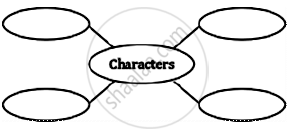
A1. Web -
Completely the following web by listing character mentioned in the extract :
A2. Poetic device -
Figure of speech :
‘Peace is a woman ?’
Name and explain the figure of speed in the above line.
A3. Personal response :
Suggest two solutions to avoid wars.
A4. Creativity :
Compose two poetic lines titled “Say ‘no’ to wars”.
But must I confess how I liked him,
How glad I was he had come like a guest in quiet, to drink at my water-trough
And depart peaceful, pacified, and thankless,
Into the burning bowels of this earth ?
(a) Who does ‘him’ refer to ?
(b) What dilemma did the poet face ?
(c) Pick out and explain the figure of speech used in line 2.
(d) Explain : ‘burning bowels of this earth’.
Read the following extract and answer the questions given below:
Now there is only one type of bobcat we see
The one that is for free, clearing the pavements of all debris
We used to walk through a footpath in a forest of pine
The smell intoxicating our lungs and mind
Now the only smell to be found comes from plastic trees
Swaying on my rear-view mirror, labelled pine breeze
We used to watch the valley play hide and seek
Questions:
(1) What signs of urbanisation are mentioned in the first six lines of the extract?
(2) Do you think skyscrapers are necessary? Why do you think so?
(3) Pick out the example of personification from the extract.
(4) Pick out the lines from the extract expressing the fond memory of the poet about the pines.
Read the following extract and answer the questions given below:
While I lay awake in bed,
God's still small voice came to me and said,
"While dealing with a stranger, common courtesy you use,
But the children you love, you seem to abuse.
Look on the kitchen floor,
You'll find some flowers there by the door.
Those are the flowers she brought for you.
She picked them herself, pink, yellow and blue.
She stood quietly not to spoil the surprise,
And you never saw the tears in her eyes."
(1) How did the mother deal with a stranger?
(2) What do you learn from this extract?
(3) Give the rhyming pairs of words from the extract. (Any two)
(4) Pick out the line from the extract suggesting the mother's
insensitive behavior towards her daughter.
