Advertisements
Advertisements
प्रश्न
Read the following poem and write an appreciation of it with the help of the given points in a paragraph format:
|
The Pulley When God at first made Man, So strength first made a way; For if I should (said He) Yet let him keep the rest, |
- The title of the poem (1)
- The poet (1)
- Central idea/theme (2)
- Rhyme scheme (1)
- Figure of speech (1)
- Special features (2)
- Favourite line/lines (1)
- Why I like/don’t like the poem (1)
Read the 'The Pulley' poem and write an appreciation of it with the help of the given points in paragraph format.
You can use the following points while appreciating the given poem.
- Title and Poet
- Rhyme Scheme
- Figure of Speech
- Theme/Central Idea (At Least 2 to 3 lines)
Advertisements
उत्तर १
The title of the poem is ‘The pulley’. The poet is George Herbert. The central idea of the poem is the reason for man's continual restlessness all his life. According to the poet, this is because God with held the quality of rest from man, so that man's thoughts would ultimately turn towards God, his creator. Each verse of the poem has five lines. The rhyme scheme of each verse is a-b-a-b-a. The chief figure of speech used in the poem is Metaphor. The 'glass of blessings' signifies the sum of all human qualities bestowed on man. The quality of 'rest' or 'Contentment' is implicitly compared to a ‘jewel’. This is a poem with a message. And the message is that however, rich we may be or whatever the abundance of qualities we may have, we must always turn our thoughts to God and thank him for the many blessings he has bestowed on us. My favourite line in this poem is 'Let him be rich and weary, This brings out the paradox of man's nature so well. Even the richest man in the world finally gets tired and experiences discontentment. This is what God intended for man. I like this poem very much because it teaches me not to be self-satisfied and contented but to always remember and thank God for all the blessings he has bestowed on me.
उत्तर २
Appreciation of the Poem ‘The Pulley’
The title of the poem is ‘The Pulley’, and it is written by George Herbert.
The central idea of the poem revolves around God’s creation of mankind. The poet describes how God granted humans various blessings such as strength, beauty, wisdom, and honor. However, He deliberately withheld “Rest” to ensure that humans do not become self-sufficient and forget God. The idea is that human beings, despite having everything, will always feel restless and ultimately turn to God for peace and fulfillment.
The poem follows the ABABA rhyme scheme, which gives it a smooth and rhythmic flow.
One of the significant figures of speech in the poem is Metaphor, where "The Pulley" symbolizes the way God draws humans toward Him through restlessness and weariness. Another important figure of speech is Personification, as God is given human-like qualities, such as speaking and making decisions.
The special features of the poem include its metaphysical nature, where deep philosophical and religious ideas are expressed through simple yet powerful imagery. The poem uses a conversational tone where God is depicted as directly speaking about His creation. It also conveys a moral lesson that true happiness and peace can only be found in devotion to God.
My favorite lines from the poem are:
“Yet let him keep the rest, / But keep them with repining restlessness.”
These lines emphasize that even with wealth and worldly pleasures, humans will always feel restless and seek God’s comfort.
I like this poem because it presents a thought-provoking idea about human nature and our connection with God. The metaphor of the pulley beautifully conveys how God ensures that humans always seek Him despite having all worldly possessions. The poem’s message is both philosophical and spiritual, making it deeply meaningful.
APPEARS IN
संबंधित प्रश्न
Read the following extract and answer the questions given below
What makes a nation's pillars high
And its foundations strong?
What makes it mighty to defy
The foes that round it throng?
It is not gold. Its kingdoms grand
Go down in battle shock;
Its shafts are laid on sinking sand,
Not on abiding rock.
(1) Why are the wealthy kingdoms unstable'? (1)
(2) Do you feel wars are the only solution to the problems between nations'? Explain. (1)
(3) Give the rhyming scheme used in the extract. (1)
(4) Pick out the words/expressions related to the mighty kingdom. (1)
Read the following extract and answer the questions given below:
Old women do not fly on magic wands
nor make obscure prophecies
from ominous forests.
They just sit on vacant park benches
in the quiet evenings,
call doves by their names
and charm them with grains of maize.
Or, trembling like waves
they stand in endless queues in
government hospitals.
(1) What do old women do in the quiet evenings?
(2) Do you feel old women should be looked after by their
families? Justify your answer.
(3) Name and explain the figure of speech in the following
line: 'Or, trembling like waves.'
(4) Pick out two pictorial images from the extract.
Read the following extract and answer the questions given below:
The banyan tree was three times as tall as our house
Its trunk had a circumference of fifty feet
Its scraggly aerial roots fell to the ground
From thirty feet or more so first they cut the branches
Sawing them off for seven days and the heap was huge
Insects and birds began to leave the tree
And then they came to its massive trunk
Fifty men with axes chopped and chopped
The great tree revealed its rings of two hundred years
We watched in terror and fascination this slaughter
(1) How does the poet describe the banyan tree?
(2) According to you, how are trees important to maintain ecological balance?
(3) Pick out an example of repetition from the extract.
(4) Pick out the words in the extract which are related to the killing.
Read the following extract and answer the questions given below:
While I lay awake in bed,
God's still small voice came to me and said,
"While dealing with a stranger, common courtesy you use,
But the children you love, you seem to abuse.
Look on the kitchen floor,
You'll find some flowers there by the door.
Those are the flowers she brought for you.
She picked them herself, pink, yellow and blue.
She stood quietly not to spoil the surprise,
And you never saw the tears in her eyes."
(1) What did the mother think as she lay sleepless in the bed?
(2) According to you, why shouldn't we hurt the feelings
of others?
(3) Pick out any two pairs of rhyming words from this
extract.
(4) What kind of poem is this? What is its purpose?
Read the extract and do the activities that follow: (4)
| Tom | : | (down L.). I believe the place is haunted |
| George | : | Nonsense. No one believes in haunted houses nowadays. There's someting gueer about the place, I'II admit, but can't be haunted. (Scream off R.) |
| Ginger | : | Listen! What was that ? (Scream repeated. This time much louder.) |
| Alfie | : | I want to go home ! |
| Tom | : | It sounds as though someone's being murdered. (Grappling with the door). I'm going to force this door. |
| Ginger | : | (Crossing L.) It's going to be a tough job, Tom |
| Alfie | : | (more lustily). I want to go home |
| George | : | (up C.) Shut up Alfie, you'II rose the house. Listen! There's someone coming _____ and it's someone in white |
| Ginger | : | It's a ghost |
| Alfie | : | (rushing to the door L.) I'm going home! |
| George | : | (coming down L.) Let me give you a hand with this door. |
| Tom | : | Buck up! |
| Ginger | : | Put your shoulder against it. (Enter the Ghost R. In the dim light his figure has a distinctly uncanny appearance). |
| Ghost | : | What on earth's the meaning of this commotion? (IIe switches on the light and is seen to be a dentist, wearing a white surgical coat. The “grinning mouths'' are seen to be models made of plaster of Paris. The boys stare about them in amazement) |
| Dentist | : | (sternly). Who are you, and what are you doing in my house? |
| Tom | : | I say – I'm awfully sorry – but we thought you were a ghost. |
| Dentist | : | (bewildered). A ghost! Why on earth should you think I was a ghost? |
| George | : | (crossing C.) I'm awfully sorry, sir. You see, we were out carol-singing, and____ |
| Dentist | : | Oh, so it was you who who were making that horrible din outside? |
| George | : | Yes – that was Ginger's idea ____ |
B1. Complete _____
Complete the following sentences:
(i) The boys considered the dentist as a ghost , because ________
(ii) Listening to the repeated scream, Tom thought that ________
(iii) The grinning mouths were models made of ________
(iv) The idea of carol-singing was given by _______
B2. Convert dialogue into a story:
Convert the above dialoguc into a story in about 50 words.
Read the following extract and answer the questions given below:
We used to walk down the snow sprinkled trail,
Maybe catch a glimpse of a bobcat, playing eye tricks with its tail
Now there is only one type of bobcat we see
The one that is for free, clearing the pavements of all debris
We used to walk through a footpath in a forest of pine
The smell intoxicating our lungs and mind
Now the only smell to be found comes from plastic trees
Swaying on my rear-view mirror, labelled pine breeze
Questions:
(1) What does the poet miss?
(2) What, according to you, are the causes of the degradation of our ecosystem?
(3) 'We used to walk down the snow sprinkled trail.'
Name and to explain the figure of speech from the above line.
(4) What kind of feelings are aroused after reading the extract?
Read the following extract and answer the questions given below :
If you accept counsel without getting sore
And re-assess yourself in the light thereof
If you pledge not to be obstinate any more
And meet others without any frown or scoff.
You may be the person I am looking for.
If you have the will to live and courage to die
You are a beacon-light for people far and wide
If you ignore the jeers and, thus, expose the lie
"That virtue and success do not go side by side."
You are the person I am looking for.
(1) What does the poet advise us about interacting with others?
(2) What good qualities do you expect in your friend?
(3) Name and explain the figure of speech in the following line:
"If you have the will to live and the courage to die."
(4) Pick out the words from the extract which denote negative traits.
Read the extract and do all the activities that follow:
We used to think seven generations ahead
Now we have become selfish
Only thinking about me, myself and I
Only thinking in the present, not learning from the past.
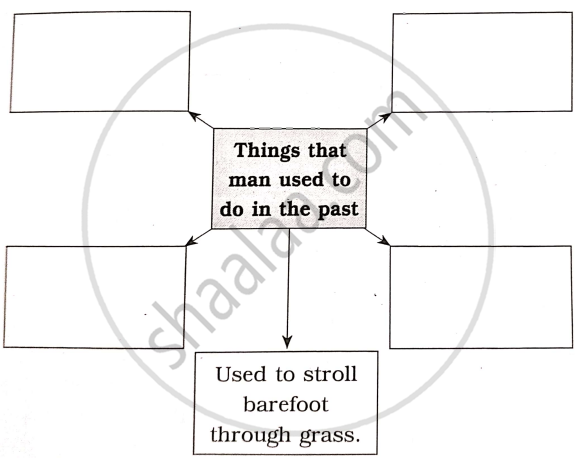
We used to stroll barefoot through the overgrown grass,
Its morning dew tickling our feet
Now we step outside onto the rugged concrete
No more natural than the over-processed food we eat
We used to walk down the snow sprinkled trail,
Maybe catch a glimpse of a bobcat, playing eye tricks with its tail
Now there is only one type of bobcat we see
The one that is fur-free, clearing the pavement of all debris
We used to walk through a footpath in a forest of pine
The smell intoxicating our lungs and mind
Now the only smell to be found comes from plastic trees.
Swaying on my rearview mirror, labelled pine breeze
we used to watch the valley play hide and seek
A1. Web :
Complete the web with the things man used to do in the past:
A2. Poetic Devices :
'We used to walk down the snow sprinkled trail'
Name the figure of speech in the above line and find out another example of the same from the extract.
A3. Personal Response :
Write in brief your views about past and present lifestyle.
A4. Poetic Creativity :
'Now we step outside onto the rugged concrete No more natural than the over-processed food.'
Read the above lines and compose at least two lines of your own. based on the same theme.
Read the following extract and answer the questions given below:
While I lay awake in bed,
God's still small voice came to me and said,
"While dealing with a stranger, common courtesy you use,
But the children you love, you seem to abuse.
Look on the kitchen floor,
You'll find some flowers there by the door.
Those are the flowers she brought for you.
She picked them herself, pink, yellow and blue.
She stood quietly not to spoil the surprise,
And you never saw the tears in her eyes."
(1) How did the mother deal with a stranger?
(2) What do you learn from this extract?
(3) Give the rhyming pairs of words from the extract. (Any two)
(4) Pick out the line from the extract suggesting the mother's
insensitive behavior towards her daughter.
Read the extract given below and answer the questions that follow:
|
I stand and look at them long and long. They do not sweat and whine about their condition. |
- The poet who has written these lines is ______.
- Robert Frost
- Carolyn Wells
- Walt Whitman
- Ogden Nash
- Who are ‘they’ referred to here?
- Animals
- Tigers
- Ananda’s friends
- Wanda’s dresses
- The poet looks at them long and long because he ______.
- Which word in the extract means ‘complain’?
