Please select a subject first
Advertisements
Advertisements
A lens forms an upright and diminished image of an object when the object is placed at its focal point. Name the lens and draw a ray diagram to show the image formation.
Concept: Images Formed by Convex Lenses
Ranbir claims to have obtained an image twice the size of the object with a concave lens. Is he correct? Give a reason for your answer.
Concept: Power of a Lens
A lens forms an erect, magnified, and virtual image of an object. Draw a labelled ray diagram to show the image formation.
Concept: Images Formed by Convex Lenses
The lens mentioned in 6(b) above is of focal length 25cm. Calculate the power of the lens.
Concept: Power of a Lens
Is it possible for a concave lens to form an image of size two times that of the object? Write Yes or No.
Concept: Images Formed by Concave Lenses
A convex lens of focal length 10 cm is placed at a distance of 60 cm from a screen. How far from the lens should an object be placed so as to obtain a real image on the screen?
Concept: Lens Formula
Linear magnification (m) produced by a concave lens is ______.
Concept: Sign Convention
A block of glass is pushed into the path of the light as shown below. Then the converging point x will:
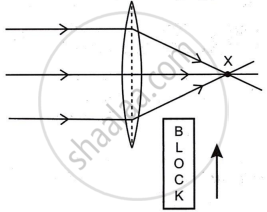
Concept: Action of a Lens as a Set of Prisms
The image of a candle flame placed at a distance of 36 cm from a spherical lens, is formed on a screen placed at a distance of 72 cm from the lens. Calculate the focal length of the lens and its power.
Concept: Lens Formula
Mixture of red + blue + green is passed through a convex lens as shown in the diagram below. State whether the ray passes through a single point or through different points on the principal axis after refraction.

Concept: Technical Terms Related to a Lens
Which color of white light is scattered the least and why?
Concept: Applications of Scattering of Light
Name the high energetic invisible electromagnetic waves which help in the study of the structure of crystals
Concept: Electromagnetic Spectrum
State an additional use of the X-rays waves
Concept: Electromagnetic Spectrum
Name the subjective property of light related to its wavelength.
Concept: Colour in White Light with Their Wavelength and Frequency Range
Name the radiation which can be detected by a thermopile.
Concept: Properties and Uses of Different Radiations of the Electromagnetic Spectrum
Why is the colour red used as a sign of danger?
Concept: Deviation Produced by a Triangular Prism
A wave has wavelength 50 Å.
- Name the wave.
- State its speed in vacuum.
- State its one use.
Concept: Electromagnetic Spectrum
The smoke from a fire looks white. Which of the following statements is true?
1) Molecules of the smoke are bigger than the wavelength of light
2) Molecules of the smoke are smaller than the wavelength of light.
Concept: Colour in White Light with Their Wavelength and Frequency Range
To which regions of the electromagnetic spectrum do the following wavelengths belong:
(a) 250 nm
(b) 1500 nm
Concept: Electromagnetic Spectrum
Name two sources of ultraviolet radiation.
Concept: Electromagnetic Spectrum
