Please select a subject first
Advertisements
Advertisements
Green light is incident at the polarising angle on a certain transparent medium. The angle of refraction is 30° . Find
(i) polarising angle, and
(ii) refractive index of the medium.
Concept: Polarisation
Can the interference pattern be produced by two independent monochromatic sources of light? Explain.
Concept: Refraction of Monochromatic Light
The intensity at the central maximum (O) in a Young’s double slit experimental set-up shown in the figure is IO. If the distance OP equals one-third of the fringe width of the pattern, show that the intensity at point P, would equal `(I_0)/4`.
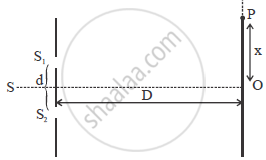
Concept: Interference
In Young’s double slit experiment, the slits are separated by 0.5 mm and screen is placed 1.0 m away from the slit. It is found that the 5th bright fringe is at a distance of 4.13 mm from the 2nd dark fringe. Find the wavelength of light used.
Concept: Interference
Derive the relation a sin θ = λ for the first minimum of the diffraction pattern produced due to a single slit of width ‘a’ using light of wavelength λ.
Concept: Diffraction of Light >> Seeing the Single Slit Diffraction Pattern
Using the monochromatic light of same wavelength in the experimental set-up of the diffraction pattern as well as in the interference pattern where the slit separation is 1 mm, 10 interference fringes are found to be within the central maximum of the diffraction pattern. Determine the width of the single slit, if the screen is kept at the same distance from the slit in the two cases.
Concept: Diffraction of Light >> Seeing the Single Slit Diffraction Pattern
What is the speed of light in a denser medium of polarizing angle 30?
Concept: Speed of Light
Define the term wavefront. Using Huygen’s wave theory, verify the law of reflection.
Concept: Huygens' Principle
Distinguish between unpolarized and linearly polarized light.
Concept: Plane Polarised Light
Answer the following question.
Define the term wavefront. Using Huygen's wave theory, verify the law of reflection.
Concept: Huygens' Principle
Explain how an unpolarised light gets polarised when incident on the interface separating the two transparent media.
Concept: Polarisation
Greenlight is an incident at the polarising angle on a certain transparent medium. The angle of refraction is 30°.
Find
(i) polarising angle, and
(ii) refractive index of the medium.
Concept: Polarisation
(a) Can the interference pattern be produced by two independent monochromatic sources of light? Explain.
(b) The intensity at the central maximum (O) in Young's double-slit experimental set-up shown in the figure is IO. If the distance OP equals one-third of the fringe width of the pattern, show that the intensity at point P, would `"I"_°/4`
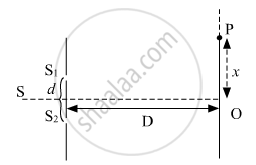
(c) In Young's double-slit experiment, the slits are separated by 0⋅5 mm and the screen is placed 1⋅0 m away from the slit. It is found that the 5th bright fringe is at a distance of 4⋅13 mm from the 2nd dark fringe. Find the wavelength of light used.
Concept: Refraction of Monochromatic Light
Derive the relation a sin θ = λ for the first minimum of the diffraction pattern produced due to a single slit of width 'a' using light of wavelength λ.
Concept: Diffraction of Light >> Seeing the Single Slit Diffraction Pattern
Using the monochromatic light of the wavelength in the experimental set-up of the diffraction pattern as well as in the interference pattern where the slit separation is 1 mm, 10 interference fringes are found to be within the central maximum of the diffraction pattern. Determine the width of the single slit, if the screen is kept at the same distance from the slit in the two cases.
Concept: Refraction of Monochromatic Light
Define a wavefront. Using 'Huygens' principle, draw the shape of a refracted wavefront, when a plane wave is incident on a convex lens.
Concept: Huygens' Principle
In Young's double-slit experiment, the two slits are separated by a distance of 1.5 mm, and the screen is placed 1 m away from the plane of the slits. A beam of light consisting of two wavelengths of 650 nm and 520 nm is used to obtain interference fringes.
Find the distance of the third bright fringe for λ = 520 nm on the screen from the central maximum.
Concept: Interference of Light Waves and Young’s Experiment
In Young's double-slit experiment, the two slits are separated by a distance of 1.5 mm, and the screen is placed 1 m away from the plane of the slits. A beam of light consisting of two wavelengths of 650 nm and 520 nm is used to obtain interference fringes.
Find the least distance from the central maximum where the bright fringes due to both the wavelengths coincide.
Concept: Width of Central Maximum
(a) A ray of light is incident normally on the face AB of a right-angled glass prism of refractive index aμg 1.5. The prism is partly immersed in a liquid of an unknown refractive index. Find the value of the refractive index of the liquid so that the ray grazes along the face BC after refraction through the prism.
(b) Trace the path of the rays if it were incident normally on the face AC.
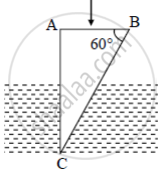
Concept: Reflection and Refraction of Plane Wave at a Plane Surface Using Wave Fronts
Choose the correct answer from given options
The relationship between Brewster angle θ and speed of light v in the denser medium is
Concept: Brewster's Law
