CBSE Science (English Medium) कक्षा १२ Important Questions for Physics - Dual Nature of Radiation and Matter
Advertisements
Advertisements
Chapter wise important questions with answers and solutions for Physics in CBSE Science (English Medium) कक्षा १२.
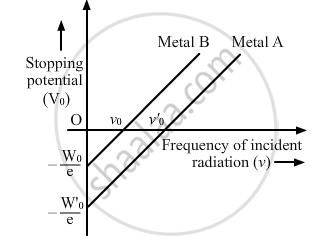
The graph shows the variation of stopping potential with frequency of incident radiation for two photosensitive metals A and B. Which one of the two has higher value of work-function? Justify your answer.
अध्याय: [11] Dual Nature of Radiation and Matter
How does one explain the emission of electrons from a photosensitive surface with the help of Einstein's photoelectric equation?
अध्याय: [11] Dual Nature of Radiation and Matter
The wavelength λ of a photon and the de-Broglie wavelength of an electron have the same value. Show that energy of a photon in (2λmc/h) times the kinetic energy of electron; where m, c and h have their usual meaning.
अध्याय: [11] Dual Nature of Radiation and Matter
Describe briefly how the Davisson-Germer experiment demonstrated the wave nature of electrons.
अध्याय: [11] Dual Nature of Radiation and Matter
Define the terms (i) ‘cut-off voltage’ and (ii) ‘threshold frequency’ in relation to the phenomenon of photoelectric effect.
Using Einstein’s photoelectric equation shows how the cut-off voltage and threshold frequency for a given photosensitive material can be determined with the help of a suitable plot/graph.
अध्याय: [11] Dual Nature of Radiation and Matter
Write two characteristic features observed is photoelectric effect which supports the photon pictures of electromagnetic radiation ?
अध्याय: [11] Dual Nature of Radiation and Matter
Draw a graph between the frequency of incident radiation (υ) and the maximum kinetic energy of the electrons emitted from the surface of a photosensitive material state clearly how this graph can be used to determine (i) Planck’s constant and (ii) work function of the material.
अध्याय: [11] Dual Nature of Radiation and Matter
Plot a graph to show the variation of stopping potential with frequency of incident radiation in relation to photoelectric effect.
अध्याय: [11] Dual Nature of Radiation and Matter
How does one explain the emission of electrons from a photosensitive surface with the help of Einstein’s photoelectric equation?
अध्याय: [11] Dual Nature of Radiation and Matter
The stopping potential in an experiment on photoelectric effect is 1.5V. What is the maximum kinetic energy of the photoelectrons emitted? Calculate in Joules.
अध्याय: [11] Dual Nature of Radiation and Matter
Answer the following question.
Why is the wave theory of electromagnetic radiation not able to explain the photoelectric effect? How does a photon picture resolve this problem?
अध्याय: [11] Dual Nature of Radiation and Matter
Name the factors on which photoelectric emission from a surface depends.
अध्याय: [11] Dual Nature of Radiation and Matter
An electron is accelerated from rest through a potential difference of 100 V. Find:
- the wavelength associated with
- the momentum and
- the velocity required by the electron.
अध्याय: [11] Dual Nature of Radiation and Matter
The energy of a photon of wavelength λ is ______.
अध्याय: [11] Dual Nature of Radiation and Matter
Which of the following graphs correctly represents the variation of a particle momentum with its associated de-Broglie wavelength?
अध्याय: [11] Dual Nature of Radiation and Matter
Sketch the graphs showing variation of stopping potential with frequency of incident radiations for two photosensitive materials A and B having threshold frequencies vA > vB.
(i) In which case is the stopping potential more and why?
(ii) Does the slope of the graph depend on the nature of the material used? Explain.
अध्याय: [11] Dual Nature of Radiation and Matter
Light of intensity ‘I’ and frequency ‘v’ is incident on a photosensitive surface and causes photoelectric emission. What will be the effect on anode current when (i) the intensity of light is gradually increased. In each case, all other factors remain the same. Explain, giving justification in each case.
अध्याय: [11] Dual Nature of Radiation and Matter
Light of intensity ‘I’ and frequency ‘v’ is incident on a photosensitive surface and causes photoelectric emission. What will be the effect on anode current when (ii) the frequency of incident radiation is increased. In each case, all other factors remain the same. Explain, giving justification in each case.
अध्याय: [11] Dual Nature of Radiation and Matter
Light of intensity ‘I’ and frequency ‘v’ is incident on a photosensitive surface and causes photoelectric emission. What will be the effect on anode current when the anode potential is increased? In each case, all other factors remain the same. Explain, giving justification in each case.
अध्याय: [11] Dual Nature of Radiation and Matter
Show that the wavelength of electromagnetic radiation is equal to the de Broglie wavelength of its quantum (photon).
