Please select a subject first
Advertisements
Advertisements
Choose the correct alternative from given options:
In the given figure, the movement on the production possibility curve from point A to point B shows _____________.
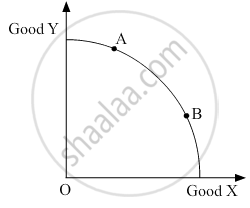
Concept: Concepts of Production Possibility Frontier
Identify and discuss the nature of the following newspaper reports in terms of positive or normative economic analysis:
(i) "India jumped 23 points in the World Bank's ease of doing business index to 77th place, highest in 2 years." – The Economic Times
(ii) "Government should further liberalise the business rules." – The Economic Times
Concept: Positive and Normative Economics
Answer the following question.
Gross Domestic Product (GDP) Does Not Give Us a Clear Indication of Economic Welfare of a Country. "Defend Or Refute the Given Statement with Valid Reason.
Concept: GDP and Welfare
Distinguish between positive externalities and negative externalities.
Concept: Factor Cost, Basic Prices and Market Prices
Discuss any two merits and demerits of the Green Revolution in the agricultural sector in the Indian economy.
Concept: Agriculture
State the meanings of the following:
Operating Surplus
Concept: Factor Cost, Basic Prices and Market Prices
Explain the role of microcredit in meeting credit requirements of the poor.
Concept: Credit and Marketing in Rural Areas
Distinguish between ‘Green Revolution’ and ‘Golden Revolution’.
Concept: Diversification into Productive Activities
"In India women participation rate is lower in urban areas than in the rural areas." Explain with valid arguments.
Concept: State of India’s Environment
“In rural areas of India more members of a family are engaged on work, yet the gross income of the family is generally low.”
Identify the type of unemployment indicated in the above statement and explain the paradox associated with it.
Concept: Concept of Unemployment
Give two examples of fixed costs.
Concept: Fixed Cost and Variable Cost
What happens to the difference between Average Total Cost and Average Variable Cost as production is increased?
Concept: Relationship Between Average Variable Cost and Average Total Cost and Marginal Cost
Choose the correct alternative from given options:
The average product curve in the input-output plane, will be ____________.
Concept: Shapes of Product Curves
Answer the following question.
"Indian Rupee (₹) plunged to an all-time low of ₹ 74.48 against the US Dollar ($)".
− The Economic Times
In light of the above report, discuss the impact of the situation on Indian Imports.
Concept: Determination of Equilibrium Income in the Short Run >> Effect of an Autonomous Change in Aggregate Demand on Income and Output
On the basis of following schedule, answer the given questions:
| Income (in ₹ crores) |
Savings (in ₹ crores) |
| 0 | -20 |
| 50 | -10 |
| 100 | 0 |
| 150 | 30 |
| 200 | 60 |
- Calculate Marginal Propensity to Save (MPS) at ₹ 150 crores level of income.
- What is the value of Autonomous Consumption?
Concept: Aggregate Demand and Its Components >> Consumption
"In an economy, the autonomous consumption is ₹ 100 and Marginal Propensity to Consume (MPC) is 0.6. If the equilibrium level of Income is 2,000, then the autonomous investment is ₹ 300." Justify the statement with valid calculation.
Concept: Aggregate Demand and Its Components >> Consumption
Distinguish between 'Fixed Investment' and 'Inventory Investment'.
Concept: Aggregate Demand and Its Components >> Investment
In an economy, the value of Marginal Propensity to Save (MPS) is 0.25, what will be the value of increase in income, if investments increased by ₹ 200 crores?
Concept: Aggregate Demand and Its Components >> Consumption
What is revenue expenditure?
Concept: Classification of Expenditure
Market for a good is in equilibrium. There is simultaneous "decrease" both in demand and supply of the good. Explain its effect on market price
Concept: Market Equilibrium
