Definitions [30]
Define interconversion of states of matter.
The process by which matter changes from one state to another and back to the original state, without any change in its chemical composition.
Define matter
Anything that has mass and occupies space is called matter.
Define the term Aqueous tension
The pressure exerted by saturated water vapour is called aqueous tension.
Define the term Hydrogen bond
The electrostatic force of attraction between a positively polarised hydrogen atom of one molecule and a highly electronegative atom (which may be negatively charged) of another molecule is called a hydrogen bond.
Define the term polarizability
Polarizability is defined as the ability of an atom or a molecule to form momentary dipoles, which means, the ability of the atom or molecule to become polar by redistributing its electrons.
Define the term Dipole moment
Dipole moment (μ) is the product of the magnitude of the charge (Q) and the distance between the centres of positive and negative charge (r). It is designated by a Greek Letter (μ) and its unit is Debye (D).
Define the term Dipole moment
Dipole moment (μ) is the product of the magnitude of the charge (Q) and the distance between the centres of positive and negative charge (r). It is designated by a Greek Letter (μ) and its unit is Debye (D).
Define the term Aqueous tension
The pressure exerted by saturated water vapour is called aqueous tension.
Define the term Hydrogen bond
The electrostatic force of attraction between a positively polarised hydrogen atom of one molecule and a highly electronegative atom (which may be negatively charged) of another molecule is called a hydrogen bond.
Define the term polarizability
Polarizability is defined as the ability of an atom or a molecule to form momentary dipoles, which means, the ability of the atom or molecule to become polar by redistributing its electrons.
A temperature scale with absolute zero (zero kelvin) as the starting point is called the absolute scale or the kelvin scale.
The volume of a given mass of a dry gas varies inversely as the pressure and directly as the absolute temperature.
V ∝ \[\frac {1}{P}\] × T or \[\frac {PV}{T}\] = k (constant)
If volume changes from V1 to V2, pressure from P1 to P2, and temperature from T1 to T2, then:
\[\frac {P_1V_1}{T_1}\] = \[\frac {P_2V_2}{T_2}\] = k (constant)
An atom is the smallest particle of an element that can take part in a chemical reaction; however, it may or may not exist independently.
A molecule is the smallest particle of an element or a compound that can exist by itself; it never breaks up except for taking part in a chemical reaction.
“The relation between three properties of a gas, i.e., pressure, volume and temperature, is called the ideal gas equation.”
OR
The relation between the three properties of a gas – pressure (P), volume (V), and temperature (T) – expressed as PV = nRT is called the ideal gas equation.
The equation that combines Boyle's Law, Charles' Law, and Gay-Lussac's Law into a single relation for a fixed mass of gas, relating the quantities pressure (P), volume (V), and temperature (T) which describe the state of the gas, is called the Equation of State.
A gas whose molecules are identical, spherical, rigid, and perfectly elastic point masses, which keep colliding among themselves and with the walls of the containing vessel in perfectly elastic collisions (total energy before collision = total energy after collision), and between which no attractive or repulsive force acts, is called an ideal gas.
Define interconversion of states of matter.
The process by which matter changes from one state to another and back to the original state, without any change in its chemical composition.
Define matter
Anything that has mass and occupies space is called matter.
Define the term ‘amorphous’.
The solids which do not possess the repeating ordered arrangement of atoms or ions are called amorphous solids.
Define unit cell.
A basic repeating structural unit of a crystalline solid is called a unit cell.
Define Anisotropy.
The ability of crystalline solids to change values of physical properties when measured in different directions is called anisotropy.
Packing efficiency is the ratio of volumes occupied by atoms in unit cell to the total volume of the unit cell. It is also known as the packing fraction or the density of packing.
A doped semiconductor, having higher conductivity than a pure intrinsic semiconductor, is an extrinsic semiconductor.
A pure semiconductor with very low but finite electrical conductivity is called an intrinsic semiconductor.
The process by which impurities are introduced into semiconductors to enhance their conductivity is called doping.
A doped semiconductor, having higher conductivity than a pure intrinsic semiconductor, is an extrinsic semiconductor.
A pure semiconductor with very low but finite electrical conductivity is called an intrinsic semiconductor.
The process by which impurities are introduced into semiconductors to enhance their conductivity is called doping.
Define the following term:
Ferromagnetism
Ferromagnetism is defined as the phenomenon in which substances, such as iron, cobalt and nickel, are strongly attracted by a magnetic field. Such substances are called ferromagnetic substances.
Formulae [3]
\[\frac{P_1V_1}{T_1}=\frac{P_2V_2}{T_2}\]
Combining the above three laws for a fixed mass of gas:
PV = nRT
PV = NkBT
where:
- P = pressure, V = volume, T = temperature
- n = number of moles, R = universal gas constant
- N = number of molecules, kB = Boltzmann's constant
Packing fraction or Packing efficiency = \[\frac{\text{Total volume of spheres}}{\text{Volume of the unit cell}}\times100\]
Theorems and Laws [13]
The total pressure of a gaseous mixture equals the sum of the partial pressures of all individual gases.
Partial pressure of a gas: Pi = xi × PTotal, where xi = mole fraction of gas i
Pressure of pure dry gas: Pdry gas = PTotal − Paq, where Paq = aqueous tension (vapour pressure of water)
Rate of diffusion of a gas is inversely proportional to the square root of its molar mass.
\[\frac{r_1}{r_2}=\sqrt{\frac{M_2}{M_1}}\]
\[\text{Rate of diffusion}=\frac{\text{Volume of gas diffused}}{\text{Time required for diffusion}}\]
Statement: For a given mass of gas at constant temperature, the volume of a gas is inversely proportional to its pressure.
- Constants held: mass of gas, temperature.
- P-V graph: Hyperbolic curve; P vs 1/V graph: straight line through origin.
- P increases → V decreases proportionally.
Charles' Law (Temperature–Volume Relationship)
At constant pressure (P) and number of moles (n), the volume of a gas is directly proportional to its absolute temperature.
\[V\propto T\quad\Rightarrow\quad\frac{V_1}{T_1}=\frac{V_2}{T_2}\]
The V–T curve at constant pressure is called an isobar
Absolute zero = 0 K = –273.15°C — the temperature at which gas volume theoretically becomes zero. It cannot be attained in practice (temperatures of ~0.000001 K have been achieved in labs)
or
Statement:
The volume of a fixed mass of gas is directly proportional to its absolute temperature if the pressure is kept constant.
Mathematically, V ∝ T ⇒ \[\frac {V}{T}\] = constant
Graph: V vs T (Isobar)
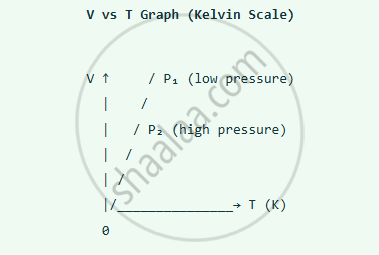 A straight line through the origin when using Kelvin. All lines converge at 0 K (absolute zero).
"Equal volumes of all gases at the same temperature and pressure contain equal numbers of molecules."
- Proposed by Avogadro in 1811.
- 1 mole of any gas at STP = 22.4 L (at 0°C, 1 atm) or 22.71 L (at 0°C, 1 bar — new IUPAC STP).
- 1 mole of any substance = 6.022 × 10²³ particles.
Avogadro's Law (Volume–Moles Relationship):
At constant temperature (T) and pressure (P), volume is directly proportional to number of moles.
When temperature is constant, the product of the pressure and volume of a gas remains constant.
When pressure is constant, the ratio of volume to temperature of a gas remains constant.
When volume is constant, the ratio of pressure to temperature of a gas remains constant.
At constant volume, the pressure of a fixed mass of gas is directly proportional to its temperature.
P ∝ T(at constant V)
At constant temperature, the volume of a fixed mass of gas is inversely proportional to its pressure.
V ∝ \[\frac {1}{P}\]
At constant pressure, the volume of a fixed mass of gas is directly proportional to its temperature.
V ∝ T(at constant P)
Name the law or principle to which the following observations confirm:
When 9650 coulombs of electricity is passed through a solution of copper sulphate, 3.175 g of copper is deposited on the cathode (at. wt. of Cu = 63.5).
Faraday’s first law of electrolysis: The mass of a substance deposited or liberated at an electrode is directly proportional to the quantity of electricity passed through the electrolyte.
Given: Charge passed = 9650 C
Atomic mass of Cu = 63.5
Valency of Cu in CuSO4 = 2
Equivalent mass of Cu = `63.5/2` = 31.75
Now, Mass deposited = `9650/96500 xx 31.75`
= 0.1 × 31.75
= 3.175 g
Name the law or principle to which the following observations confirm:
When 9650 coulombs of electricity is passed through a solution of copper sulphate, 3.175 g of copper is deposited on the cathode (at. wt. of Cu = 63.5).
Faraday’s first law of electrolysis: The mass of a substance deposited or liberated at an electrode is directly proportional to the quantity of electricity passed through the electrolyte.
Given: Charge passed = 9650 C
Atomic mass of Cu = 63.5
Valency of Cu in CuSO4 = 2
Equivalent mass of Cu = `63.5/2` = 31.75
Now, Mass deposited = `9650/96500 xx 31.75`
= 0.1 × 31.75
= 3.175 g
Key Points
Matter is categorised based on its chemical composition into two broad groups:
1. Pure Substances have a definite, fixed chemical composition. They are further divided into:
-
Elements — the simplest form of matter; cannot be broken down further by ordinary chemical means. Example: pure silver.
-
Compounds — formed when two or more elements chemically combine in a fixed ratio. Example: common salt (NaCl).
2. Mixtures have no fixed composition and therefore no definite properties. They are divided into:
-
Homogeneous Mixtures — constituents are uniformly distributed throughout the sample. Example: vinegar.
-
Heterogeneous Mixtures — constituents are not uniformly distributed. Example: tomato sauce.
Quick memory trick:
Pure → Fixed composition. Mixture → Variable composition.
| Property | Solid | Liquid | Gas |
|---|---|---|---|
| Mean molecular separation | ~3–5 Å | ~3–10 Å | >5 Å |
| Particle arrangement | Tightly packed, regular | Loosely packed, irregular | Highly irregular |
| Particle movement | Fixed positions, cannot move freely | Moves a small distance within liquid | Continuous random motion |
| Shape & volume | Definite shape and volume | Takes shape of container, definite volume | Takes shape and volume of container |
| Intermolecular space | Very small | Moderate | Large |
| Effect of temperature | Small volume change | Moderate volume change | Significant volume change |
| Compressibility | Practically incompressible | Slightly compressible | Highly compressible |
| Example | A piece of iron | Water, spirit, oil | Air |
Intermolecular forces are attractive (and repulsive) forces acting between neighbouring molecules. They are weaker than covalent or ionic bonds but determine the physical state of matter.
As intermolecular forces increase: Gas → Liquid → Solid (thermal energy decreases in the same direction).
Types of Intermolecular Forces:
| Type | Occurrence | Strength | Key Point | Example |
|---|---|---|---|---|
| Dipole–Dipole | Between polar molecules | Medium (3–4 kJ mol⁻¹) | +ve end attracts –ve end | HCl |
| Ion–Dipole | Between ion & polar molecule | Stronger than dipole–dipole | Depends on charge & size of ion | Na⁺ – H₂O |
| Dipole–Induced Dipole | Polar + non-polar molecule | Weak | Polar molecule induces dipole | NH₃ + C₆H₆ |
| London Dispersion | Non-polar molecules, noble gases | Weakest | Due to temporary dipoles | N₂, O₂, noble gases |
| Hydrogen Bonding | H with N, O, F | Strong (but < covalent) | Special dipole–dipole | HF, H₂O |
Intermolecular forces are attractive (and repulsive) forces acting between neighbouring molecules. They are weaker than covalent or ionic bonds but determine the physical state of matter.
As intermolecular forces increase: Gas → Liquid → Solid (thermal energy decreases in the same direction).
Types of Intermolecular Forces:
| Type | Occurrence | Strength | Key Point | Example |
|---|---|---|---|---|
| Dipole–Dipole | Between polar molecules | Medium (3–4 kJ mol⁻¹) | +ve end attracts –ve end | HCl |
| Ion–Dipole | Between ion & polar molecule | Stronger than dipole–dipole | Depends on charge & size of ion | Na⁺ – H₂O |
| Dipole–Induced Dipole | Polar + non-polar molecule | Weak | Polar molecule induces dipole | NH₃ + C₆H₆ |
| London Dispersion | Non-polar molecules, noble gases | Weakest | Due to temporary dipoles | N₂, O₂, noble gases |
| Hydrogen Bonding | H with N, O, F | Strong (but < covalent) | Special dipole–dipole | HF, H₂O |
- An ideal gas has point-mass molecules, no intermolecular forces, and perfectly elastic collisions.
- The Ideal Gas Equation, PV = nRT, combines all three laws into a single universal relationship.
- The Universal Gas Constant R = 8.314 J mol⁻¹ K⁻¹ is the same for all ideal gases.
- Real gases approximate ideal behaviour at low pressure and high temperature.
- Always use absolute temperature (Kelvin) in gas law calculations. T(K) = T(°C) + 273.15
- A gas consists of an extremely large number of tiny, discrete molecules whose actual volume is negligible compared to the total volume of the gas
- Gas molecules are in constant, random motion moving in straight lines; they change direction upon collisions with other molecules or container walls
- Intermolecular forces are negligible — molecules neither attract nor repel each other
- Effect of gravity on molecules is negligible
- All molecular collisions are perfectly elastic — total kinetic energy is conserved (though energy can be redistributed)
- Gas pressure is caused by molecular bombardment against the walls of the container
- Different molecules have different kinetic energies, but the average KE is directly proportional to absolute temperature: Average KE ∝ T
| Property | Solid | Liquid | Gas |
|---|---|---|---|
| Mean molecular separation | ~3–5 Å | ~3–10 Å | >5 Å |
| Particle arrangement | Tightly packed, regular | Loosely packed, irregular | Highly irregular |
| Particle movement | Fixed positions, cannot move freely | Moves a small distance within liquid | Continuous random motion |
| Shape & volume | Definite shape and volume | Takes shape of container, definite volume | Takes shape and volume of container |
| Intermolecular space | Very small | Moderate | Large |
| Effect of temperature | Small volume change | Moderate volume change | Significant volume change |
| Compressibility | Practically incompressible | Slightly compressible | Highly compressible |
| Example | A piece of iron | Water, spirit, oil | Air |
| Property | Ionic Solids | Covalent Network Solids | Molecular Solids | Metallic Solids |
|---|---|---|---|---|
| Particles | Cations and anions | Covalently bonded atoms | Mono/polyatomic molecules | Metal ions in a sea of electrons |
| Forces | Electrostatic | Covalent bonds | London, dipole-dipole, H-bonding | Metallic bonds |
| Hardness | Hard and brittle | Very hard | Soft | Soft to very hard |
| Melting point | 600–3000°C | 1200–4000°C | Low (−272 to 400°C) | −39 to 3400°C |
| Conductivity | Poor (solid); good (molten/aqueous) | Poor (except graphite; diamond conducts heat) | Poor | Good conductor of heat and electricity |
| Examples | NaCl, CaF₂ | Diamond, silica | Ice, benzoic acid | Na, Mg, Cu, Au |
Solids are classified into three groups based on conductivity:
| Type | Conductivity (Ohm⁻¹ m⁻¹) | Band Gap | Reason | Examples |
|---|---|---|---|---|
| Metallic conductors | 10⁴ – 10⁷ (very high) | No band gap (overlapping s & p bands) | Motion of electrons | Cu, Al, Ag |
| Insulators | 10⁻²⁰ – 10⁻¹⁰ (very low) | Large (forbidden zone) | Electrons cannot cross | Diamond, wood, rubber |
| Semiconductors | 10⁻⁶ – 10⁴ (moderate) | Small | Motion of interstitial electrons/holes | Si, Ge |
Conductivity of metals decreases with increase in temperature; conductivity of semiconductors increases with temperature.
Solids are classified into three groups based on conductivity:
| Type | Conductivity (Ohm⁻¹ m⁻¹) | Band Gap | Reason | Examples |
|---|---|---|---|---|
| Metallic conductors | 10⁴ – 10⁷ (very high) | No band gap (overlapping s & p bands) | Motion of electrons | Cu, Al, Ag |
| Insulators | 10⁻²⁰ – 10⁻¹⁰ (very low) | Large (forbidden zone) | Electrons cannot cross | Diamond, wood, rubber |
| Semiconductors | 10⁻⁶ – 10⁴ (moderate) | Small | Motion of interstitial electrons/holes | Si, Ge |
Conductivity of metals decreases with increase in temperature; conductivity of semiconductors increases with temperature.
Motion of electrons generates a magnetic field — each electron behaves like a tiny bar magnet with a magnetic moment measured in Bohr Magneton (μ_B) = 9.27 × 10⁻²⁴ A m².
| Type | Nature | Electron Configuration | Examples |
|---|---|---|---|
| Diamagnetic | Weakly repelled by magnetic field; magnetised in opposite direction | All electrons paired | NaCl, H₂O, N₂, C₆H₆, F₂, benzene |
| Paramagnetic | Weakly attracted by magnetic field; magnetised in same direction | Unpaired electrons; lose magnetism when field removed | O₂, Cu²⁺, Fe³⁺, Cr³⁺ |
| Ferromagnetic | Strongly attracted; can be permanently magnetised (all domains align in field direction) | Unpaired electrons + aligned domains | Fe, Co, Ni, Gd, CrO₂ |
Concepts [58]
- Classification of Matter
- States of Matter
- The Solid State
- The Liquid State
- The Gaseous State
- Intermolecular Forces
- Intermolecular Forces
- Dispersion Forces Or London Forces
- Dipole - Dipole Forces
- Dipole-induced Dipole Forces
- Hydrogen Bond
- Intermolecular Forces Vs. Thermal Interactions
- Gas Laws
- Boyle’s Law (Pressure - Volume Relationship)
- Charles’ Law (Temperature - Volume Relationship)
- Gay Lussac’s Law (Pressure- Temperature Relationship)
- Avogadro's Law
- Ideal Gas Equation
- Density and Molar Mass of a Gaseous Substance
- Dalton’s Law of Partial Pressures
- Absolute Scale of Temperature
- Kinetic Energy and Molecular Speeds
- Kinetic Molecular Theory of Gases
- Classification of Gases: Real Gases and Ideal Gases
- Behaviour of Real Gases: Deviation from Ideal Gas Behaviour
- Liquefaction of Gases
- Compressibility Factor
- Van Der Waals Equation
- Vapour Pressure
- Viscosity
- Surface Tension
- States of Matter
- General Characteristics of Solid State
- Amorphous and Crystalline Solids
- Classification of Crystalline Solids
- Crystal Lattices and Unit Cells
- Crystal Lattices and Unit Cells - Primitive and Centred Unit Cells
- Number of Atoms in a Unit Cell
- Bragg's Law and Its Applications
- Close Packed Structures of Solids
- Close Packed Structures - Formula of a Compound and Number of Voids Filled
- Packing Efficiency
- Packing Efficiency in hcp and ccp Structures
- Efficiency of Packing in Body-centred Cubic Structures
- Packing Efficiency in Simple Cubic Lattice
- Calculations Involving Unit Cell Dimensions
- Imperfections in Solids - Introduction
- Imperfections in Solids
- Types of Point Defects - Stoichiometric Defects
- Types of Point Defects - Impurity Defects
- Types of Point Defects - Non-stoichiometric Defects
- Properties of Solids: Electrical Properties
- Properties of Solids: Electrical Properties
- Conduction of Electricity in Metals
- Conduction of Electricity in Semiconductors
- Applications of n-type and p-type Semiconductors
- Properties of Solids: Magnetic Properties
- Crystal Structure of Solids
