Advertisements
Advertisements
प्रश्न
Write a scientific reason.
Lithium and sodium are included in the same group in the periodic table.
Advertisements
उत्तर
- Electronic configuration of lithium is (2, 1). The electronic configuration of sodium is (2, 8, 1).
- Both lithium and sodium have single electron in their outermost shell.
- Their valency is 1.
- In the periodic table, elements belonging to the same group have the same valency. Hence, lithium and sodium are included in the same group in the periodic table.
APPEARS IN
संबंधित प्रश्न
Nitrogen (atomic number 7) and phosphorus (atomic number 15) belong to group 15 of the Periodic Table. Write the electronic configuration of these two elements. Which of these will be more electronegative? Why?
Name the scientist who first of all showed that atomic number of an element is a more fundamental property than its atomic mass.
What is meant by a group, in a periodic table?
What is meant by a period, in a periodic table?
On the basis of electronic configuration, how will you identify chemically similar elements?
What is a group in the periodic table?
How many groups and periods does the modern periodic table have?
Correct the statement.
Copper and zinc are representative elements.
Correct the statement.
Transition elements are placed at extreme right of the periodic table.
Name two elements in each case:
Transition element
Name two elements in each case:
Actinides
Name the type of elements which have two electrons in the outermost orbit.
Answer the following in respect of element `31/15 P`
Give its electronic configuration
Name the noble gas with 3 shells.
Name the cation and the anion in the salt – calcium sulphate
Give the symbol and valency of the following element and radical.
Calcium
Give the symbol and valency of the following element and radical.
Chlorine [Chloride]
Give the symbol and valency of the following element and radical.
Nitrogen [Nitride]
Give the symbol and valency of the following element and radical.
Bisulphate
Give the symbol and valency of the following element and radical.
Carbonate
Give the symbol and valency of the following element and radical.
Sulphate
Give the chemical formula of calcium phosphate
The d-block elements are called as ______ elements.
p-block is composed of groups 1 and 2.
Write an explanation.
Period
In the modern periodic table, the positions of 1 to 20 elements are shown here. Identify the elements A and B. Write their atomic number.
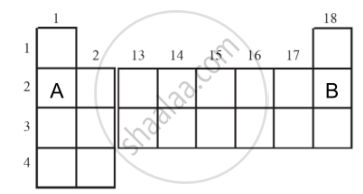
An X element with atomic number 11 and Y element with atomic number 13 belongs to the third period in the modern periodic table. With this information, give the answers of the below questions.
- Which element has more metallic character from these two elements?
- What is the valency of each X and Y elements?
- Atom size of Y element is smaller than atom size of X element? Explain?
Elements in the modern periodic table are arranged in ______groups and______ periods.
What are groups and periods in the modern periodic table?
State any five features of modern periodic table.
Which of the following is the outermost shell for elements of period 2?
Which of the following elements does not lose an electron easily?
“Hydrogen occupies a unique position in Modern Periodic Table”. Justify the statement.
Three elements A, B and C have 3, 4 and 2 electrons respectively in their outermost shell. Give the group number to which they belong in the Modern Periodic Table. Also, give their valencies.
If an element X is placed in group 14, what will be the formula and the nature of bonding of its chloride?
Compare the radii of two species X and Y. Give reasons for your answer.
- X has 12 protons and 12 electrons
- Y has 12 protons and 10 electrons
Spot the error:
The elements of group 13 are called the carbon family.
An element with atomic number ______ will form a basic oxide.
Name the non-metals in the first twenty elements.
