Advertisements
Advertisements
प्रश्न
Write a scientific reason.
Lithium and sodium are included in the same group in the periodic table.
Advertisements
उत्तर
- Electronic configuration of lithium is (2, 1). The electronic configuration of sodium is (2, 8, 1).
- Both lithium and sodium have single electron in their outermost shell.
- Their valency is 1.
- In the periodic table, elements belonging to the same group have the same valency. Hence, lithium and sodium are included in the same group in the periodic table.
APPEARS IN
संबंधित प्रश्न
Fill in the blank:
The modern periodic table consists of ……………. periods.
Name the scientist who first of all showed that atomic number of an element is a more fundamental property than its atomic mass.
Fill in the following blank with suitable word:
Group 18 elements are called ...............
Give two example of group 18 elements.
Explain why all the elements of a group have similar chemical properties.
Explain why all the elements of a period have different chemical properties.
State how the valency of elements varies in a period of the periodic table?
Define:
Periodic table
Name the scientist who stated the modern periodic law.
Name two elements in Inert gas.
Answer the following in respect of element `31/15 P`
Give its electronic configuration
An element barium has atomic number 56. Look up its position in the periodic table and answer the following question.
What will be the formula of its phosphate?
The electronic configuration of an element T is 2, 8, 8, 1.
What is the period number of T?
From the standpoint of atomic structure, what determines which elements will be the first and which the last in a period of the periodic table?
What is the number of elements in the 3rd period, of the modern periodic table?
Give the symbol and valency of the following element and radical.
Hydrogen
Give the symbol and valency of the following element and radical.
Magnesium
Give the symbol and valency of the following element and radical.
Oxygen [Oxide]
Give the chemical formula of sodium hydroxide
Give the chemical formula of calcium phosphate
How were elements arranged in the long form of the periodic table or the Modern Periodic Table?
Find the correlation:
Mendeleev’s periodic table : atomic mass : : Modern periodic table : _______
Find the correlation:
Group 13 to 18 : p block : : ______ : d block
Complete the following flow chart.
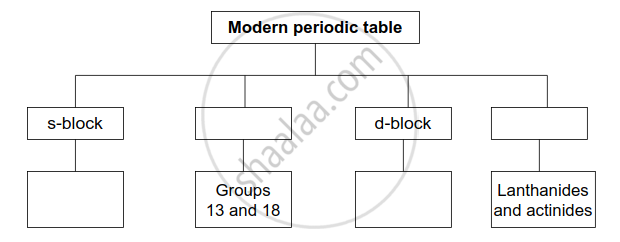
______ forms the basis of the modern periodic table.
______ and ______ are called inner transition elements.
The element which has the least tendency to lose electrons is ______
On moving from left to right in a period in the periodic table, the size of the atom ______
The element with atomic number 14 is hard and forms acidic oxide and a covalent halide. To which of the following categories does the element belong?
The longest period of the Modern Periodic Table is period.
The element with atomic number 14 is hard and forms acidic oxide and a covalent halide. To which of the following categories does the element belong?
Compare the radii of two species X and Y. Give reasons for your answer.
- X has 12 protons and 12 electrons
- Y has 12 protons and 10 electrons
State the group and period, of the element having three shells with three electrons in valence shell.
Name the metalloids in the first twenty elements.
Name the following metal:
A metal present in period 3, group 1 of the periodic table.
Answer the following in respect of element \[\ce{_16^32S}\].
Give its formula with hydrogen.
Match the atomic number with the following:
An element of group 2.
