Advertisements
Advertisements
प्रश्न
Why is it that the line of treatment for a genetic disease is different from infectious diseases?
Advertisements
उत्तर
The line of treatment for a genetic disease is different from infectious diseases because genetic disease cannot be treated with any medication only the signs and symptoms can be taken care of. The only way to treat them is by the manipulation of genes to correct or replace the faulty genes. On the other hand, infectious diseases are caused by pathogens and therefore, can be treated by substances that kill the pathogen or hamper its growth.
APPEARS IN
संबंधित प्रश्न
Suggest any two possible treatments that can be given to a patient exhibiting adenosine deaminase deficiency.
Diagrammatically represent the experimental steps in cloning and expressing an human gene (say the gene for growth hormone) into a bacterium like E. coli?
Describe the steps that are followed during secondary treatment of sewage.
Answer the following question.
Describe the roles of heat, primers, and the bacterium Thermus aquaticus in the process of PCR.
Answer the following question.
Explain the various steps involved in the production of artificial insulin.
ELISA is mainly used for ____________.
How was Insulin obtained before the advent of rDNA technology? What were the problems encountered?
If a person thinks he is infected with HIV, due to unprotected sex, and goes for a blood test. Do you think a test such as ELISA will help? If so why? If not, why?
ADA is an enzyme which is deficient in a genetic disorder SCID. What is the full form of ADA?
Which is false about antibiotics?
ELISA is based on:
The Adenosine deaminase deficiency results in ______.
Give the full form of ELISA. Which disease can be detected using it? Discuss the principle underlying the test.
Can a disease be detected before its symptoms appear? Explain the principle involved.
How is a mature, functional insulin hormone different from its prohormone form?
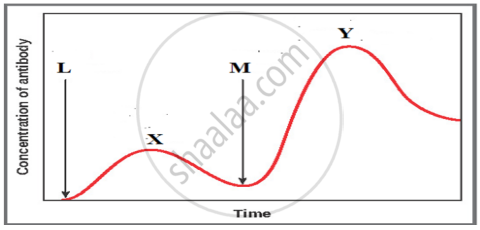
The graph given below indicates the administration of the first (L) and second dose (M) of a vaccine. The corresponding response of the body is indicated by X, and Y. Interpret the graph and explain the reason for such a response shown by the body.
In humans, somatic gene therapy was carried out to correct an immunodeficiency disease. Name this disease.
Atherosclerosis can be treated with recombinant protein called ______
Globally, approximately how many recombinant therapeutics have been approved for human use, and how many of them are currently marketed in India?
