Advertisements
Advertisements
प्रश्न
The diagram given below represents the schematic structure of proinsulin, which undergoes certain modifications before it becomes a fully functional insulin.
Study the diagram carefully and answer the questions that follow:

- State the change the proinsulin undergoes to become fully functional.
- Name the modern scientific technique used for the production of human insulin.
- How are the two polypeptide chains of the fully functional insulin held together?
Advertisements
उत्तर
- Proinsulin undergoes a chemical change in which the C-peptide is cleaved and eliminated before becoming completely functional as mature insulin. The C-chain breaks to generate an active insulin molecule.
- Recombinant DNA (rDNA) technology is used to produce human insulin.
-
Disulfide bonds connect the two polypeptide chains, the A chain (21 amino acids) and the B chain (30 amino acids), to form the fully functioning insulin molecule. These chains are linked by two disulfide bonds, while the A chain contains an additional internal disulfide bond. These connections are critical to insulin's structure and activity.
APPEARS IN
संबंधित प्रश्न
Expand the Given and mention one application of each:
ELISA
State the best-known contribution of P.K. Sethi
Answer the following question.
Explain the various steps involved in the production of artificial insulin.
How is the amplification of a gene sample of interest carried out using PCR?
What is genetically engineered Insulin?
Human insulin is being commercially produced forma transgenic species of ______.
Which is false about antibiotics?
Can a disease be detected before its symptoms appear? Explain the principle involved.
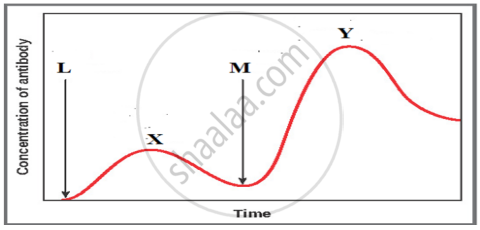
The graph given below indicates the administration of the first (L) and second dose (M) of a vaccine. The corresponding response of the body is indicated by X, and Y. Interpret the graph and explain the reason for such a response shown by the body.
Globally, approximately how many recombinant therapeutics have been approved for human use, and how many of them are currently marketed in India?
