Advertisements
Advertisements
प्रश्न
What is a recombinant DNA vaccine? Give two examples.
Advertisements
उत्तर
Recombinant DNA vaccines are the vaccines which are manufactured by Recombinant DNA technology. It involves the construction of a plasmid using a copy of DNA from pathogen with an empty plasmid.
Examples:
- Hepatitis B is produced from yeast culture (Saccharomyces cerevisiae).
- Japanese encephalitis vaccine.
APPEARS IN
संबंधित प्रश्न
Why do children cured by enzyme-replacement therapy adenosine deaminase deficiency need periodic treatment?
State the role of C-peptide in human insulin.
Diagrammatically represent the experimental steps in cloning and expressing an human gene (say the gene for growth hormone) into a bacterium like E. coli?
State the best-known contribution of P.K. Sethi
Describe the steps that are followed during secondary treatment of sewage.
Describe the role of bacterium Thermus aquaticus in carrying the process of polymerase chain reaction.
PCR proceeds in three distinct steps governed by temperature, they are in order of ____________.
Explain how recombinant Insulin can be produced.
A patient suffering from diabetes mellitus will have ______.
C-peptide of human insulin is ______.
Can a disease be detected before its symptoms appear? Explain the principle involved.
Discuss briefly how a probe is used in molecular diagnostics.
When a foreign DNA is introduced into an organism, how is it maintained in the host and how is it transferred to the progeny of the organism?
A host cell must be made competent, before it is able to receive an rDNA. Justify.
Explain how recombinant human insulin was prepared in 1983 by Eli Lily an American company.
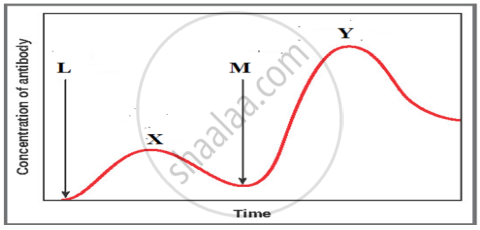
The graph given below indicates the administration of the first (L) and second dose (M) of a vaccine. The corresponding response of the body is indicated by X, and Y. Interpret the graph and explain the reason for such a response shown by the body.
The diagram given below represents the schematic structure of proinsulin, which undergoes certain modifications before it becomes a fully functional insulin.
Study the diagram carefully and answer the questions that follow:

- State the change the proinsulin undergoes to become fully functional.
- Name the modern scientific technique used for the production of human insulin.
- How are the two polypeptide chains of the fully functional insulin held together?
Choose the INCORRECT statement.
Globally, approximately how many recombinant therapeutics have been approved for human use, and how many of them are currently marketed in India?
