Advertisements
Advertisements
प्रश्न
When we write informal letters (to a friend, or to a member of our family) we use this layout.
|
33 Bhagat Singh Road Dear Dad (body of the letter - in paragraphs) Yours affectionately |
Advertisements
उत्तर
..............
APPEARS IN
संबंधित प्रश्न
The Shehnai of Bismillah Khan Thinking about the text :
Tick the right answer.
The (shehnai, pungi) was a ‘reeded noisemaker.’
Answer these question in 30–40 words.
How is a shehnai different from a pungi?
Who had these opinion about Einstein?
He was a freak.
Thinking about Language
Here are some sentences from the text. Say which of them tell you, that the author:
(a) was afraid of the snake, (b) was proud of his appearance, (c) had a sense of humour,
(d) was no longer afraid of the snake.
1. I was turned to stone.
2. I was no mere image cut in granite.
3. The arm was beginning to be drained of strength.
4. I tried in my imagination to write in bright letters outside my little heart the words, ‘O
God’.
5. I didn’t tremble. I didn’t cry out.
6. I looked into the mirror and smiled. It was an attractive smile.
7. I was suddenly a man of flesh and blood.
8. I was after all a bachelor, and a doctor too on top of it!
9. The fellow had such a sense of cleanliness…! The rascal could have taken it and used it
after washing it with soap and water.
10. Was it trying to make an important decision about growing a moustache or using eye
shadow and mascara or wearing a vermilion spot on its forehead?
Answer the following question in one or two sentences.
Had Abdul Kalam earned any money before that? In what way?
Read the comic strip based on. H.G. Wells' novells.


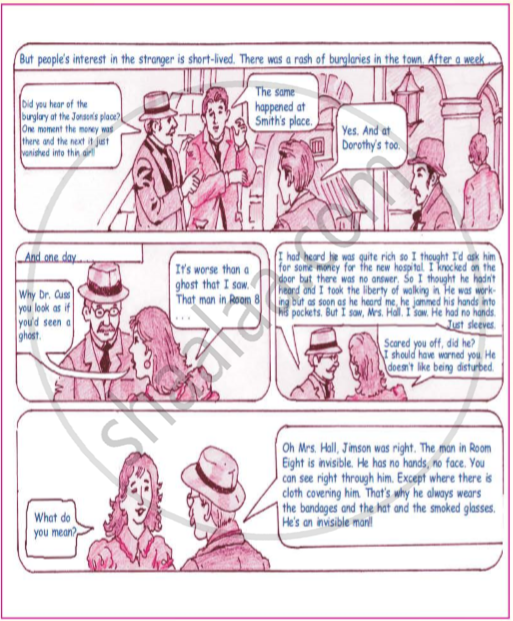
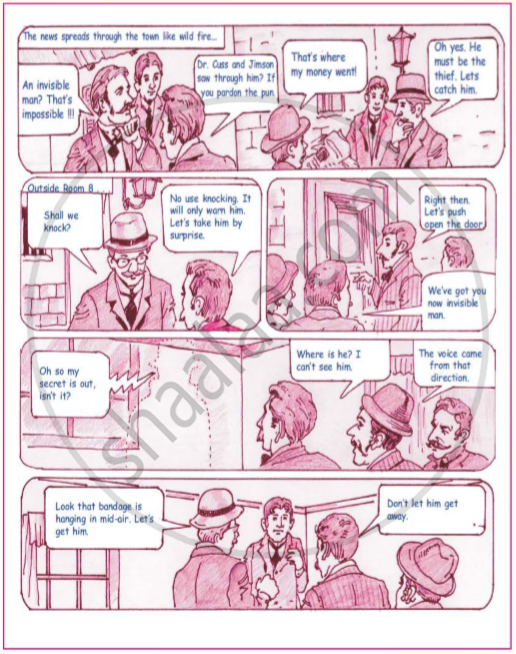
Answer the questions by ticking the correct option.
(a) The strange-looking man wanted ....
(i) the best room at the inn.
(ii} a room with a fire and a good lock.
(iii} a room with a good view.
(iv) a room where he could work quietly.
(b) Jimson was suspicious of the stranger because ...
(i} he did not answer Jimson's questions.
(ii} he did not want to talk about the weather.
(iii} he kept his back turned towards Jimson at all times.
(iv) he shouted atJimson when he entered his room.
(c) The people of the town gossiped about the stranger as ...
(i} he did not go out or talk to anyone in the town.
(ii} he had met with an accident and his face was bandaged.
(iii} he was new to the town and behaved rudely.
(iv) he stayed in his room and did not show his face to anyone.
(d) 'There was a rush of burglaries in the town. This means that ________
(i} there were many robberies in the town.
(ii) a few people in the town had seen a rob her.
(iii} the burglaries in the town were done in a rush.
(iv) the burglar was a rash and careless man.
(e) Although Jimson and Dr Cuss are suspicious of the strange guest, Mrs Hall tolerates him because ....
(i} she is not superstitious or ignorant.
(ii) she is sorry for the stranger who is bandaged.
(iii} the stranger is paying her a good amount of money for the room.
(iv} the stranger is polite and kind to Mrs Hall at all times.
(f) The stranger who was staying at the inn can be described as being ....
(I} violent
(ii} upright
(iii} dishonest
(iv) sensible
What does he plant who plants a tree? a
He plants a friend of sun and sky;b
He plants the flag of breezes free;
The shaft of beauty, towering high;
He plants a home to heaven anigh;
For song and mother-croon of bird
In hushed and happy twilight heard____
The treble of heaven's harmony_____
These things he plants who plants a tree.
Read the lines given above and answer the question that follow:
Old Kaspar took it from the boy,
Who stood expectant by;
And then the old man shook his head,
And,with a natural sigh,
"Tis some poor fellow's skull," said he,
"Who fell in the great victory.
"I find them in the garden,
For there's many here about;
And often when I go to plough,
The ploughshare turns them out!
For many thousand men,"said he,
"Were slain in that great victory."
Read the lines given above and answer the question that follow.
Explain with reference to context.
The waves beside them danced, but they
Out-did the sparkling leaves in glee;
A poet could not be but gay,
In such a jocund company!
I gazed-and gazed-but little thought
What wealth the show to me had brought:
Read the lines given above and answer the question that follow.
Explain with reference to context.
Of the seven hundred villages dotting the map of India, in which the majority of India’s five hundred million live, flourish and die, Kritam was probably the tiniest, indicated on the district survey map by a microscopic dot, the map being meant more for the revenue official out to collect tax than for the guidance of the motorist, who in any case could not hope to reach it since it sprawled far from the highway at the end of a rough track furrowed up by the iron-hooped wheels of bullock carts. But its size did not prevent its giving itself the grandiose name Kritam, which meant in Tamil coronet or crown on the brow of the subcontinent. The village consisted of fewer than thirty houses, only one of them built from brick and cement and painted a brilliant yellow and blue all over with
gorgeous carvings of gods and gargoyles on its balustrade, it was known as the Big House. The other houses, distributed in four streets, were generally of bamboo thatch, straw, mud and other unspecified material. Muni’s was the last house in the fourth street, beyond which stretched the fields. In his prosperous days Muni had owned a flock of sheep and goats and sallied forth every morning driving the flock to the highway a couple of miles away.
Read the extract given below and answer the question that follow.
What did the Big House look like?
The village consisted of less than thirty houses, only one of them built with brick and cement. Painted a brilliant yellow and blue all over with gorgeous carvings of gods and gargoyles on its balustrade, it was known as the Big House. The other houses, distributed in four streets, were generally of bamboo thatch, straw, mud, and other unspecified material. Muni’s was the last house in the fourth street, beyond which stretched the fields. In his prosperous days Muni had owned a flock of forty sheep and goats and sallied forth every morning driving the flock to the highway a couple of miles away.
Read the extract given below and answer the question that follow.
What did Muni’s wife cook for him in the morning? How did she cook it?
What information does Gilman give to Twisden? Why did Twisden decide to withdraw from the case ?
In which situation is the lead held high? What does he mean by 'knowledge is free'? What are 'narrow domestic walls'?
Notice how in a comic book, there are no speech marks when characters talk. Instead what they say is put in a speech ‘bubble’. However, if we wish to repeat or ‘report’ what they say, we must put it into reported speech.
Change the following sentences in the story to reported speech. The first one has been done for you.
I want to see the king.
Gopal told the guards_________________
What was the connection between the motor and the fan’s Chatter?
Fill in the blank in the sentence below with the words or phrases from the box. (You may not know the meaning of all the words. Look such words up in a dictionary, or ask your teacher.)
This ____________ we are going to have a class exhibition.
Multiple Choice Question:
What does the word harvest mean?
Replace the italicised portion of the sentence below with a suitable phrase from the box. Make necessary changes, wherever required.
They criticised him in the meeting but he accepted without protest all the criticism.
Your partner and you may now be able to answer the question.
From the way the child envies the hawker, the gardener, and the watchman, we can guess that there are many things the child has to do, or must not do. Make a list of the do’s and don’ts that the child doesn’t like. The first line is done for you.
| The child must come home at a fixed time. | The child must not get his clothes dirty in the dust. |
|
|
|
Now add to the list your own complaints about the things you have to do, or must not do.
Complete the following sentences by providing a reason.
Macbeth returns to the witches in Act IV Scene i because ______.
