Advertisements
Advertisements
प्रश्न
What would happen if a large volume of untreated sewage is discharged into a river?
Advertisements
उत्तर
It untreated sewage is discharged directly into rivers it will lead to serious pollution of the waters with organic matter and pathogenic bacteria, Protozoa and many other diseases. This water, if used will cause outbreaks of water-borne diseases.
APPEARS IN
संबंधित प्रश्न
Explain the role of microbes in sewage treatment.
Explain the different steps involved during primary treatment phase of sewage.
Explain the process of sewage water treatment before it can be discharged into natural water bodies.
Answer the following question.
What are ‘flocs’, formed during secondary treatment of sewage?
What are flocs with respect to sewage treatment?
Due to which of the following reason/s sewage water cannot be discharged directly into river?
Small part of activated sludge is passed back into ______ and major part is pumped into large tanks called ______.
Identify the INCORRECT statement with respect to sewage treatment.
In a sewage treatment plant, all of the following processes belong to secondary treatment except:
What is the group of bacteria found in both the rumen of cattle and shidge of sewage treatment?
Study the given diagram of the Sewage Treatment Plant (S.T.P.) and answer the question that follows:
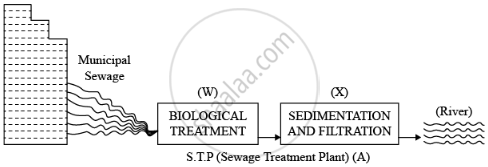
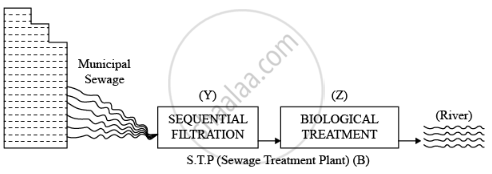
- Which one of the two 'S.T.P.' (A) or (B) will be more effective in treating the human excreta in municipal waste?
- Write the steps followed in carrying the treatment of the sewage in step (Z), once the BOD of sewage is reduced significantly till it is passed on to the "anaerobic sludge digesters".
Which one is wrongly matched?
After a significant reduction in the BOD of wastewater, it is passed into a settling tank where bacterial flocs are allowed to sediment. This sediment is called ______.
During primary sewage treatment, floating debris is separated by which physical process?
In a sewage treatment plant, grit comprising soil and small pebbles is removed during which stage and process?
What happens to the polluting potential of wastewater as its Biochemical Oxygen Demand (BOD) increases?
Which mixture of gases is collectively produced as biogas during anaerobic sludge digestion?
Approximately what percentage of suspended solids is removed during primary sedimentation in a sewage treatment plant?
