Advertisements
Advertisements
प्रश्न
The aeration tank of a sewage treatment plant is not functioning properly. Explain in detail the impact of this on the treatment of sewage and BOD of the effluent.
Advertisements
उत्तर
- It will adversely affect the secondary treatment or biological treatment of sewage.
- When the aeration tank is not functional, the air will not be pumped into it.
- This will not allow the vigorous growth of useful aerobic microbes into flocs (masses of bacteria associated with fungal filaments to form mesh-like structures).
- Thus, the major part of the organic matter in the effluent will not be consumed by these bacteria.
- The BOD (biochemical oxygen demand) of the effluent will not be reduced. BOD refers to the amount of oxygen that would be consumed if all the organic matter in one litre of water were oxidised by bacteria.
- The greater the BOD of wastewater, the more its polluting potential. Thus, the effluent will remain polluted with a high amount of organic matter and high BOD.
APPEARS IN
संबंधित प्रश्न
Explain the process of secondary treatment given to the primary effluent up to the point it shows significant change in the level of biological oxygen demand (BOD) it.
Distinguish between the roles of flocs and anaerobic sludge digesters in sewage treatments.
Describe how do 'flocs' and 'activated sludge' help in Sewage Treatment.
Answer the following question.
What are ‘flocs’, formed during secondary treatment of sewage?
Small part of activated sludge is passed back into ______ and major part is pumped into large tanks called ______.
Which of the following occurs during secondary treatment?
Study the given diagram of the Sewage Treatment Plant (S.T.P.) and answer the question that follows:
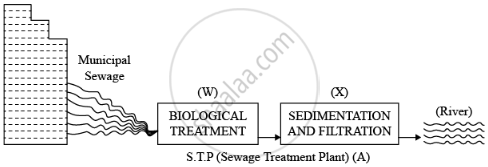
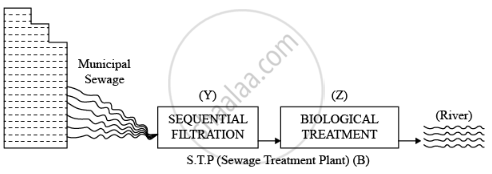
- Which one of the two 'S.T.P.' (A) or (B) will be more effective in treating the human excreta in municipal waste?
- Write the steps followed in carrying the treatment of the sewage in step (Z), once the BOD of sewage is reduced significantly till it is passed on to the "anaerobic sludge digesters".
Biochemical Oxygen Demand (BOD) serves as an indirect measure of which water quality parameter?
What is the primary composition of municipal sewage by mass?
Approximately what percentage of suspended solids is removed during primary sedimentation in a sewage treatment plant?
