Advertisements
Advertisements
प्रश्न
What is the coordination entity formed when excess of aqueous KCN is added to an aqueous solution of copper sulphate? Why is it that no precipitate of copper sulphide is obtained when H2S(g) is passed through this solution?
Advertisements
उत्तर
When aqueous KCN solution is added to aqueous copper sulphate solution, [Cu(CN)4]2− coordination species is obtained as follows:
\[\ce{[Cu(H2O)4]^2+ + 4CN- -> [Cu(CN)4]^2- + 4H2O}\]
The coordination species thus formed [Cu(CN)4]2− is very stable because CN– is a strong ligand. Hence, on passing H2S gas through this solution, CuS precipitate is not obtained because free Cu2+ ions are unavailable.
संबंधित प्रश्न
Classify the following ligands into monodentate and polydentate —
- Ammonia
- Carbon monoxide
- Ethylene diamine
- Ethylene diamine tetra acetate ion
Give the oxidation state, d-orbital occupation and coordination number of the central metal ion in the following complex:
(NH4)2[CoF4]
Give the oxidation state, d-orbital occupation and coordination number of the central metal ion in the following complex:
[Mn(H2O)6]SO4
IUPAC name of the following compound is
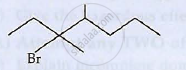
(a) 3 - Bromo- 3, 4- dimethylheptane
(b) 3, 4- dimethyl - 3- bromoheptane
(c) 5- Bromo- 4, 5- dimethylheptane
(d) 4, 5- dimethyl- 5- bromoheptane
Write IUPAC names of the following compounds:

How is Benzonitrile converted to Benzophenone?
Write the structures of compounds A, B and C in the following reactions:

Write the structures of compounds A, B and C in the following reactions

Which of the following represents a chelate ligand?
In which of the following compounds the oxidation state of the nickel atom is 0?
The correct \[\ce{IUPAC}\] name of \[\ce{[Pt(NH3)2Cl2]}\] is ______.
Arrange the following complexes in the increasing order of conductivity of their solution:
[Co(NH3)3Cl3], [Co(NH3)4Cl2]Cl, [Co(NH3)6]Cl3, [Cr(NH3)5Cl]Cl2
A coordination compound \[\ce{CrCl3.4H2O}\] precipitates silver chloride when treated with silver nitrate. The molar conductance of its solution corresponds to a total of two ions. Write structural formula of the compound and name it.
Oxidation number of cobalt in K[Co(CO)4] is
In which of the following compounds, the oxidation number of iodine is fractional?
The complex which has no d electrons in the central atom is:-
According to IUPAC nomenclatures, sodium nitroprusside is named as
How many ions are produced from the complex Co(NH3)6]Cl2 in solution?
What is meant by a didentate ligand?
