Advertisements
Advertisements
प्रश्न
What is dehydrohalogenation? State the rule for the formation of the preferred product of dehydrohalogenation.
Advertisements
उत्तर
- Dehydrohalogenation reaction: When an alkyl halide having at least one β-hydrogen is boiled with an alcoholic solution of potassium hydroxide (KOH), it undergoes elimination of hydrogen atom from β-carbon and halogen atom from α-carbon resulting in the formation of an alkene. As hydrogen and halogen are removed in this reaction, it is termed a dehydrohalogenation reaction.
- Saytzeff’s rule:
Statement - “In dehydrohalogenation reaction, the preferred product is that alkene which has a greater number of alkyl groups attached to doubly bonded carbon atoms.”
संबंधित प्रश्न
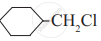
from the following pair would undergo SN2 faster from the other?

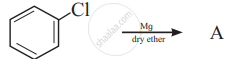
Complete the following reaction giving major products.
Name the reagent used to bring about the following conversion.
1-Chloropropane to 1-nitropropane
Arrange the following in the increasing order of boiling points.
- 1-Bromopropane
- 2- Bromopropane
- 1- Bromobutane
- 1-Bromo-2-methylpropane
Distinguish between SN1 and SN2 mechanism of substitution reaction.
Convert the following:
Ethanol to propane nitrile
Convert the following:
tert-Butyl bromide to isobutyl bromide
Complete the following reaction sequence by writing the structural formulae of the organic compound 'A', 'B' and 'C'.
\[\ce{2-Bromobutane->[Alc.KOH]A->[][Br2]B->[][NaNH2]C}\]
Complete the following reaction sequence by writing the structural formulae of the organic compound 'A', 'B' and 'C'.
\[\ce{Isopropyl alcohol ->[\triangle][PBr3] A ->[][NH3 excess] B}\]
Observe the following and answer the question given below.

Can it react by SN1 mechanism? Justify your answer.
Major product of the following reaction is _______________
\[\ce{CH3-CH2-Mg-Br + NH3 ->?}\]
Nucleophilic substitution reaction of 2, 4-dinitrochlorobenzene is faster than p-nitrochlorobenzene. Give reason.
In alkaline hydrolysis of tertiary butyl bromide, ____________.
The least reactive towards nucleophilic addition reactions is ____________.
Ethyl bromide undergoes the following reaction:
\[\ce{\underset{Ethyl bromide}{C2H5Br} + \underset{(aq.)}{KOH} ->[\Delta] \underset{Ethyl alcohol}{C2H5OH} + KBr}\]
Which of the following is a WRONG statement?
Nitroalkanes are obtained in laboratory from primary or secondary alkyl halides by the action of ______.
Which of the following carbocation is the most stable?
Which of the following is FALSE regarding SN2 reaction mechanism?
Complete the following reactions giving major product.
\[\begin{array}{cc}
\ce{CH3}\phantom{................}\\
|\phantom{...................}\\
\ce{CH3 - C - CH2 - Cl ->[Na/dry ether] A}\\
|\phantom{...................}\\
\ce{CH3}\phantom{.................}
\end{array}\]
What is the action of following on ethyl bromide?
alcoholic sodium hydroxide
Complete the reaction:
\[\ce{CH3CH2Cl ->[AgCN][alc.\Delta]}\] ?
Identify the chiral molecule from the following.
Complete the following reaction giving major product.
\[\begin{array}{cc}
\ce{CH3}\phantom{................}\\
|\phantom{...................}\\
\ce{CH3 - C - CH2 - Cl->[Na/ dry ether]A}\\
|\phantom{...................}\\
\ce{CH3}\phantom{................}\\
\end{array}\]
Complete the following reaction giving major product.
\[\begin{array}{cc}
\ce{CH3}\phantom{.................}\\
|\phantom{...................}\\
\ce{CH3 - C - CH2 - Cl ->[Na/dry ether] A}\\
|\phantom{...................}\\
\ce{CH3}\phantom{.................}\\
\end{array}\]
Complete the following reaction giving major product.
\[\begin{array}{cc}
\ce{CH3}\phantom{................}\\
|\phantom{...................}\\
\ce{CH3 - C - CH2 - Cl ->[Na/dry ether] A}\\
|\phantom{...................}\\
\ce{CH3}\phantom{................}\\
\end{array}\]
Identify the substrate 'X' in the following reaction.
\[\ce{\underset{}{X + O2} ->[i) Co-naphtenate 423 K][ii) dil HClΔ] \underset{\underset{}{}}{Phenol + Acetone}}\]
