Advertisements
Advertisements
प्रश्न
What does the poem say about the poet’s choice of subject?
Advertisements
उत्तर
The poem is a reflection of the poet’s desire to compose poetry on most mundane elements that we come across in our day to day surrounding. A squirrel is the most commonly found animal that we see around us. Yet, very few of us would have thought of it as a potent subject matter for a writer’s pen. The poet very simplistically discusses the various aspects of the squirrel, which each one of us must have observed closely.
संबंधित प्रश्न
Answer these question in one or two words or in short phrase.
Name the two temples the author visited in Kathmandu.
Six humans trapped by happenstance
In black and bitter cold.
Each one possessed a stick of wood,
Or so the story's told.
Their dying fire in need of logs;
The first man held his back.
For on the faces around the fire,
He noticed one was black.
Read the lines given above and answer the question that follow:
Why does the poet use this diction?
“So that is what you are doing out here? A marshal!” “My dear Miss Fairchild,” said ’ Easton, calmly, “I had to do something. Money has & way of taking wings unto itself, and
you know it takes money to keep step with our crowd in Washington. I saw this opening in the West, and—well, a marshalship isn’t quite as high a position as that of ambassador, but—” “The ambassador,” said the girl, warmly, “doesn’t call any more. He needn’t ever have done so. You ought to know that. And so now you are one of these dashing Western heroes, and you ride and shoot and go into all kinds of dangers. That’s different from the Washington life. You have been missed from the old crowd.” The girl’s eyes, fascinated, went back, widening a little, to rest upon the glittering handcuffs. “Don’t you worry about them, miss,” said the other man. “All marshals handcuff themselves to their prisoners to keep them from getting away. Mr. Easton knows his business.” “Will we see you again soon in Washington?” asked the girl. “Not soon, I think,” said Easton. “My butterfly days are over, I fear.”
Read the extract given below and answer the question that follow.
What does Mr Easton mean by the phrase, “My butterfly days are over, I fear.”
This woman had been despised, scoffed at, and angrily denounced by nearly every man, woman, and child in the village; but now, as the fact of, her death was passed from lip to lip, in subdued tones, pity took the place of anger, and sorrow of denunciation.
Neighbours went hastily to the old tumble-down hut, in which she had secured little more than a place of shelter from summer heats and winter cold: some with grave-clothes for a decent interment of the body; and some with food for the half-starving children, three in number. Of these, John, the oldest, a boy of twelve, was a stout lad, able to earn his living with any farmer. Kate, between ten and eleven, was bright, active girl, out of whom something clever might be made, if in good hands; but poor little Maggie, the youngest, was hopelessly diseased. Two years before a fall from a window had injured her spine, and she had not been able to leave her bed since, except when lifted in the arms of her mother.
“What is to be done with the children?” That was the chief question now. The dead mother would go underground, and be forever beyond all care or concern of the villagers. But the children must not be left to starve.
Read the extract given below and answer the question that follow.
Why did the neighbour’s attitude change when they heard the news of her death?
She lighted another match, and then she found herself sitting under a beautiful Christmas-tree. It was larger and more beautifully decorated than the one which she had seen through the glass door at the rich merchant’s. Thousands of tapers were burning upon the green branches, and colored pictures, like those she had seen in the show- windows, looked down upon it all. The little one stretched out her hand towards them, and the match went out.
The Christmas lights rose higher and higher, till they looked to her like the stars in the sky. Then she saw a star fall, leaving behind it a bright streak of fire. “Someone is dying,” thought the little girl, for her old grandmother, the only one who had ever loved her, and who was now dead, had told her that when a star falls, a soul was going up to God.
Read the extract given below and answer the question that follow.
Describe the Christmas tree.
Discuss the following topic in groups.
When a group of bees finds nectar, it informs other bees of it's location, quantity, etc. through dancing. Can you guess what ants communicate to their fellow ants by touching one another’s feelers?
Whose advice did the king finally think of seeking?
What were the replies the king received for his first question?
What was special about the Arabian horse?
Was it right for the author’s friend to dismantle the bicycle?
- What steps did he take to save himself?
- Did his plan work? How?
What do you know about Tansen’s life before he joined Akbar’s court?
Discuss these questions in small groups before you answer them.
When do you think an adult would say this?
No one thinks you are funny.
There are twelve words hidden in this table. Six can be found horizontally and the remaining six vertically. All of them are describing words like ‘good’, ‘happy’, etc. The first letters of the words are given below:
Horizontal: H R F F S G
Vertical: A W S F L Q 2020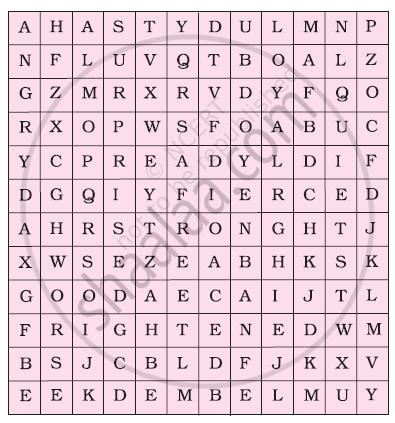
Read these lines from the poem:
(i) One thing led to another
(ii) The start of it was slight
(iii) The end of it was strong
(iv) The afternoon turned black
(v) Thumped me on the back
Discuss with your partner what these lines mean.
Answer the following question.
Nasir wants to learn ______________________________________________
Talk to your partner and say whether the following statement is true or false.
Most snakes are harmless.
Look at the following phrases and their meanings. Use the phrase to fill in the blank in the sentence given below.
We should _____________ a little money every month.
Put each of the following in the correct order. Then use them appropriately to fill in the blanks in the paragraph that follows. Use correct punctuation marks.
- English and Hindi/both/in/he writes
- and only / a few short stories/many books in English/in Hindi
- Is/my Hindi / than my English/much better
Ravi Kant is a writer and ………….. Of course, he is much happier writing in English than in Hindi. He has written …………….. . I find his books a little hard to understand ………………… .
Read the following extract from Stephen Leacock’s short story, ‘With the Photographer’ and answer the questions that follow:
|
“The photographer beckoned me in. I thought he seemed quieter and graver than before. I think, too, there was a certain pride in his manner. He unfolded the proof of a large photograph, and we both looked at it in silence. ‘Is it me?’ I asked. “Yes,” he said quietly, ‘it is you,” and we went on looking at it.” |
- Where was the narrator?
Why had he gone there?
Why do you think that there was a certain pride in the photographer's manner? [3] - What does the word "proof” mean in this context?
Why did the narrator ask, “Is it me?”? [3] - Which of the narrator's facial features had the photographer altered? [3]
- What was the only part of the narrator's face that seemed original in the photograph?
How did the photographer plan to ‘fix’ this? [3] - At the end of the story, the narrator flies into a rage.
What makes him angry?
How would you justify the narrator's angry outburst? [4]
