Advertisements
Advertisements
प्रश्न
Using the distance formula, show that the given points are collinear:
(1, -1), (5, 2) and (9, 5)
Advertisements
उत्तर
Let A (1,-1), B(5,2) and C(9,5) be the give points. Then
`AB= sqrt((5-1)^2 +(2+1)^2 ) = sqrt(4^2+3^2) = sqrt(25) = 5` unts
`BC = sqrt((9-5)^2 +(5-2)^2 ) = sqrt((4^2+3^2)) = sqrt(25)` = 5 units
`AC= sqrt((9-1)^2 +(5+1)^2) = sqrt(8^2+6^2) = sqrt(100)`=10 unit
∴ AB+BC = (5+5) units = 10 units = AC
APPEARS IN
संबंधित प्रश्न
Find the distance between the following pairs of points:
(−5, 7), (−1, 3)
ABC is a triangle and G(4, 3) is the centroid of the triangle. If A = (1, 3), B = (4, b) and C = (a, 1), find ‘a’ and ‘b’. Find the length of side BC.
Find the centre of the circle passing through (6, -6), (3, -7) and (3, 3)
Find the co-ordinates of points of trisection of the line segment joining the point (6, –9) and the origin.
Find the distance between the following pair of points.
L(5, –8), M(–7, –3)
The perimeter of a triangle with vertices (0, 4), (0, 0) and (3, 0) is ______.
Find the distance of the following point from the origin :
(0 , 11)
Find the distance between the following point :
(sin θ , cos θ) and (cos θ , - sin θ)
Find the distance of a point (13 , -9) from another point on the line y = 0 whose abscissa is 1.
Find the coordinate of O , the centre of a circle passing through A (8 , 12) , B (11 , 3), and C (0 , 14). Also , find its radius.
Prove that the points (7 , 10) , (-2 , 5) and (3 , -4) are vertices of an isosceles right angled triangle.
Prove that the points (0 , -4) , (6 , 2) , (3 , 5) and (-3 , -1) are the vertices of a rectangle.
Given A = (3, 1) and B = (0, y - 1). Find y if AB = 5.
Show that each of the triangles whose vertices are given below are isosceles :
(i) (8, 2), (5,-3) and (0,0)
(ii) (0,6), (-5, 3) and (3,1).
If the distance between point L(x, 7) and point M(1, 15) is 10, then find the value of x.
Show that the point (0, 9) is equidistant from the points (–4, 1) and (4, 1).
Find the value of a, if the distance between the points A(–3, –14) and B(a, –5) is 9 units.
The points A(–1, –2), B(4, 3), C(2, 5) and D(–3, 0) in that order form a rectangle.
Read the following passage:
|
Alia and Shagun are friends living on the same street in Patel Nagar. Shagun's house is at the intersection of one street with another street on which there is a library. They both study in the same school and that is not far from Shagun's house. Suppose the school is situated at the point O, i.e., the origin, Alia's house is at A. Shagun's house is at B and library is at C. |
Based on the above information, answer the following questions.
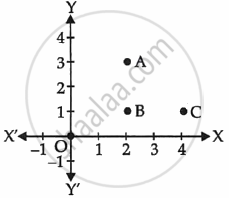
- How far is Alia's house from Shagun's house?
- How far is the library from Shagun's house?
- Show that for Shagun, school is farther compared to Alia's house and library.
OR
Show that Alia’s house, shagun’s house and library for an isosceles right triangle.
The distance of the point (5, 0) from the origin is ______.
