Advertisements
Advertisements
प्रश्न
Underline the verb and choose the correct option from the options.
They are sportsmen.
विकल्प
singular
plural
Advertisements
उत्तर
They are sportsmen- plural.
APPEARS IN
संबंधित प्रश्न
Change the following sentence into simple sentence.
Einstein smiled and put his arm across my shoulder.
Present Progressive
(Progressive = continuous)
Form

S +is/ am/ are +verb+ ing
S +is/ am/ are+ not+ verb+ ing.
Is/am/me+ S + verb+ing?
S + is/ am/ are +being+ Verb (past participle)
- Complete the following sentences by filling in the blanks with the present progressive form of the given verbs.
i. "You've put on weight, Cheryl."
"Yes. I.. .... (eat) a lot these days."
ii. "Hurry up! We ... (get) late for school."
"Justa second, please! I ... (come}."
iii. Temperatures ... (rise} all over the world.
iv. "You .... not ... (wear) this dirty shirt to office. Wait, I'll give you another."
v. "l...not ... (do) your homework-forget it. I still haven't forgotten how you
fought with me in the morning."
vi. The Prime Minister ... (leave) for Russia tomorrow on a 5 day state visit.
Vii "You ... (be) ver:yrude, Abhi."
viii. She ... always (make) excuses for coming late.
ix. Aabha ... (write) a novel these days.
- The table below shows different uses or meanings of the present progressive. Match the verbs in the above sentences with the uses or meanings they convey.
| a. Something pre-arranged or a fixed plan ............ b. Insistence............. c. Annoyance............ d. Repeated action............. e. Some development or change........... f. Emphatic refusal............. g. Something happening 'around now'.............. h. An action just starting.......... i. Temporary action not necessarily taking place at the moment of speaking............ |
*It is a little difficult to match the sentences with uses of present progressive
tense. Here are the answers:
a-vi, b-iv, c-vii, d-i, e-iii, f-v, g-ix, h-ii, i-viii.
Compare your answers with these and have a class discussion.
Study the following picture carefully and then write a paragraph to describe what is happening.
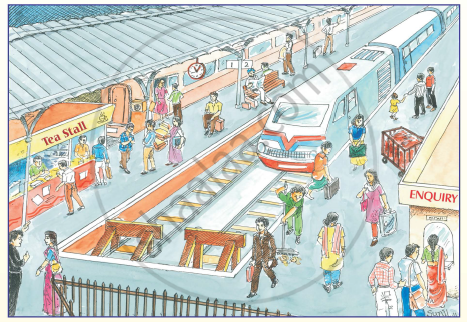
Look at the incomplete sentences below. Using the information provided, complete each sentence using a suitable tense. Follow the examples:
1947 until now India I has been (be) independent since 1947.
1947 India became (become) independent in 1947.
1. 1947 until now l There --------- (be) manywars.
2. 1991 There ------- (be) a war in the Persian Gulf.
3. 1953 -------- Edmund Hilary and Tensing first (climb) Everest.
4. 1953 until now Many people ________ (climb)Everest.
5. 1983 India --------- (win) the Prudential Cricket World Cup in England.
6. 1983 until now India -------- (win) many limited-overs cricket trophies.
As Susie, write a reply to Nikita's letter. Do take care to answer all the
questions Nikita has asked you. What verb forms would you like to use?
Milan
25th October, 2011
Dear Nikita
.............................................................................................................................................
.............................................................................................................................................
.............................................................................................................................................
Yours
Susie
Simple Past Tense-Past Perfect Tense
Underline the main verbs in the sentences below. Then, rewrite the sentences in the correct order of events.
1) The people began to starve.
2) In 1925, a disease destroyed the crops in one village.
3) Later, the village people came to retrieve their children
4) The chief decided to send the children of the village to live in a settlement in the next valley.
5) However, they had married outside the village.
6) This caused a war between the two villages.
__________________
__________________
Now work with your partner and tick (✓) the sentence in which a different tense has been used. In pairs, discuss why this has been done.
Sentence No: 5 uses a different tense because ..................................................................................................................................................
..................................................................................................................................................
Study the following sentences.
1) I didn't know Jim had migrated to the United States.
2) When we arrived at the theatre, the show had already begun.
3) The patient had died before the ambulance reached the hospital.
4) He had got married by the time he started working.
5) I couldn't open the locker because I had mislaid the keys.
6) Byom Bakshi felt that he had seen the man somewhere before.
As you can see, each of the above sentences describes two different actions, events or situations. Work with a partner and list them as shown in the example.
| A. Occurred First | B. Occurred Later |
| 1. Example: Jim had migrated to the United States. | 1. I did not know it. The speaker came to know the fact later.) |
| 2. | 2. |
| 3. | 3. |
| 4. | 4. |
| 5. | 5. |
| 6. | 6. |
What verb forms have been used in (A) and (B) respectively?
A. ....................................................................
B ....................................................................
What conclusion can you draw from your analysis?
...................................................................
...................................................................
Complete the following sentences correctly by using the simple past or
past perfect forms of the given verbs.
1) We ____ already (reach) home when Irlan __ (say) that he (forget) his books at school.
2) Wendy (wake up) late, then she ____ (miss) her school bus, so by the time she (reach) school, it already (start).
3) I ___ (visit) my town again ten years after I _____ (leave) it and ___ (find) thatit completely (change).
4) When Feroze and Mehr (meet) for the first time, they ___ _ (not like) each other but now they are married.
Now write short paragraphs to describe the trends in the other groups of visitors featured in the graph.
• Overseas Visitors
....................................................
....................................................
• Domestic Visitors
....................................................
....................................................
• Total Number ofVisitors
....................................................
....................................................
The Dauphin will give me all I need.
(Rewrite the sentence using the present perfect tense)
Read this sentence.
M. Hamel had said that he would question us on participles.
In the sentence above, the verb form “had said” in the first part is used to indicate an “earlier past.” The whole story is narrated in the past. M. Hamel’s “saying” happened earlier than the events in this story. This form of the verb is called the past perfect.
Pick out five sentences from the story with this form of verb and say why this form has been used.
Use the correct tense form of the verb given in the bracket and rewrite the sentence.
All this ________ destroyed in a few years.
Use the correct tense form of the verb given in the bracket and rewrite the sentence.
She ______ like a dressmaker’s dummy standing there.
Name the Tense of the Verb underlined to include Time (Past/Present/Future) and Aspect (Simple/Continuous/Perfect/Perfect Continuous).
You haven’t found it.
Name the Tense of the Verb underlined to include Time (Past/Present/Future) and Aspect (Simple/Continuous/Perfect/Perfect Continuous).
We were designing the first Macintosh computer.
Name the Tense of the Verb underlined to include Time (Past/Present/Future) and Aspect (Simple/Continuous/Perfect/Perfect Continuous).
It had made all the difference.
Name the Tense of the Verb underlined to include Time (Past/Present/Future) and Aspect (Simple/Continuous/Perfect/Perfect Continuous).
I am fine, now.
Name the Tense of the Verb underlined to include Time (Past/Present/Future) and Aspect (Simple/Continuous/Perfect/Perfect Continuous).
I have been facing death.
Name the Tense of the Verb underlined to include Time (Past/Present/Future) and Aspect (Simple/Continuous/Perfect/Perfect Continuous).
I shall be telling you three stories.
Change the Tense as instructed.
The dots will somehow connect. (Past Perfect)
Change the Tense as instructed.
I started the company. (Present Continuous)
Change the Tense as instructed.
My doctor advised me. (Past Perfect Continuous)
Rewrite the sentence as per the instruction given along with it.
She surveyed the area for the vicious male langur.
(Rewrite the sentence in the Simple Future Tense)
Rewrite the sentence as per the instruction given along with it.
She simply sat there quietly.
(Rewrite the sentence in the Present Continuous Tense)
Underline the verb and choose the correct option from the options.
Preeti even wrote about it.
Underline the verb and choose the correct option from the options.
Rahul finds Maths easy.
Underline the verb and choose the correct option from the options.
Preeti was scornful.
Match the sentences given in part ‘A’ with the sentences given in part ‘B’. Note the differences in structure.
| ‘A’ Part | B’ Part |
| (1) He was kidnapped by an extremist militia. | (a) They forced the child to kill his friends and family |
| (2) The child was forced to kill his friends and family. | (b) An extremist militia kidnapped him. |
Observe the following underlined phrases. Here ‘have /has’ are followed by the past participle form of the verb. This construction indicates the perfect present tense. Find more such sentences from the speech.
- We have made progress in the last couple of decades.
- We have prevented millions of child deaths.
- It has happened.
- ________________________
- ________________________
- ________________________
Rewrite in the past perfect continuous tense:
The marlin fights for its life desperately.
Form two present participle in which the last letter is doubled.
Rewrite the sentence in future tense:
I am doing it.
Rewrite the sentence in simple future tense.
He has been playing since afternoon.
Fill in each of the numbered blanks with the correct form of the word given in brackets. Do not copy the passage but write in correct serial order the word or phrase appropriate to the blank space.
It was hot in the railway compartment and the fan ______ (1) (not work). The elderly lady ______ (2) (use) up all her water because she had cheerfully shared it with her fellow passengers. She knew that the train ______ (3) (halt) at the station for only three minutes. Calling a shoeshine boy she said, ‘Will you help me? I ______ (4) (need) a bottle of cold water and here is the money,' and she put a twenty rupee note in his hand. The boy snatched the money and ______ (5) (disappear) into the crowd on the platform. A fellow passenger ______ (6) (cannot believe) what he had witnessed. ‘What ______ (7) (you do)?’ He said, ‘You ______ (8) (never see) your money again.' Just then the whistle was heard and the train began to move. At that moment the child appeared at the window with the water. 'Your water,' he gasped, out of breath. ‘And the change.'
