Advertisements
Advertisements
प्रश्न
Two straight line AB and CD intersect one another at the point O. If ∠AOC + ∠COB + ∠BOD = 274°, then ∠AOD =
विकल्प
86°
90°
94°
137°
Advertisements
उत्तर
Let us draw the following diagram showing two lines AB and CD intersecting at a point O.
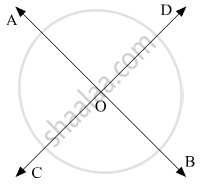
Thus,
\[\angle \text { AOD}, \angle \text { AOC }, \angle \text { COB } \text { and } \angle \text { BOD }\] form a complete angle, that is the sum of these four angle is 360°.
That is,
It is given that
∠AOC + ∠COB +BOD = 274° ...(ii)
Subtracting (ii) from (i), we get:
∠AOD =360° - 274°
∠AOD = 86°
APPEARS IN
संबंधित प्रश्न
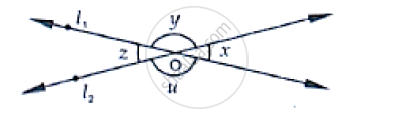
In the below fig, lines �1 and �2 intersect at O, forming angles as shown in the figure. If x = 45, Find the values of x, y, z and u.
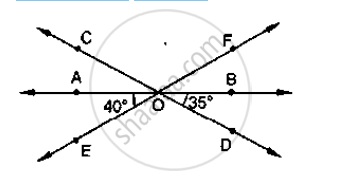
In the below fig, lines AB, CD and EF intersect at O. Find the measures of ∠AOC, ∠COF,
∠DOE and ∠BOF.
Consider the following statements:
When two straight lines intersect:
(i) adjacent angles are complementary
(ii) adjacent angles are supplementary
(iii) opposite angles are equal
(iv) opposite angles are supplementary
Of these statements
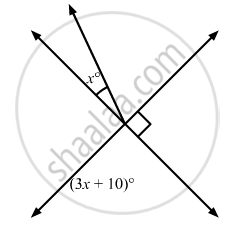
In the given figure, the value of x is ______.
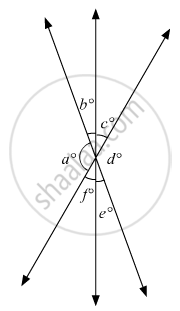
In the given figure, which of the following statements must be true?
(i) a + b = d + c
(ii) a + c + e = 180°
(iii) b + f = c + e
Look at the picture given below. Decide whether the lines given in picture is parallel or perpendicular to each other and write the answer in the box.
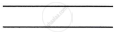
Look at the picture given below. Decide whether the lines given in picture is parallel or perpendicular to each other and write the answer in the box.

Two parallel lines meet each other at some point.
What is the geometric relationship between two straight lines in the same plane that will never intersect, no matter how much they are extended?
If the shortest distance between two straight lines in a plane is observed to change, what must be true about the lines?
