Advertisements
Advertisements
प्रश्न
Consider the following statements:
When two straight lines intersect:
(i) adjacent angles are complementary
(ii) adjacent angles are supplementary
(iii) opposite angles are equal
(iv) opposite angles are supplementary
Of these statements
विकल्प
(i) and (ii) are correct
(ii) and (iii) are correct
(i) and (iv) are correct
(ii) and (iv) are correct
Advertisements
उत्तर
Let us draw the following diagram showing two straight lines AD and BC intersecting each other at a point O.
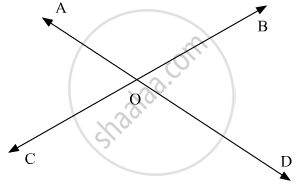
Now, let us consider each statement one by one:
(i) When two lines intersect adjacent angles are complementary.
This statement is incorrect
Explanation:
As the adjacent angles form a linear pair and they are supplementary.
(ii) When two lines intersect adjacent angles are supplementary.
This statement is correct.
Explanation:
As the adjacent angles form a linear pair and they are supplementary.
(iii) When two lines intersect opposite angles are equal.
This statement is correct.
Explanation:
As the vertically opposite angles are equal.
(iv) When two lines intersect opposite angles are supplementary.
This statement is incorrect.
Explanation:
As the vertically opposite angles are equal
Thus, out of all, (ii) and (iii) are correct.
APPEARS IN
संबंधित प्रश्न
How many pairs of adjacent angles are formed when two lines intersect in a point?
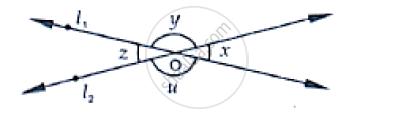
In the below fig, lines �1 and �2 intersect at O, forming angles as shown in the figure. If x = 45, Find the values of x, y, z and u.
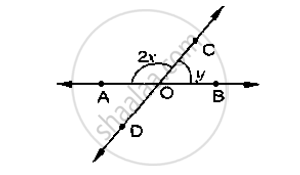
In the below fig, rays AB and CD intersect at O.
Determine y when x = 60°
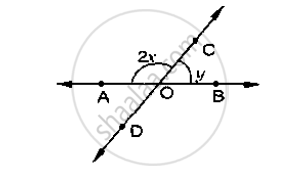
In the below fig, rays AB and CD intersect at O
Determine x when y =40
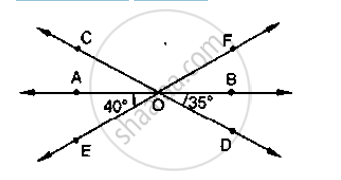
In the below fig, lines AB, CD and EF intersect at O. Find the measures of ∠AOC, ∠COF,
∠DOE and ∠BOF.
Give two examples of parallel lines you can see in your environment.
Mention two real life situations where we use parallel lines
Two parallel lines meet each other at some point.
Which phrase correctly describes the distance between two parallel lines?
In the example of a 'Zebra crossing,' what feature specifically exemplifies the constant distance property of parallel lines?
