Advertisements
Advertisements
प्रश्न
Two lines are respectively perpendicular to two parallel lines. Show that they are parallel to each other.
Advertisements
उत्तर
Given Two lines m and n are parallel and another two lines p and q are respectively perpendicular to m and n.
i.e., p ⊥ m, p ⊥ n, q ⊥ m, q ⊥ n
To prove p || g
Proof Since, m || n and p is perpendicular to m and n.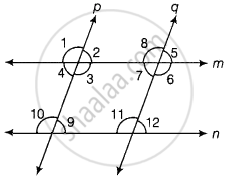
∴ ∠1 = ∠10 = 90° ...[Corresponding angles]
Similarly, ∠2 = ∠9 = 90° ...[Corresponding angles]
∴ ∠4 = ∠9 = 90° and ∠3 = ∠10 = 90° ...[Alternative interior angles] [∵ p ⊥ m and p ⊥ n]
Similarly, if m || n and q is perpendicular to m and n.
Then, ∠7 = 90° and ∠11 = 90°
Now, ∠3 + ∠7 = 90° + 90° = 180°
So, sum of two interior angles is supplementary.
We know that, if a transversal intersects two lines such that a pair of interior angles on the same side of the transversal is supplementary, then the two lines are parallel.
Hence, p || g.
APPEARS IN
संबंधित प्रश्न
In the below fig, three coplanar lines intersect at a point O, forming angles as shown in the figure. Find the values of x, y, z and u.
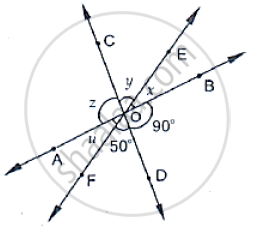
Prove that the bisectors of a pair of vertically opposite angles are in the same straight line.
In the below fig, rays AB and CD intersect at O
Determine x when y =40
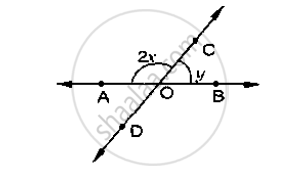
Two lines AB and CD intersect at O. If `∠`AOC + `∠`COB + `∠`BOD = 270°, find the
measures of `∠`AOC, `∠`COB, `∠`BOD and `∠`DOA.
Given ∠POR = 3x and ∠QOR = 2x + 10°. If POQ is a straight line, then the value of x is
In the given figure, AOB is a straight line. If ∠AOC + ∠BOD = 85°, then ∠COD =
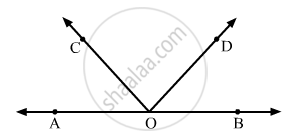
In the given figure, the value of x is ______.
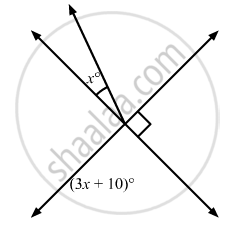
Two lines AB and CD intersect at O. If ∠AOC + ∠COB + ∠BOD = 270°, then ∠AOC =
Look at the picture given below. Decide whether the lines given in picture is parallel or perpendicular to each other and write the answer in the box.
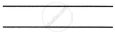
Which phrase correctly describes the distance between two parallel lines?
