Advertisements
Advertisements
प्रश्न
Two lines are respectively perpendicular to two parallel lines. Show that they are parallel to each other.
Advertisements
उत्तर
Given Two lines m and n are parallel and another two lines p and q are respectively perpendicular to m and n.
i.e., p ⊥ m, p ⊥ n, q ⊥ m, q ⊥ n
To prove p || g
Proof Since, m || n and p is perpendicular to m and n.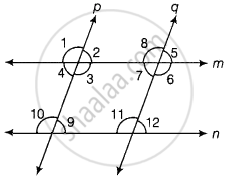
∴ ∠1 = ∠10 = 90° ...[Corresponding angles]
Similarly, ∠2 = ∠9 = 90° ...[Corresponding angles]
∴ ∠4 = ∠9 = 90° and ∠3 = ∠10 = 90° ...[Alternative interior angles] [∵ p ⊥ m and p ⊥ n]
Similarly, if m || n and q is perpendicular to m and n.
Then, ∠7 = 90° and ∠11 = 90°
Now, ∠3 + ∠7 = 90° + 90° = 180°
So, sum of two interior angles is supplementary.
We know that, if a transversal intersects two lines such that a pair of interior angles on the same side of the transversal is supplementary, then the two lines are parallel.
Hence, p || g.
APPEARS IN
संबंधित प्रश्न
How many pairs of adjacent angles are formed when two lines intersect in a point?
Prove that the bisectors of a pair of vertically opposite angles are in the same straight line.
If one of the four angles formed by two intersecting lines is a right angle, then show that
each of the four angles is a right angle.
In the below fig, rays AB and CD intersect at O.
Determine y when x = 60°
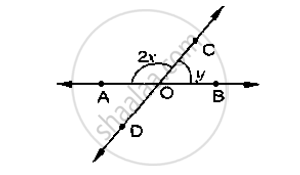
In the below fig, rays AB and CD intersect at O
Determine x when y =40
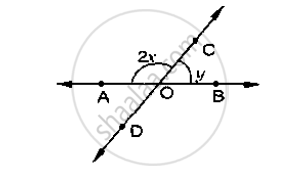
Two lines AB and CD intersect at O. If `∠`AOC + `∠`COB + `∠`BOD = 270°, find the
measures of `∠`AOC, `∠`COB, `∠`BOD and `∠`DOA.
Two straight line AB and CD intersect one another at the point O. If ∠AOC + ∠COB + ∠BOD = 274°, then ∠AOD =
Consider the following statements:
When two straight lines intersect:
(i) adjacent angles are complementary
(ii) adjacent angles are supplementary
(iii) opposite angles are equal
(iv) opposite angles are supplementary
Of these statements
Give two examples of perpendicular lines you can see in your environment.
Mention two real life situations where we use parallel lines
