Advertisements
Advertisements
प्रश्न
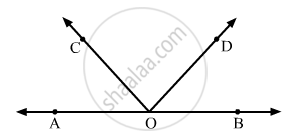
In the given figure, AOB is a straight line. If ∠AOC + ∠BOD = 85°, then ∠COD =
विकल्प
85°
90°
95°
100°
Advertisements
उत्तर
It is given that AOC is a straight line.
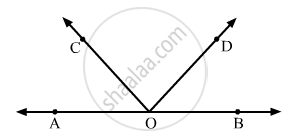
Also, ∠AOC, ∠BOC, and ∠COD form a linear pair.
Therefore, their sum must be supplementary.
That is
∠AOC + ∠BOD+ ∠COD= 180° ....(1)
It is given that
\[\angle COD + 85^\circ = 180^\circ \]
\[ \Rightarrow \angle OD = 180^\circ - 85^\circ \]
\[ \Rightarrow \angle COD = 95^\circ \]
APPEARS IN
संबंधित प्रश्न
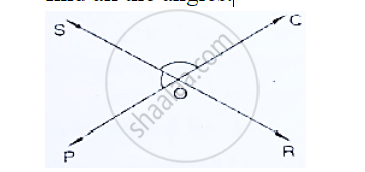
In the below fig, lines PQ and RS intersect each other at point O. If ∠POR: ∠ROQ − 5 : 7,
find all the angles.
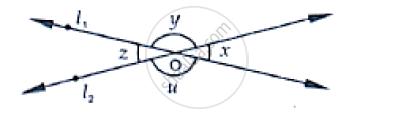
In the below fig, lines �1 and �2 intersect at O, forming angles as shown in the figure. If x = 45, Find the values of x, y, z and u.
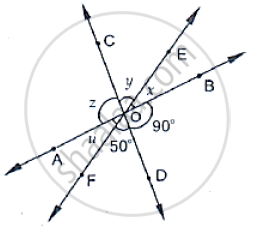
In the below fig, three coplanar lines intersect at a point O, forming angles as shown in the figure. Find the values of x, y, z and u.
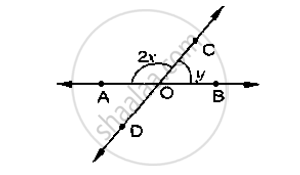
In the below fig, rays AB and CD intersect at O.
Determine y when x = 60°
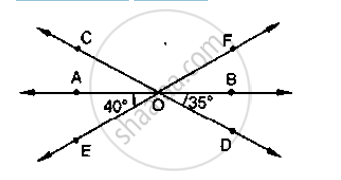
In the below fig, lines AB, CD and EF intersect at O. Find the measures of ∠AOC, ∠COF,
∠DOE and ∠BOF.
Two lines AB and CD intersect at O. If ∠AOC + ∠COB + ∠BOD = 270°, then ∠AOC =
Look at the picture given below. Decide whether the lines given in picture is parallel or perpendicular to each other and write the answer in the box.
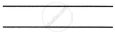
Which phrase correctly describes the distance between two parallel lines?
Which symbolic notation correctly represents the statement 'Line m is parallel to Line n?'
In the example of a 'Zebra crossing,' what feature specifically exemplifies the constant distance property of parallel lines?
