Advertisements
Advertisements
प्रश्न
Two straight line AB and CD intersect one another at the point O. If ∠AOC + ∠COB + ∠BOD = 274°, then ∠AOD =
पर्याय
86°
90°
94°
137°
Advertisements
उत्तर
Let us draw the following diagram showing two lines AB and CD intersecting at a point O.
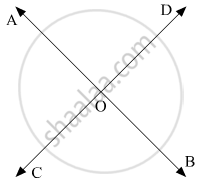
Thus,
\[\angle \text { AOD}, \angle \text { AOC }, \angle \text { COB } \text { and } \angle \text { BOD }\] form a complete angle, that is the sum of these four angle is 360°.
That is,
It is given that
∠AOC + ∠COB +BOD = 274° ...(ii)
Subtracting (ii) from (i), we get:
∠AOD =360° - 274°
∠AOD = 86°
APPEARS IN
संबंधित प्रश्न
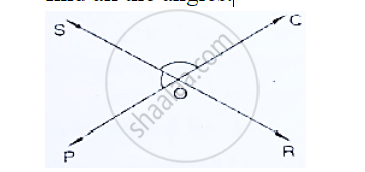
In the below fig, lines PQ and RS intersect each other at point O. If ∠POR: ∠ROQ − 5 : 7,
find all the angles.
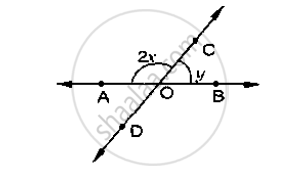
In the below fig, rays AB and CD intersect at O
Determine x when y =40
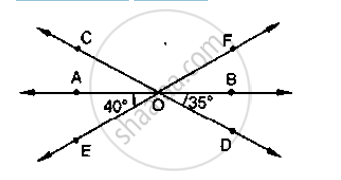
In the below fig, lines AB, CD and EF intersect at O. Find the measures of ∠AOC, ∠COF,
∠DOE and ∠BOF.
Two lines AB and CD intersect at O. If `∠`AOC + `∠`COB + `∠`BOD = 270°, find the
measures of `∠`AOC, `∠`COB, `∠`BOD and `∠`DOA.
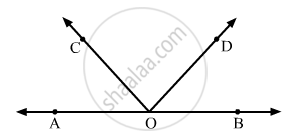
In the given figure, AOB is a straight line. If ∠AOC + ∠BOD = 85°, then ∠COD =
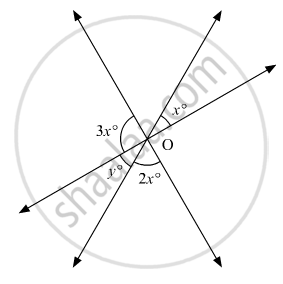
In the given figure, the value of y is
Two lines are respectively perpendicular to two parallel lines. Show that they are parallel to each other.
Which symbolic notation correctly represents the statement 'Line m is parallel to Line n?'
In the example of a 'Zebra crossing,' what feature specifically exemplifies the constant distance property of parallel lines?
If the shortest distance between two straight lines in a plane is observed to change, what must be true about the lines?
