Advertisements
Advertisements
प्रश्न
The tenure of World Heritage Committee is ____________.
Advertisements
उत्तर
The tenure of World Heritage Committee is six years.
APPEARS IN
संबंधित प्रश्न
Pair up with your partner and answer the following question.
Do you like to travel?
Pair up with your partner and answer the following question.
Have you heard about the wonders of the world?
Pair up with your partner and answer the following question.
What does UNESCO stand for?
Pair up with your partner and answer the following question.
What is meant by Heritage?
Pair up with your partner and answer the following question.
Do you know of any Heritage building in your own city?
Heritage Sites - Rank these with your partner. Put the best at the top.
Great Barrier Reef
Mount Fuji
Grand Canyon
The Pyramids
Panda Sanctuaries
Machu Picchu
Vatican City
Great Wall of China
With the help of your partner complete the information in the table.
| Tourist spot | Favourite | Why? |
| Park | ||
| Mountain | ||
| Beach | ||
| Sea | ||
| Forest | ||
| Countryside/Rural site |
What is the tenure of the World Heritage Committee?
What are our duties towards the preservation /conservation of any historical site?
Why should we preserve the World Heritage Sites?
Complete the following.
| Year | Establishment | Role |
| 1954 | ____________ | ____________ |
| 1959 | ____________ | ____________ |
| 1965 | ____________ | ____________ |
| 1968 | ____________ | ___________ |
| 1972 | ____________ | ____________ |
Complete the following by giving reasons why World Heritage Sites are in danger.
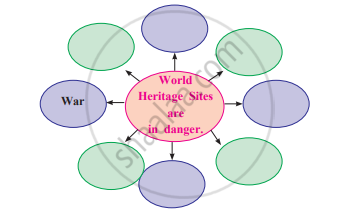
The highest number of World Heritage Sites are located in ____________.
The tenure of World Heritage Committee is ____________ years.
Complete the following information from the text.
| Tasks | Activities to |
| Preservation of any historical site → (Duties) | |
| Preserving World Heritage sites → (Reasons) | |
| Promoting tourism → (Role) |
World Heritage Sites - Make a poster about World Heritage Sites, specifying some details and specialties about each of them.
Now each group representative from the previously formed groups, should narrate the information to the class, using proper attractive sentences.
Prepare a Travel Brochure or Leaflet of your native place or any town/historical place/hill station to attract tourists using the points below.
| Nearest Railway Station ________________________ Nearest Air Port ________________________ Nearest Bus Stand ________________________ |
| Top five spots to visit ________________________ ________________________ ________________________ ________________________ |
| Special features of this spots ________________________ ________________________ ________________________ ________________________ |
| Have Fun! Entertainment ________________________ ________________________ ________________________ ________________________ |
| Mouthwatering/special cuisine ________________________ ________________________ ________________________ ________________________ |
| Other nearby sight-seeing spots ________________________ ________________________ ________________________ ________________________ |
Write the importance of the years given below, with reference to World Heritage Sites.
| Year | Importance |
| 1959 | ________________________ |
| 1965 | ________________________ |
| 1968 | ________________________ |
| 1972 | ________________________ |
| 2009 | ________________________ |
The famous dam in Egypt on River Nile ____________
The place where the conference based on Human Environment was held __________________.
The body which can exclude a site from World Heritage list ____________
The World Heritage Sites include __________________.
There are around ____________ World Heritage Sites in the world.
The Role of World Heritage Committee is
We can get more information about World Heritage Sites from it __________________.
Why should we preserve the World Heritage Sites?
Complete the following flow- chart by choosing from the options given below to show how any site of any country can become a World Heritage Site.
| Take an inventory |
| ↓ |
| ↓ |
| ↓ |
- Inclusion of the name of a site from the tentative list to the nomination file.
- Name of the site is inscribed on the World Heritage list after meeting the criteria.
- Inclusion of the name of site for the nomination in a tentative list after an inventory in the country or the state.
- Decision of the World Heritate Committee after review of the nominated file.
- A review of the file included by the advisory bodies.
Match the pairs to define different roles of the World Heritage Sites.
| A | B | ||
| 1 | Identify cultural and natural sites | a | green, local based, stable, and decent jobs |
| 2 | Identify sites of | b | of outstanding universal value across countries |
| 3. | Identify sites that represent | c | preserve outstanding sites and natural resources |
| 4. | UNESCO seeks to | d | tourism |
| 5. | World Heritage Sites should have | e | an asset for economic development and investment |
| 6 | World Heritage Sites should | f | protect these sites |
| 7. | World Heritage Sites serve as | g | best examples of world’s cultural and/or natural heritage |
| 8. | World Heritage Sites should ensure | h | special importance for everyone |
| 9 | It should at large develop | i | relevant development plan policies |
Do you know the difference between World heritage and Cultural heritage?
