Advertisements
Advertisements
प्रश्न
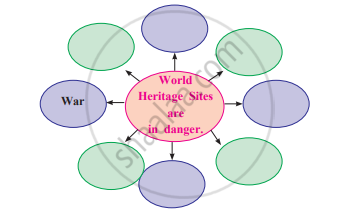
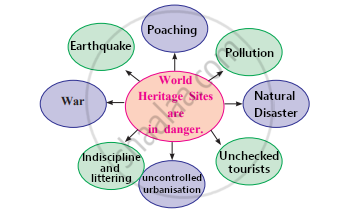
Complete the following by giving reasons why World Heritage Sites are in danger.

Advertisements
उत्तर

APPEARS IN
संबंधित प्रश्न
What do heritage sites in the world include?
What is the role of World Heritage Committees?
Mount Huangshan is situated in____________
Match the pairs to define different roles of the World Heritage Sites.
| A |
B |
|
1. Identify cultural and natural sites |
1. green, local based, stable, and decent. |
|
2. Natural sites Identify sites of |
2. of outstanding universal value across countries. |
|
3. Identify sites that represent |
3. preserve outstanding sites and natural resources |
|
4. UNESCO seeks to |
4. tourism |
|
5. World Heritage Sites should have |
5. an asset for economic development and investment. |
|
6. World Heritage should |
6. protect these sites. |
|
7. World Heritage Site serves as |
7. best examples of the world's cultural and/or natural heritage. |
|
8. World Heritage Site should ensure |
8. special importance for everyone. |
|
9. It should at large develop |
9. relevant development plan policies. |
Complete the following information from the text.
| Tasks | Activities to |
| Preservation of any historical site → (Duties) | |
| Preserving World Heritage sites → (Reasons) | |
| Promoting tourism → (Role) |
Now each group representative from the previously formed groups, should narrate the information to the class, using proper attractive sentences.
The country in which the highest number of World Heritage Sites are __________________.
The Role of World Heritage Committee is
Why should we preserve the World Heritage Sites?
B1. Read the following passage and do the activities:
- International World Heritage Program is administered by ______.
- UNESCO
- WHO
- WHC
- UN
- World Heritage Sites are significant ______.
- Naturally and culturally
- Naturally and traditionally
- Naturally and literary
- None of these
- Which site played a role in historical Chinese art and literature?
- Aswan High Dam
- Mount Huangshan
- Abu Simbel Temple
- Egyptian artefacts
- UNESCO launched an international campaign in ______.
- 1950
- 1959
- 1958
- 1957
|
A World Heritage Site is a site determined by the United Nations Educational, Scientific and Cultural Organization (UNESCO) to have significant cultural or natural importance to humanity. As such, the sites are protected and maintained by the International World Heritage Programme which is administered by the UNESCO World Heritage Committee, because World Heritage Sites are places that are significant culturally and naturally, they vary in type but include forests, lakes, monuments, buildings and cities. World Heritage Sites can also be a combination of both cultural and natural areas. For example, Mount Huangshan in China is a site with significance to human culture because it played a role in historical Chinese art and literature. The mountain is also significant because of its physical landscape characteristics. HISTORY OF WORLD HERITAGE SITES Although the idea of protecting cultural and natural heritage sites around the world began in the early twentieth century, momentum for its actual creation was not started until the 1950s. In 1954, Egypt started plans to build the Aswan High Dam to collect and control water from the Nile River. The initial plan for the dam's construction would have flooded the valley containing the Abu Simbel Temples and scores of ancient Egyptian artefacts. To protect the temples and artefacts, UNESCO launched an international campaign in 1959 that called for the dismantling and movement of the temples to higher ground. The project cost an estimated US $80 million, $40 million of which came from 50 different countries. |
B2. Briefly describe the international campaign launched by UNESCO in 1959.
B3. Make sentences using the following phrases.
- Play a role
- Scores of
B4. Rewrite the following sentences using 'not only' and 'but also'.
- World Heritage Sites can also be a combination of both cultural and natural areas.
- Egypt started plans to build the Aswan High Dam to collect and control water from the Nile River.
B5. How do you think can an individual conserve and protect a World Heritage Site?
